Wolf, Goat and Cabbage
The wolf eats the goat, the goat eats the cabbage: get everyone across. Twelve puzzles, and fails that make you laugh.
Ages 6 and up
Leaderboard
Loading leaderboard…
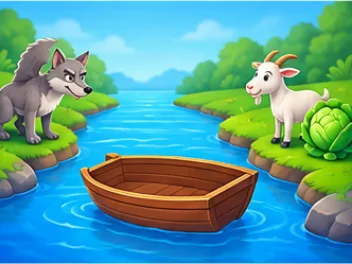
A ferryman, a boat with room for one, and three passengers who don't get along: the wolf eats the goat, the goat eats the cabbage. The riddle is more than a thousand years old, it fits in three lines, and it still stumps half the people who meet it for the first time. Seven crossings are enough, but you have to accept bringing someone back, and that is exactly what your brain refuses to do.
This game takes that river crossing puzzle as its first step, then stacks eleven more on top of it. Twelve in all, split into three families: the river and its rules about who can't be left together, a group of wolves and sheep where numbers are what count, and a bridge at night where a single lamp lights the way for two people at a time. The same gesture everywhere, different rules every time.
And when it goes wrong, it really goes wrong: the wolf tiptoes closer, a bush trembles, a little burp, a bone drops. Nothing is lost: the puzzle sets itself back up and you try again. The fails are half the fun, so they got plenty of care.
How to play Wolf, Goat and Cabbage
Everything works with a finger, a mouse or the keyboard.
- Tap a passenger to put them aboard: they hop into the boat, which sinks a little.
- Tap them again to send them back ashore.
- Tap the boat, or the opposite bank, to cross. The purple button does the same thing.
- On a keyboard:
Tabmoves from one passenger to the next,Spaceputs them aboard or sends them ashore,Enterstarts the crossing.Backspaceundoes.
The ferryman, when there is one, is always on board: he does the rowing, and a bank where he stands is safe. As long as he is there, the wolf doesn't dare touch the goat. The danger starts the second the boat pulls away.
Three buttons come with the game. Undo takes back the last crossing in one go, as many times as you need. Hint shows which passenger to put aboard now to stay on the shortest path. Start all over resets the puzzle without touching the stars you have already earned on other puzzles.
Below the scene, a strip of sand keeps track of every crossing you have made: one arrow per trip, with the passengers who were on board. It is the memory of your game, and reading it back is often how you spot where you are going around in circles.
The three worlds
The river
Four puzzles, a ferryman, and passengers who can't be left alone together.
The first one is the classic: wolf, goat, cabbage, a single seat in the boat, seven crossings at the very least. The second adds another goat, and the two goats refuse to ride together: they keep butting heads. This time the boat has two seats, which changes everything: you have to figure out which pair can leave first without trouble on either bank.
The third brings in a new cast: a fox, a hen, a sack of grain, and a dog that howls at the moon as soon as it is left alone on a bank. Nine crossings. The fourth goes back to the wolf, the goat and the cabbage, and adds that same dog plus a basket of apples that can't stand up on its own: it always needs someone next to it. Five passengers, one seat, eleven crossings.
Wolves and sheep
Here, there is no ferryman. Someone on board has to row, so the boat never leaves empty. And the rule is no longer a list of forbidden pairs but a count: on a bank, the sheep must never be outnumbered by the wolves. One sheep facing two wolves, and things turn ugly. No sheep at all, on the other hand, and the wolves do nothing: you can perfectly well leave three wolves alone on a bank.
The wolves give you a warning, too. When the rule is about to break, they growl and sway: the signal isn't just a color, it moves.
First two pairs, five crossings. Then three pairs, and that is where the count gets tough: eleven crossings, with back-and-forth trips that seem absurd and are nonetheless required. The third puzzle swaps the last sheep for a lamb that can't stand being left alone. The fourth lines up four wolves and four sheep, a boat with three seats, and a wolf cub, one of the four wolves, who can't row: he never leaves without a grown-up.
The bridge at night
A complete change of measure. Four to six people have to cross a bridge in the dark, there is only one lamp, the bridge only holds two people at a time, and two people crossing together move at the pace of the slower one. What you count is no longer the number of trips but the minutes.
The textbook case opens the world: four walkers who take one, two, five and ten minutes. The obvious solution, where the fastest walks everyone across and brings the lamp back, costs nineteen minutes. The right one costs seventeen, and it means sending the two slowest together, once, while the two fast ones handle things on either side. The next three puzzles pick up the idea with five, then six walkers and other sets of times.
The lamp has a limited supply of oil. If you dawdle too long, it goes out, and everyone bumps into each other in the dark.
When it goes wrong
A disaster costs you nothing but time, and you get to watch it to the end.
- The wolf tiptoes up to the goat; a bush grows in front of her, trembles, and all that is left is a bouncing bone.
- The goat munches the cabbage leaf by leaf, and the leaves fly away.
- The fox runs off with the hen, and a shower of feathers comes down.
- The hen empties the sack of grain, one grain at a time.
- The dog left alone howls at the moon, and the notes rise above the bank.
- The basket tips over and the apples roll into the grass.
- The wolves, outnumbering the sheep, close in with a grin.
- The lamp goes out, night falls all at once, and collision stars burst in the dark.
Then a bright banner says "Try again!", the puzzle sets itself back up, and you start over from the beginning of that puzzle only. Nothing else is lost.
Stars and progress
Each puzzle earns one to three stars.
- Three stars: you did as well as the best possible solution, the "par" shown under the counter.
- Two stars: up to two crossings over par, or three minutes over par in the third world.
- One star: the puzzle is solved, however many trips it took.
A single star is enough to unlock the next puzzle. So you are never stuck on a puzzle you can't optimize: solve it however you can, move on, and come back later for the third star.
The puzzle map, opened with the button at the top left, shows the twelve squares, their stars and the ones still locked. At the end of each world, one sentence sums up the big idea of that family, the one that works for every puzzle of the same kind and that you will run into elsewhere in life.
Your progress is saved in your browser, on your device, with no account to create. If you clear your browser data, your stars start again from zero.
Leaderboard
Every puzzle you solve earns points, and your leaderboard score is the total of all your puzzles. Points follow your stars, and later worlds are worth more: on the river, three stars earn 50 points, two earn 40 and one earns 30; with the wolves and sheep, it pays double, so 100, 80 or 60; on the bridge at night, triple, so 150, 120 or 90. Solving all twelve puzzles at par adds up to 1,200 points.
Each puzzle counts once, for your best solution. Replaying a puzzle for more stars raises your total; replaying it worse costs you nothing. What counts is the path that leads to the solution: a crossing you undo is no longer part of it, and a disaster resets the counter along with the puzzle. The leaderboard only keeps verified solutions: the server replays every one of your crossings, with the same rules as the game, before it accepts the score. The first time you solve a puzzle, the game asks for a nickname, and from then on your total is sent on its own without interrupting your game.
Five ideas to solve them faster
Look at who stays, not who leaves. The classic mistake is choosing the passenger who seems most urgent to take. The right question is the reverse: who will be left alone behind me, and will that go well?
Going back is not a waste of time. In the very first puzzle, the only solution goes through a passenger you bring back. As long as you refuse that idea, you go around in circles. As soon as you accept it, the puzzle opens up.
Find the troublemaker. In almost every river puzzle, one passenger is in conflict with two others: that one is the pivot. They often travel first, and often more than once.
In the wolves' world, count out loud. Three wolves and two sheep on a bank, and it is already over. Before each crossing, count both banks as they will be afterward, not as they are now.
On the bridge, pair up the slow ones. A minute lost by a slow walker can never be won back. Send them across together, just once, while a fast walker holds the lamp on each side.
For more puzzles that teach you to plan ahead, browse the educational games category, or try Code the Robot.
Frequently asked questions
Do you really need seven crossings for the wolf, the goat and the cabbage? Yes. Seven is the proven minimum, and the game checks it: the "par" of each puzzle comes from an exhaustive search of every possible position. There is no solution in five.
Why doesn't the wolf eat the goat when the ferryman is there? Because the ferryman keeps watch over the bank where he stands. That is the historical rule of the riddle, and it is what makes it playable: otherwise, the first crossing would already be lost.
Can the ferryman cross with an empty boat? In the first world, yes, and it is essential: sometimes he has to go back alone to fetch the next passenger. In the other two worlds, there is no ferryman, and the boat won't leave without a passenger who can row.
What happens if I make a mistake? The scene plays out, the wolf has a feast, the apples roll, the lamp goes out, and then the puzzle returns to its starting point. You don't lose any stars already earned on another puzzle, and nothing stops you from trying again right away.
What is the Undo button for? To go back one crossing, as many times as you like, all the way to the start. It is the tool for anyone chasing the shortest solution: you try one branch, go back, and try another.
Does the hint give away the whole solution? No, only the next useful move, the one that keeps you on the shortest path. If your position no longer leads anywhere, it tells you so and suggests undoing.
Is there a leaderboard? Yes: it adds up the points of the puzzles you have solved, 30 to 150 each depending on the world and your stars, up to 1,200 points for all twelve at par. The twelve puzzles are the same for everyone, and you play them at your own pace.
What age is this game for? The first puzzle can be solved in thirty seconds from age seven or eight. The wolves and sheep world requires comparing two numbers. The bridge at night requires adding and comparing minutes: it is comfortable from age ten, and it is very good at tripping up adults.
Can I play with a keyboard, or without a mouse? Yes, completely. Tab moves the focus from one passenger to the next, Space puts them aboard, Enter starts the crossing, Backspace undoes. Each passenger announces their name and their bank, and every crossing is announced to screen readers.
More educational games
Educational games- Electric Circuits
Turn the wires, close the loop and light the bulbs: series, parallel and short circuits, in twenty-four levels. - Tangram
Seven pieces, one shadow to fill: thirteen shapes and an album to complete. - Logic Gates
Place the right gates, flip the switches and make the lamp follow the whole truth table. - Telling Time
Set both hands to the time you're given, from o'clock times to the exact minute, PM times included. - Algebra Balance
Take away, add, divide — but always on both sides. The scale stays level until x stands alone. - Making Change
The customer pays too much: put the right coins in their hand, and as few as you can. - Prime Factor Tree
Split every number down to its primes, which light up like lanterns. Eight trees against the clock, solo or in a race. - Mental Math
Twenty sums that get harder and harder: answer right, and as fast as you can.
