Nuts and Bolts
Unscrew the planks in the right order: each screw joins a box of its color, and the waiting slots fill up fast.
Ages 6 and up
Leaderboard
Loading leaderboard…
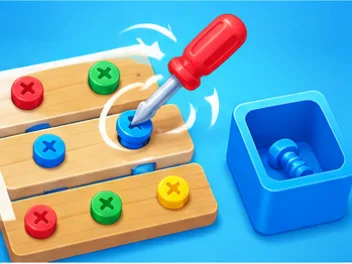
Nuts and Bolts is played on a board of twelve stacked planks, held in place by twenty-four colored screws. A screw only comes out if no plank covers it, and every screw you remove goes into a box of its color. When a box holds three screws, it closes and makes room for the next one. Your goal: remove all twenty-four screws, and so take the whole board apart, without jamming the five waiting slots.
This kind of nuts and bolts puzzle, where you unscrew stacked plates, has been one of the big hits of mobile gaming in recent years. The version here keeps the mechanics and drops what weighs them down: no falling planks, no physics simulation, no timer to buy. Everything is clean and still, and you play it with a finger or a mouse. It opens straight in your browser, for free and without signing up, on a computer, a tablet or a phone.
How to play Nuts and Bolts
The board fits in a grid of 6 columns by 8 rows. Twelve planks are laid on top of one another: each one covers two to four squares, horizontally or vertically, and has a screw at each of its two ends.
Tap or click a screw to unscrew it. It comes out if it is uncovered, meaning no plank laid higher up passes over it. A covered screw is out of reach: what you see in that spot is the plank on top, and you will have to remove that plank first.
A plank leaves as soon as its last screw is gone. As it disappears, it frees everything it was covering: screws that were stuck until then suddenly become reachable. That is the heart of the game: every plank you remove opens up others, and the order in which you take things apart decides what comes next.
Below the board, three boxes are waiting, each with a color. A screw you remove flies into the first open box of its color. If no box takes that color, the screw goes to wait in one of the five waiting slots at the bottom of the screen. As soon as a box of the right color shows up, the waiting screws drop into it on their own, and sometimes the line clears in a cascade.
On a keyboard, the arrow keys move the selection from one screw to the next, and Enter or Space unscrews the selected one. Besides its color, every screw has its own shape: circle, square, triangle, diamond, star or hexagon. So you can play without telling the colors apart.
The game ends in one of two ways. Either the last screw comes out and the board is taken apart: you win. Or no screw can move anymore, because the waiting slots are full and no box takes the colors available: the game stops there.
Planks, boxes and the waiting slots
A plank is always both an obstacle and a support. It protects the screws it covers, while its own screws are reachable as long as an even higher plank doesn't hide them. At the start, about ten screws are stuck and about ten are free: you have real room to maneuver, but it shrinks fast.
The boxes come in an order set at the start of the game. Three are visible, and the others wait their turn. A box closes at three screws, never before; it then leaves, and the next one in line takes its place. On a board of twenty-four screws, eight boxes come and go this way.
The five waiting slots are your safety margin. They absorb the screws whose color doesn't have a box yet. A screw that goes through a waiting slot isn't lost: it will join its box later, automatically. But it costs you points, and above all it takes up a spot. Five screws waiting and no box to take them, and the game is over.
Every board is built backward, starting from a solution: there is always at least one order for taking it apart that never uses a waiting slot. No random draw can produce an impossible board. Your job is to find that order, or another one that holds up.
Score and leaderboard
The score rewards winning, a clean solve and speed, in that order:
- you have to take the whole board apart; a game that gets stuck doesn't go on the leaderboard;
- you start at 10,000 points;
- every screw that goes through a waiting slot costs 100 points;
- every tenth of a second costs 1 point.
A perfect game, with no trip through the waiting slots, lands around 9,700 points for about thirty seconds of play. One detour through a waiting slot is worth ten seconds of thinking: it pays to think a little rather than rush.
Every new game draws a different board, and the leaderboard keeps your best score.
The server replays every game you send, screw by screw, from the board's seed. A forged score doesn't get through: you really have to have taken the board apart to appear on the leaderboard.
Tips to clear the board
Read the stack before you touch anything. First find the planks on top: they are the only ones completely free. Each of them, once gone, uncovers others.
Two screws, one plank. A plank only leaves once both its screws are out. Removing just one of them frees nothing at all: as long as the other holds, the plank stays and keeps covering what is underneath. If you plan to remove a plank, plan to take both its screws right after each other.
Follow the open boxes. Before choosing a screw, look at the three boxes. A screw whose color has an open box is free: it costs nothing. A screw whose color doesn't have one will cost you a waiting slot.
Keep two slots free. With the waiting slots full, the game stops dead. Two slots of margin are almost always enough to absorb a nasty surprise; with only one, you are playing with fire.
Close boxes, they bring in others. When two screws of a color are already in a box, going for the third is often the best move: the box leaves, a new color comes in, and sometimes the waiting slots empty in one go.
Don't unscrew just to unscrew. A screw removed for no reason takes up a waiting slot or fills a box you would have needed later. Every move should open something up: a plank, a color, a slot.
For more puzzles to take apart, browse the puzzles category.
Frequently asked questions
Is the game free? Yes, completely, with no sign-up and no download. It opens in your browser.
Do I need an account to play? No. A nickname is enough to appear on the leaderboard, and you pick it when you send a score.
Does every board have a solution? Yes. Every board is built from a solution, and there is always an order for taking it apart that never uses a waiting slot.
Why won't this screw come out? Because a plank laid higher up covers it. First remove both screws of that plank: it will leave and free the stuck screw.
What happens when the waiting slots are full? As long as a box can still take an uncovered screw, the game goes on. If no screw can move anymore, the game stops and the score doesn't go on the leaderboard.
Can I undo a move? No. A screw you remove can't be screwed back in: that is what gives every decision its weight.
Can I play with a keyboard? Yes. The arrow keys move the selection from one screw to the next, and Enter or Space unscrews it.
What if I have trouble telling colors apart? Every color also has a shape, on the screw as well as on the box and the waiting slots. Color is never the only clue.
More puzzles
Puzzles- Blocked Parking
Free the red car: slide the vehicles, none of them turns, none of them jumps another. - Mummy on the Run
The little mummy runs straight on until it hits a wall: grab the tomb's gold, dodge the spikes and bats, and dash for the exit. - Sneaky Cat
The little orange cat sneaks through the house: swipe every fish without catching the dogs' eye, put them to sleep from behind, and slip out the cat door. - Fruit Cutter
Fruit flies up from everywhere: slice it with one swipe in a splash of juice, chain your combos, and whatever you do, don't touch the bombs. - Territory Conquest
Leave your zone, draw a loop and come back: everything inside it is yours. But watch out for rivals cutting your trail! - Snake Feast
Eat the pellets to grow your crowned snake, and make rivals crash into your body: they turn into a feast. - Color Sort
Pour colors from tube to tube until every tube holds a single color. - Fill the Grid
Place the pieces on the grid and complete lines to clear them.