Hearts
Trick-taking in reverse: dodge the hearts, duck the queen of spades, and finish on the lowest total.
Ages 14 and up
Leaderboard
Loading leaderboard…
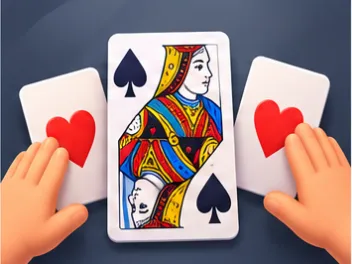
Hearts is a trick-taking game played in reverse. In almost every other card game, winning a trick is good news: you count your tricks, score your points, and congratulate yourself on playing the ace at the right moment. Here it is the exact opposite. Every heart you take costs you a point, and the queen of spades costs you thirteen on her own. The winner is not the player with the biggest total: it is the one with the smallest.
That one simple reversal changes everything. An ace becomes a burden. A king of spades becomes a trap, just waiting for a chance to hand you the queen. And a small, worthless card, the two of clubs nobody would want in any other game, becomes a key piece: it is what lets you lose a trick when you desperately need to. The whole game is about choosing what you will not play.
Here you sit down at a full table right away, with no one to wait for. Three computer players fill the other seats and play their own game: they pass cards, keep their low cards, and try to make the queen land on someone else. Nothing to install, no account to open. The table appears in your browser, on a computer or a phone, and you can play with a mouse, a finger or entirely with the keyboard.
How to play Hearts
The fifty-two cards are dealt into four hands of thirteen. There are no trumps, no bidding and no partners: everyone plays for themselves, from start to finish.
Before play begins, there is the pass. You choose three cards from your hand and give them to an opponent, who gives you three in return. The direction changes with every hand: to the left, then to the right, then across, then one whole hand is played with no pass, and the cycle starts again. Nobody sees what they are being sent before choosing what they send — all four passes are decided at the same time, from the original hands. It is the first real choice of the hand, and often the one with the biggest consequences.
Play itself always starts the same way: whoever holds the two of clubs leads it, whatever the rest of their hand looks like. Then each player lays a card in turn, going around the table. You must follow the suit that was led if you can. If you cannot, you discard whatever you like, and that is exactly when you get rid of your dangerous cards. The trick goes to the highest card of the suit led — the ace is highest, the two lowest — and whoever takes it leads the next one.
Two safeguards shape the start of a hand. On the first trick, no points can be played: no hearts and no queen of spades, as long as you have something else to give. And you cannot lead a heart until a heart has fallen on a trick; this is called "breaking hearts." (If all you have left is hearts, you can lead one anyway.) These two rules stop players from dumping their poison cards in the first second, and give everyone time to settle in.
Points, and shooting the moon
At the end of the thirteen tricks, you count. Each heart you took is worth one point. The queen of spades is worth thirteen. That makes twenty-six points in play every hand, shared among the four players — and each player's total adds up from hand to hand.
Except in one case. If a single player takes all twenty-six points, the hand flips completely: that player scores zero, and each of the other three takes twenty-six. This is called shooting the moon, the great feat of the game, and also its greatest danger. A player who starts taking every trick with big cards may not be collapsing at all: they may be taking everything on purpose. All it takes to stop them is to win a single heart, leaving them with twenty-five points on their back.
The game stops as soon as a player reaches the target. You choose that target before your first card: a short game goes to fifty points and usually lasts five to eight hands; a long game goes to one hundred points and takes about twice as many. From your first decision on, the length is locked in: it is written into the replay, and the game has to be played to the end to count. Once the target is crossed, the standings read upside down: the lowest total wins.
Score and leaderboard
Your leaderboard score is not your points total, since here a small total beats a big one. It is how far ahead of the table's average you finish, added up over the whole game. A player exactly on the average of the three opponents gets one thousand points; every point you finish below that average earns you twenty more. So a long game counts for more than a short one: every hand you play adds to your lead.
There is a reason for this. A short game and a long game do not hand out the same number of raw points, and comparing raw totals would favor one of the two. By measuring the gap between you and the three players sitting across from you, the leaderboard stays comparable whatever length you choose. A lost game counts too: finishing second with a decent total is better than not finishing at all. Only a game abandoned halfway is worth nothing.
The server replays your whole game from your decisions before accepting any score. The other three players' cards, their passes, their choices on every trick: everything is recalculated exactly. The points on your screen are only a preview; the replay is what counts.
You choose the length and can start again as often as you like.
Tips to win at Hearts
Pass the queen if you cannot protect her. Holding the queen of spades is only dangerous if you risk being forced to play her. With five spades including the queen, you can usually defend her: you have enough low spades to let the rounds go by. With the queen and only one other card of the suit, she will almost certainly fall. In that case, she goes in the pass.
Do not throw away your low spades. This is the most common mistake. The two, three and four of spades are worth nothing, but they are what let you follow a spade lead without taking the trick. Getting rid of them dooms you to play high later — and to pick up the queen on the way.
Create a void. If you only have two diamonds, pass them: you will then be free to discard whatever you want as soon as someone leads diamonds. An empty suit is often worth more than a good card you hang on to.
Take the free tricks early. A trick with no hearts and no queen costs nothing. Winning it with your ace while it is still harmless burns a dangerous card and gives you the lead to play what you want. Waiting until the end of the hand to play that ace means playing it when the table is full of hearts.
Keep an eye on the queen. Until she has fallen, every spade lead is a question put to the table. If you hold neither the king nor the ace, leading a low spade is an excellent way to flush her out of someone else's hand. If you hold the king or the ace, that is exactly what you must not do.
Count the hearts. Thirteen hearts are in play. When you know the last hearts still out are all in your hand and the queen has fallen, you can lead another suit without risk: nobody has a point card left to throw on it. Each player's tally stays on screen for the whole hand: you can always see who has already taken points, and who is gathering enough to try to shoot the moon.
If you enjoy trick-taking games, try Oh Hell or Belote, or browse all the card games.
Frequently asked questions
Do I need an account to play? No. The game starts with one click, with no sign-up and nothing to install. Only sending a score to the leaderboard asks for a nickname.
How long does a game take? A short game, up to fifty points, usually takes between eight and fifteen minutes. A long game, up to one hundred points, takes about twice as long.
Can I play on my phone? Yes. The table adjusts to your screen, and cards can be dragged with a finger or tapped. The game can also be played entirely with the keyboard, using the arrow keys and Enter.
What happens if I take every point? You score zero and each of the other three takes twenty-six points. It is the most rewarding move in the game, and the riskiest: let a single heart slip away and you are left with twenty-five points.
Why can't I lead a heart? Because no heart has fallen yet. The rule stops anyone from opening hostilities on the first round. As soon as a heart has been played on a trick, the suit is free to lead.
Can I change the game length halfway through? No. You choose the length before your first decision, then it is locked: it is written into the replay that the server checks. You can, however, start a new game whenever you like.
Does a lost game count on the leaderboard? Yes, as long as it was played to the end. The score measures your gap with the table, not whether you won: a narrow loss is worth more than a win in a dull game.
Do the computer players cheat? No. The three computer players only see their own hand and the cards already played on the table, exactly like you. They know neither your hand nor the passes they did not receive.
More card games
Cards- Coinche
Belote with numbered bidding: call your points from 80 up to a slam, and double the contract opposite. - Manille
The trick-taking game of the North: the ten beats everything, and you must play higher whenever you can. - Manillen
The Flemish card game: the dealer picks trump, players double with “I’m in”, and the game runs to 101. - French Tarot
Seventy-eight cards, twenty-one trumps and the excuse: take the dog and make your contract, alone against three. - Tri Peaks Solitaire
Clear cards one rank above or below the discard pile, in long streaks, until all three peaks are gone. Solo, or racing other players. - President
Be the first to get rid of your cards, in pairs and three of a kind, against three players: five deals to finish President, not Beggar. - Nain Jaune – Yellow Dwarf
A classic French family card game: build runs from ace to king, collect the tokens on the board and empty your hand first. - Rikken
Dutch bidding whist for four: bid rik, troela, misère or piek, call an ace to find your partner, and set your own house rules.