Plant Cell and Photosynthesis
Spot the organelles on a real textbook diagram, then switch on photosynthesis and watch the leaf come to life.
Ages 10 and up
Leaderboard
Loading leaderboard…
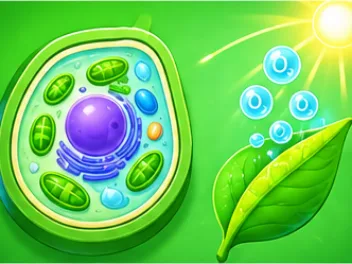
A cell fills the whole screen, drawn like a textbook diagram: the nucleus and its pores, mitochondria striped with folds, the reticulum attached to the nucleus, ribosomes in tiny strings. At first everything is gray and nothing has a name. At the bottom, the names wait side by side. You tap "Mitochondrion," you tap a mitochondrion, and it takes on its color while its name appears on it. You have just labeled a piece of a living thing.
This is the classic science class exercise, labeling a diagram, turned into a game. You are not guessing a place at random: you recognize a shape. A mitochondrion looks like a bean striped with folds, the Golgi apparatus like a stack of curved sacs, a lysosome like a small speckled bead. As in a real cell, some organelles come in several copies: any one of the mitochondria is the right answer.
Twelve levels, two worlds. The first world builds the cell, animal and then plant. The second wires up photosynthesis on a cross-section of a leaf and lets you watch it work for real: sunlight streams down, water rises from the roots, carbon dioxide enters through the stomata, the chloroplasts light up, sugar heads down the stem and oxygen escapes in bubbles. It is a hands-on way to learn plant and animal cell structure, and a free photosynthesis game for school review or simple curiosity.
How to play
- Tap a piece at the bottom of the screen. It lifts up and turns purple: that is the one you are holding.
- Tap the organelle it names in the cell, or its arrow on the leaf diagram. In the first world, an organelle lights up softly under your mouse so you can see what you are about to tap; in the second, the free arrows start to breathe as soon as you are holding a piece.
- If you are right, the organelle takes on its color and its name is written on it; in the second world, the piece settles onto its arrow. A short sentence tells you what it does.
- If you are wrong, what you tapped shakes and you keep the piece in hand. On your second miss with the same piece, the right answer lights up in purple, and in the cell the game tells you what the organelle you are looking for looks like: missing teaches you to recognize it.
- In the second world, once everything is wired up, the Run button starts bouncing. Tap it, and the process comes to life.
Everything also works with a keyboard alone: Tab moves from one button or organelle to the next, Enter picks up a piece and then places it, Escape lets it go. Each organelle has a description that screen readers can read, with its shape described in words.
World 1: build the cell
Six levels, from the simplest to the most demanding.
- The animal cell starts with five pieces: the membrane, the cytoplasm, the nucleus, the mitochondrion and the ribosome. Thirty seconds are enough to finish this level, without reading a single rule.
- The complete animal cell adds the Golgi apparatus, the endoplasmic reticulum, the lysosome and the vacuoles. Nine organelles, and the tokens no longer show a drawing: you have to look closely at the shapes.
- The plant cell changes shape. It has corners, because a rigid wall of cellulose encloses it; a large vacuole fills the middle and pushes the nucleus to the side; chloroplasts wait out in the cytoplasm.
- Who does what? The tokens no longer show a name but a job: "I supply the energy," "I give the orders," "I pack and ship." You place each job on the organelle that does it, and the name appears.
- Plant only, or both? Two columns to fill. Three organelles exist only in plant cells: the cell wall, the chloroplast and the large vacuole. The six others are found in both cells, and plenty of people get that wrong.
- The plant cell, from memory. Nine organelles and no help: the right organelle will not light up, not even on a second miss. This is the level that proves you remember.
Anything that exists only in plant cells never shows up in an animal level, and the other way around. That is not a decorative detail: it is exactly the question that middle school science tests ask about the difference between plant and animal cells.
World 2: photosynthesis
The leaf is drawn in cross-section, like in a textbook: the upper epidermis, the palisade cells packed with chloroplasts, the vein in the middle, the air spaces underneath, and two open stomata on the underside of the leaf. The stem runs down to the roots, and the sun is at the top.
- Wire up photosynthesis. Five tokens to place on five arrows: three go into the leaf, light, water and carbon dioxide, and two come out, glucose and oxygen. Every arrow has a direction, and you have to respect it.
- The path of water. Number the path from 1 to 5: the soil, the roots, the stem, the veins, the chloroplast. A sixth arrow is a trap: water does not enter through the stomata, it comes from the roots.
- The leaf at night. No more sun, so no more sugar made: two arrows have to stay empty. But the leaf breathes, by night as well as by day: it takes in oxygen, gives off carbon dioxide, and burns sugar in its mitochondria to stay alive.
- The leaf without water. The soil is cracked, the leaf is wilting. Find where to put the water back, wire up the rest again, and watch the leaf straighten up as the water rises.
- Why the leaf is green. Three colors of light reach a close-up chloroplast. Chlorophyll absorbs red and blue and sends back green: that green is what reaches your eye. You can tell each token's wavelength by the shape of its wave, not only by its color.
- Balance the equation. Six molecules of carbon dioxide and six of water give one glucose and six oxygen molecules. You do not type any numbers: you place counters in front of each molecule, and three of the five counters are decoys.
Once the setup is complete, Run sets everything in motion. That is the reward of the level, and it is different every time: water rising, oxygen bubbles, the green ray heading back toward the eye, the leaf standing up again.
Stars and progress
Each level is rated from one to three stars:
- three stars if you finish it without a single mistake;
- two stars with one or two mistakes;
- one star for finishing it, however many tries it took.
A single star is enough to unlock the next level: nobody gets stuck. And you can come back to a level you have finished to earn the stars you are missing, which is the best practice before a test.
Your progress (stars and unlocked levels) is saved in your browser, with no account to create: you will find it when you come back to the page, on the same device and in the same browser. Your play time goes to the server for your profile page, and your cleared levels go to the leaderboard.
Leaderboard
Every level you clear earns points, and your leaderboard score is the total of all your levels. Your stars set the price: in the first world, three stars earn 50 points, two earn 40 and one earns 30; the second world, the photosynthesis one, pays double, so 100, 80 or 60 points. Clearing all twelve levels without a single mistake adds up to 900 points. To count, a level needs at least half of your placements to be right: if you make more mistakes than there are spots to fill, it still unlocks the next level and keeps its star, but earns no points. In the second world, a level is cleared once you have pressed Run and watched the process play all the way through.
Each level counts once, for your best game. Replaying a level for more stars raises your total; replaying it worse costs you nothing. Time does not count: the leaderboard rewards accuracy, not speed. It only keeps verified games: the server replays every piece you placed, wrong ones included, before it accepts the score. The first time you clear a level, the game asks for a nickname, and from then on your total is sent on its own without interrupting your game.
A few tips
- Start with the frame. The membrane runs all around the cell and the cytoplasm fills the whole background: they are the easiest to find.
- Look at the shape, not the place. Mitochondria and ribosomes float all over the cytoplasm; what sets them apart is how they look. Only the nucleus has a place of its own: in the center of the animal cell, pushed to the side by the large vacuole in the plant cell.
- The reticulum clings to the nucleus. Its folds start at the nuclear envelope, dotted with ribosomes; the Golgi apparatus, a stack of curved sacs, sits right next to it, and proteins pass from one to the other.
- In world 2, read the direction of the arrow before you place anything. An arrow leaving the leaf cannot take something that goes in.
- Every token has a home, apart from the counters of the equation level. Each other piece has one place and only one. If you hesitate between two, place the one you are sure of first.
- Traps announce themselves. An arrow that has to stay empty tells you so when you try to put something on it, and tells you why.
If you enjoy learning science by building things, try Electric Circuits and The Solar System, or browse the whole educational games category.
Frequently asked questions
What age is it for? The first world can be played from about nine or ten, simply by observing; you do need to read a little, since organelle names are written out, but on the first level of each cell every piece also shows its drawing. The second world matches middle school life science, stays useful in high school for review, and is a good refresher for anyone.
Are the names and shapes the ones taught in class? Yes. The names, the jobs, the shapes and the equation are the ones taught in school. The drawing is a textbook diagram: the smallest organelles are enlarged so you can see them, but nothing in it is wrong.
Why is the plant cell square? Because its cellulose wall is rigid: it holds the cell's shape, like a box. The animal cell, which only has a soft membrane, rounds out.
Does a leaf breathe? Yes, day and night. It only carries out photosynthesis during the day, when there is light. By day, photosynthesis is stronger than respiration, so the leaf gives off oxygen; at night, only respiration is left.
Why are leaves green? Because chlorophyll mostly absorbs red and blue light and sends back green. What you see of a leaf is the color it did not keep.
Is there a leaderboard? Yes: it ranks players by the total points of the levels they have cleared, up to 900 if all twelve are done without a mistake. The twelve levels are the same for everyone, and you play them at your own pace.
What happens if I make a lot of mistakes? Nothing serious: you still finish the level, with one star. The right answer lights up on your second miss so you remember it, except in the memory level, where there is no help at all.
Does it work on a phone? Yes. You tap and then place, with no drag and drop required, and in portrait mode the cell turns a quarter turn to fill the whole screen.
More educational games
Educational games- Wolf, Goat and Cabbage
The wolf eats the goat, the goat eats the cabbage: get everyone across. Twelve puzzles, and fails that make you laugh. - Electric Circuits
Turn the wires, close the loop and light the bulbs: series, parallel and short circuits, in twenty-four levels. - Tangram
Seven pieces, one shadow to fill: thirteen shapes and an album to complete. - Logic Gates
Place the right gates, flip the switches and make the lamp follow the whole truth table. - Telling Time
Set both hands to the time you're given, from o'clock times to the exact minute, PM times included. - Algebra Balance
Take away, add, divide — but always on both sides. The scale stays level until x stands alone. - Making Change
The customer pays too much: put the right coins in their hand, and as few as you can. - Prime Factor Tree
Split every number down to its primes, which light up like lanterns. Eight trees against the clock, solo or in a race.