Nonogram
Follow the numbers, fill in the right cells: a color picture appears at the end. Solo, or in a race with friends.
Ages 6 and up
Leaderboard
Loading leaderboard…
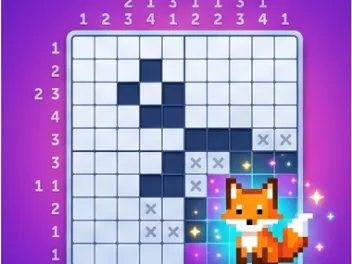
A nonogram is a logic puzzle that ends in a picture. In front of you, an empty grid; at the head of every row and every column, a short list of numbers. Those numbers tell you how many filled squares follow one another in that line, and in what order. Square by square, by matching what the rows and the columns say, you work out which squares to fill. When you find the last one, the grid turns into a small color picture: a fox, a pear, a sailboat, a snowman.
It also goes by hanjie, paint by numbers or Japanese crosswords, and some magazines publish it under their own names. The principle never changes: no luck, no complicated math, just deduction. Here you play it for free in your browser, with no download and no sign-up, on a computer, a tablet or a phone. Every picture was drawn by hand, pixel by pixel, and every grid can be solved by logic alone, without ever having to guess. You can also challenge your friends to a race on the same picture, each on your own screen.
If you are looking for free nonograms to play online, a picture cross puzzle for a child who is just starting out, or big 15 × 15 grids to sink your teeth into, you will find 94 of them here, in three sizes, plus a multiplayer race mode.
How to play
To start, you choose the size of the grid: Small, Medium or Large. One tap on the size starts the game, and the opening screen shows how many of its pictures you have already found.
Two tools share the grid, and a clearly visible switch below it lets you go from one to the other:
- Fill colors in a square. This is your real move: you are stating that this square is part of the picture.
- Cross puts a gray X on a square to note that it stays empty. Crosses are your personal notes: you place them and erase them freely, and the game never judges them.
With a mouse, you do not need the switch: left-click fills, right-click adds or removes a cross. On a keyboard, the arrow keys move the cursor, Space or Enter fills the square, and the X key puts a cross on it.
To go faster, drag your finger or the mouse along a row or a column. Your first movement sets the tool and the direction for the whole drag: you fill or cross out several squares in a line in one stroke, without spilling over onto the next line.
The row and the column of the square you are pointing at are highlighted, which helps you read the right numbers on a big grid. Every move, every mistake and every finished line is also announced to screen readers.
You win as soon as every square of the picture is filled. The grid then fills with color square by square, the title of the picture appears, and the end panel gives you your time, your mistakes, your penalty and your score.
What the numbers mean
Each number is a block of filled squares in a row. The line "3 1" holds a block of three filled squares, then, further along, a block of a single square, in that order, from left to right. For a column, the numbers read from top to bottom.
Between two blocks there is always at least one empty square; before the first block and after the last one, there can be as many empty squares as you like, or none at all. A line marked "0" holds no filled squares.
The numbers do not say where the blocks start. That is the whole game: finding their exact position, knowing that each square has to satisfy both its row and its column.
Nonogram solving techniques
Here are the lines of reasoning that come back from one grid to the next, from the simplest to the subtlest. With them, every grid in the game can be solved to the very end.
Empty lines and full lines. A "0" line gets crossed out entirely. On the other hand, a ten-square line marked "10" fills in one go. Subtler: a five-square line marked "3 1" is full too, since three squares, a gap and one square make exactly five. Add up the blocks and add one gap between each: if the total equals the length of the line, there is only one way to fill it.
Overlapping blocks. This is the king of techniques. Take a ten-square line marked "7". If the block is pushed to the left, it covers squares 1 to 7; if it is pushed to the right, squares 4 to 10. Wherever it sits, it always covers squares 4 to 7: you can fill them right away. The rule is quick to work out: a block longer than half the line has a sure part, equal to its length minus the space left over. Here, 7 minus 3 squares of slack gives 4 sure squares. With several blocks, push them all as far left as possible, then all as far right as possible, and see where each block overlaps itself.
The edges. A filled square touching the edge of the grid has to be the start of the first block. If the leftmost column gives you a filled square at the head of a row marked "4 2", then the first four squares of that row are filled, and the fifth is empty. The edge works like a wall the block leans against.
Crosses. Crossing out is just as useful as filling. A square that no block can reach is empty: put a cross on it. In the "7" line from earlier, if you find out that square 2 is filled, the block cannot go past square 8: squares 9 and 10 get crossed out. Crosses shrink the space available, and a shorter space reveals new overlaps.
Cross-checking rows and columns. Every square belongs to a row and a column. A square you fill thanks to a row becomes new information for its column, and the other way around. So the method is to go back and forth: you squeeze everything a row can tell you, then you look at the columns you just touched.
A small example, in words. On a 10 × 10 grid, the first row says "8". By overlap, its squares 3 to 8 are filled. Now look at column 3: it says "2", and its first square has just been filled. That square touches the top edge, so it is the start of the block of two: the second square of the column is filled, and the rest of the column gets crossed out. You have just gained nine squares from two numbers. The second row, which now has a filled square in third position, will in turn be easier to read.
Three grid sizes
You pick the size before you start, on the opening screen.
- Small, 5 × 5. To get started, for ages 6 and up. Twenty-four simple pictures that take a minute or two each. This is the right place to learn to read the numbers and spot full lines.
- Medium, 10 × 10. Forty pictures, and the overlap techniques become essential. Count on a few minutes per grid.
- Large, 15 × 15. Thirty more detailed pictures that call for method and patience. On a phone, a zoom button enlarges the grid in a scrolling frame, and the row and column numbers always stay visible on the side.
Small and Medium grids fit on a phone screen without any zoom.
Score, penalties and the leaderboard
There are no lives: a mistake never stops you. But every move is checked on the spot. Filling a square that is not part of the picture is a mistake: the square gets a permanent red X, it shakes, and your clock takes a time penalty. That penalty grows with every mistake:
- 30 seconds for the first mistake;
- 60 seconds for the second;
- 120 seconds for the third;
- 240 seconds for the fourth, then 240 seconds for each one after that.
A drag stops at the first mistake it runs into, so it never costs you several at once. A correct square, on the other hand, stays filled for good. And since everything is checked as you play, a line where all the filled squares have been found is necessarily finished: its numbers turn gray, and its remaining squares get crossed out on their own.
Your score starts from a base that depends on the size, and loses a point for every slice of time spent, penalties included:
- Small: 2,000 points, minus one point per tenth of a second.
- Medium: 6,000 points, minus one point every 150 milliseconds.
- Large: 10,000 points, minus one point per fifth of a second.
The score never drops below zero. A few examples:
- A 5 × 5 grid finished in 45 seconds with no mistakes: 2,000 − 450 = 1,550 points.
- A 10 × 10 grid finished in 4 minutes with one mistake: the 30-second penalty is added, and 6,000 − 1,800 = 4,200 points.
- A 15 × 15 grid finished in 12 minutes with no mistakes: 10,000 − 3,600 = 6,400 points.
A finished grid always counts as a win, even when the score has dropped to zero.
The server checks every score before writing it on the leaderboard. It finds your grid again, replays each of your squares in order with its timing, recounts the mistakes and penalties, and works out the score on its own. The leaderboard keeps each player's best score; you are asked for a nickname with your first score.
Your picture album
Every picture you finish goes into your album. From the opening screen, you browse it size by size: the pictures you have found show up small and in color, the others stay silhouettes marked with a question mark. Each size's counter tells you where you stand, for example "12 / 40 found."
The game picks a picture you have not found yet first. Once a whole size is complete, it draws from all of its pictures again. The album is kept in your browser, with no account to create: it stays there as long as you do not clear the site's data.
Play nonograms with friends: the race
Nonograms can also be played with friends, two to four players, each on their own screen. On the game page, choose Play together, then Create a table: the table gets an eight-letter code. Send the link, read out the code or have your friends scan the QR code; each of them enters the code with Join, and you are the one who accepts or declines the requests before starting the game.
Everyone gets the same medium 10 × 10 grid, drawn at random for the table. There are no turns: each player fills their own grid at their own pace, and every square is checked the moment you fill it. Here, a mistake adds no time penalty: it freezes you instead, and you cannot fill any square for 3 seconds after the first mistake, 6 after the second, then 12 after each one that follows. Crosses are still allowed while you are frozen.
During the race, you see everyone's progress as a percentage and their number of mistakes, but never their squares: nobody can copy someone else's grid. The race ends as soon as someone has filled the whole picture. It then appears in color on every screen, with the standings: first whoever finished, then the others by correct squares, and in a tie, the fewest mistakes. Anyone can ask for a rematch, and a new picture is drawn at random. Races with friends do not count on the game's leaderboard, which stays the one for solo games.
A bit of history
The nonogram was born in Japan in 1987, invented twice, independently. Non Ishida, a Japanese graphic designer, had just won a competition in Tokyo with pictures made from the lit and unlit windows of a skyscraper; the idea of a picture hidden in a grid grew out of it. The same year, Tetsuya Nishio, a professional puzzle maker, came up with the same grids and published them in another magazine.
The grids then made their way to the United Kingdom. James Dalgety, a British puzzle collector, introduced them there and gave them their name, attaching Non Ishida's first name to the end of the word "diagram." From 1990 on, the Sunday Telegraph published one every week, and the press did the rest: during the 1990s, nonograms settled into newspaper puzzle pages, then into specialized magazines and, later, onto consoles and phones.
Tips to solve faster
Start with the big numbers. Long blocks have the biggest overlaps. On a fresh grid, scan the rows and columns for numbers bigger than half the length, and for lines whose total is almost equal to the size.
Cross out freely. Crosses cost nothing and are never checked. As soon as a square is surely empty, cross it out: it is often that very square that later cuts a space in two and unlocks a block.
Watch for grayed-out lines. When a line's numbers turn gray, it is finished and its empty squares are crossed out. Take a look at the columns running through it: they have all just received new information.
Never try a square just to see. Every grid can be solved by logic, line after line. If you are stuck, there is always a row or a column that says enough; a square filled at random costs you a penalty at best, and penalties double fast.
Drag with care. Dragging is fast, but a drag that runs too long can bite into an empty square. Fill in one stroke the blocks you have fully worked out, and square by square the ones you are not sure about.
Frequently asked questions
Do I need to pay or sign up to play?
Neither. The game is free and opens in your browser, with no download; for the leaderboard, a nickname chosen with your first score is all you need.
What do the numbers at the start of each row mean?
Each number is a block of filled squares in a row, in the order the numbers are written. Between two blocks there is at least one empty square.
Do I ever have to guess?
Never. Every picture has a single solution, and it is chosen so that the numbers, read one row or one column at a time, are enough to find it down to the last square.
What happens when I make a mistake?
The square gets a permanent red X and your clock takes a penalty: 30 seconds, then 60, 120, and 240 seconds for every mistake from the fourth on. You never lose the game. In a race with friends, a mistake freezes you for a few seconds instead of adding a time penalty.
Are the crosses checked?
No. They are your notes: you place them and remove them freely, they cost nothing and they do not count in the score.
Can I play with a keyboard?
Yes. The arrow keys move the cursor, Space or Enter fills the square, and the X key adds or removes a cross.
Where are the pictures I found kept?
In your album, stored in your browser. It needs no account, but it does not follow you from one device to another and disappears if you clear the site's data.
More logic games
Logic- Tricky Riddles
Fifty riddles that never work out the way you think: tap the question, move what's in the way, or just wait a little… The right answer is rarely one of the buttons. - Word Search
Find the words hidden in the grid across four levels, forwards, backwards or diagonally. - Hangman
Guess the word letter by letter before the last balloon pops. - Exact Count
Six numbers, four operations: hit the three-digit target. - Queen Regions
Place one queen per row, column and region, with no two queens touching. - Arrow Escape
Tap the arrows out of the grid in the right order without bumping. - Binary Puzzle
Fill the grid with 0s and 1s: never three alike in a row, as many of each per line. - Naval Grid
Find a whole fleet from the edge numbers alone, solved by deduction.
