Multiplication Tables
Feed a hungry monster: tap the fruit with the right answer, and watch it grow.
Ages 6 and up
Leaderboard
Loading leaderboard…
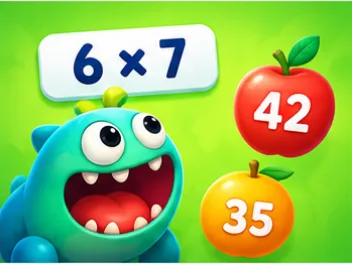
A hungry little monster holds a slate. On it, a multiplication problem: 7 × 8. In front of it, four fruits float in the air, each one carrying a number. Tap the right one, and the monster catches it, chews it, swallows it, burps, and grows a little bigger. Get it wrong, and it spits the fruit out, pulls a face, and the right answer is shown in pictures: seven rows of eight dots light up and are counted, all the way to 56.
That's the whole game. No worksheet in disguise, no clock scolding you from the very first question: a monster to feed, fruit to catch, and fourteen creatures to collect. Times tables are learned through repetition, that's true, but repetition only sticks if you keep coming back. So here, you come back for the monster.
The game works from age seven or eight, when multiplication shows up in school, and it stays useful long after: the 7 and 8 times tables and missing factors still trip up plenty of adults. Everything runs in your browser, with nothing to install, no sign-up and no account to create. Your progress, your stars and your monster album stay in your browser.
How to play
A round is ten questions. The rule fits in one line: tap the fruit with the right answer.
- The monster's slate shows the problem, big and easy to read.
- Four fruits float underneath: an apple, a pear, cherries, a banana… Each one carries a number.
- Tap the right fruit: the monster swallows it and grows. Tap a wrong one: it spits it out, and the game shows you why.
- The bar at the top shows where you are: question 4 of 10, your right answers, and your current streak.
On a keyboard, the keys 1 to 4 pick a fruit directly, the arrow keys move the selection and Enter confirms. The selection outline is always visible: you can play a whole round without ever touching the screen or the mouse. On a phone, the fruits are big and well spaced on purpose, so a child's finger doesn't miss.
Five right answers in a row set off a little burst of fireworks, and the monster grows an extra notch: by the end of a perfect round, it is about one and a half times its starting size. It's the only "bonus" in the game, and you have to earn it.
The monster, the slate and the four fruits
The three wrong answers on offer are never picked at random. That would be too easy, and above all, it wouldn't teach anything. Each wrong fruit stands for a mistake people really make:
- the neighboring fact: for 7 × 8, the game offers 49, which is 7 × 7, or 64, which is 8 × 8;
- the swapped digits: 65 instead of 56, the classic slip;
- adding instead of multiplying: 15, because 7 + 8 = 15 and the hand moved too fast;
- the tens mistake: 46 or 66, when the answer is almost right.
So answering takes knowing, not guessing. And when you get it wrong, the mistake has a name: you can see right away whether you mixed up two tables, swapped two digits or added instead of multiplying.
Within a round, the same problem never comes up twice. In the levels that work on a single table, the ten questions cover exactly the ten multipliers, from 1 to 10: you go through the whole table, in a shuffled order.
Fourteen levels, three worlds
The game moves forward in small steps, from the simplest to the trickiest.
World 1: one table at a time. Six levels: the 2, 5 and 10 times tables, which follow the most regular patterns, then 3, 4 and 6. Before each round, the whole table is shown in a column: 2 × 1 = 2, 2 × 2 = 4, up to 2 × 10 = 20. You read it for a few seconds, press "Let's go!", and the round begins. Reviewing right before playing is what turns a test into practice.
World 2: the hard tables. Five levels: 7, 8 and 9, the ones that hold out the longest, then two missing factor levels. The slate then shows 7 × ? = 56, and the fruit to catch carries the missing number. It's the same table, read backward: exactly what you will need later for division.
World 3: the big mix. Three levels: first an easy mix of the 2, 5 and 10 times tables, then a full mix of every table from 2 to 10. The last level adds a timer: eight seconds per question, with a bar that fills up while the monster gets impatient. If time runs out, the question is lost, but the right answer is still explained. The timer is there to build speed and recall, not to punish.
Every mistake explained in pictures
This is the most important rule in the game: missing teaches you something.
Every time a fruit misses, or time runs out, a panel opens. It shows the multiplication as an array of dots: for 7 × 8, seven rows of eight dots. The rows light up one after another, and the running total appears at the end of each one: 8, then 16, then 24… all the way to 56. Underneath, the complete fact, in big print: 7 × 8 = 56.
It isn't decoration. Multiplying means repeating an addition, and this picture shows it in one second, without a single sentence of explanation. A child who has seen the array for the 7 times table ten times ends up picturing it in their head when it's time to answer. The panel stays on screen until you press "Got it": nobody is rushing you.
Stars and the monster album
Each level is rated in stars, out of three:
- three stars for ten right answers out of ten;
- two stars for nine out of ten;
- one star from seven out of ten.
One star is enough to unlock the next level. Three stars, on the other hand, take a perfect round: that's the real reason to replay a level you've already cleared. And since the set of questions changes with every attempt, you can't succeed by memorizing the order of the fruits.
The level map shows the fourteen levels spread over three worlds, with their stars. You can go back to any unlocked level whenever you like.
Every level you clear adds its monster to your album. All fourteen are different: body shape, color, number of eyes, horns, antennae, teeth, spots. Until a level is cleared, its slot shows an egg: the surprise holds until the very end. The album opens with one button, at any time, and it's often what decides the next round.
Leaderboard
Every level you clear earns points, and your leaderboard score is the total of all your levels. Your stars are what count, and later worlds are worth more: in the first world, three stars earn 50 points, two earn 40 and one earns 30; the second world pays double, the third triple. Clearing all fourteen levels without a single mistake adds up to 1,250 points. To count, a level needs at least seven right answers out of ten, which is its first star and more than half: below that, it earns no points, and it doesn't unlock the next level either.
Each level counts once, for your best round. Replaying a level for more stars raises your total; replaying it worse costs you nothing. Time does not count toward points: the leaderboard rewards getting it right, not getting it fast, and on the last level a question that runs out of time simply counts as a mistake. It only keeps verified answers: the server rebuilds the ten questions of your round and checks every answer you gave before it accepts the score. The first time you clear a level, the game asks for a nickname, and from then on your total is sent on its own without interrupting your game. Your progress, your stars and your album stay on your device; your play time and your leaderboard rankings show up on your profile page.
Tips for learning the times tables
- The 2 times table doubles: 2, 4, 6, 8… It's the first one to click, and it helps with all the others.
- The 5 times table always ends in 0 or 5, taking turns. Five times an even number ends in 0.
- The 10 times table adds a zero. It's the easiest, and it works as a landmark: 7 × 10 = 70, so 7 × 9 is 70 − 7 = 63.
- The 4 times table is double the double: 4 × 7 is 7 doubled (14), then doubled again (28).
- The 8 times table is double the double of the double: 8 × 6 is 6 → 12 → 24 → 48.
- The 6 times table is the 3 times table doubled: 3 × 7 = 21, so 6 × 7 = 42.
- The 9 times table has a signature: the two digits of the answer always add up to 9. 9 × 4 = 36, and 3 + 6 = 9. Another trick: 9 × 4 is 10 × 4 minus 4.
- The 7 times table is the toughest. Lean on 7 × 5 = 35 and count up by sevens: 42, 49, 56. And remember that 7 × 8 = 56 uses four digits in a row: 5, 6, 7, 8.
- Multiplication works both ways. If you know 3 × 8, you know 8 × 3. That cuts the number of facts to remember in half.
One last tip, the most useful one: three rounds of ten questions a day beat an hour in a row once a week. Times tables sink in through small, repeated doses, and the monster is hungry every day.
Want more math practice? Try Mental Math or the Prime Factor Tree, or browse all the educational games.
Frequently asked questions
What age is it for?
From age seven for the 2 times table, and around eight or nine for the hard tables and missing factors. The first level makes sense without any explanation: a slate, four fruits, tap. There's no long text to read before you start.
Do I need to create an account?
No. No sign-up, no email address to give, no ads interrupting the game. It opens and you play. Your progress is saved in your browser, on your device.
Is my progress saved?
Yes, in your browser. Your stars and the monsters you caught come back on your next visit, on the same device and the same browser. In a private window, or if you clear the site's data, everything starts over. There's no online account to carry your progress from one device to another.
Which times tables does it cover?
The tables of 2 to 10, with multipliers from 1 to 10. World 1 takes them one at a time, world 2 tackles 7, 8 and 9 and then missing factors, and world 3 mixes everything.
Is the timer mandatory?
No. Only one level out of fourteen is timed, the last one, with eight seconds per question. The other thirteen are played at your own pace: you can think, count on your fingers, go back over it in your head. Nothing ticks away while you look at the slate.
What happens when I get it wrong?
The monster spits out the fruit, the right answer gets a check mark, and a panel opens: the multiplication drawn as rows of dots, counted one by one up to the total. You move on to the next question when you decide.
Can I play with a keyboard?
Yes, entirely. The keys 1 to 4 pick a fruit, the arrow keys move the selection, Enter confirms, and Escape closes the level map or the album. Focus is always visible, and every change is announced to screen readers.
Is there a leaderboard?
Yes: it ranks players by the total points of the levels they have cleared, each level counted once, from seven right answers out of ten. This game is first about building automatic recall, at your own pace. The stars and the album of fourteen monsters stay on your device.
More educational games
Educational games- World Map Quiz
A country is named, you tap it on the map. 162 countries, every continent, ten levels with stars to earn. - Tower of Hanoi
Move the tower disk by disk, never putting a big one on a small one. Ten levels, up to twelve disks and four pegs. - Plant Cell and Photosynthesis
Spot the organelles on a real textbook diagram, then switch on photosynthesis and watch the leaf come to life. - Wolf, Goat and Cabbage
The wolf eats the goat, the goat eats the cabbage: get everyone across. Twelve puzzles, and fails that make you laugh. - Electric Circuits
Turn the wires, close the loop and light the bulbs: series, parallel and short circuits, in twenty-four levels. - Tangram
Seven pieces, one shadow to fill: thirteen shapes and an album to complete. - Logic Gates
Place the right gates, flip the switches and make the lamp follow the whole truth table. - Telling Time
Set both hands to the time you're given, from o'clock times to the exact minute, PM times included.
