Telling Time
Set both hands to the time you're given, from o'clock times to the exact minute, PM times included.
Ages 6 and up
Leaderboard
Loading leaderboard…
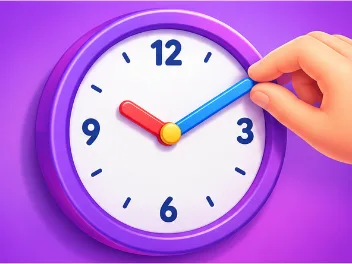
A time appears, quarter to seven, and a clock face is waiting for you, its hands set to ten past ten. It is your job to move them. The long hand first, the one for the minutes, then the short hand, the one for the hours. You check your answer, and the clock tells you whether you got it right.
It looks easy, and it is, on the first day. Then comes the question that trips everyone up: at quarter to seven, where is the short hand? Not on the 7. Not on the 6 either. Between the two, very close to the 7, because an hour hand does not jump from one number to the next: it glides for sixty minutes. That is the thing hand-drawn clock faces teach badly, and it is exactly what this telling time game puts in front of your eyes.
Twelve levels, six rounds each. You start with o'clock times and finish with "twenty past four" written out in words, with afternoon times along the way. It is a free way to learn to tell time on an analog clock, for kids who are just starting and for anyone who wants to practice.
How to play
At the top is the time you have to set. Depending on the level, it is written in digits, like 7:45, or in words, like quarter to eight. Both say the same thing, and switching from one to the other is part of the game. The hour part of the time is colored like the short hand, orange, and the minute part like the long hand, blue, so you always know which hand each part is about.
In the middle is the clock face. Touch it near a hand: the hand closest to your finger responds, and you drag it to where it should point. When the two hands overlap, touch toward the edge to grab the long hand and toward the center to grab the short one. The first time, a little animated hand shows you the gesture.
Always start with the long hand. It snaps to the step of the level on its own: in the first levels, it only stops on the hour, and later it accepts any minute. Then move on to the short hand. That one does not need to be exact to the degree: it just has to sit between the two right numbers. The game never asks you for a watchmaker's precision, only to know which hour you are in.
When both hands are in place, tap the check mark under the clock to check your answer.
If you are right, a green ring closes around the clock face, and the hands settle into their exact position. That is when you see the short hand finish its journey between two numbers. If you are wrong, the clock shakes, and the right position appears as dashed outlines over yours, each hand in its own color. You see at a glance where you went wrong, and the next round arrives.
Six dots at the top count your rounds: green for right, red for missed.
What each hand tells you
The long hand counts the minutes. A full turn is one hour. Each small mark is one minute, and each number on the clock face is worth five minutes. That is the first real hurdle: the 3 does not mean three, it means fifteen. The 6 means thirty, and the 9 means forty-five.
The short hand counts the hours. It moves twelve times more slowly. When the long hand makes a full turn, the short hand travels only one space. And during that whole hour, it never stops moving: at seven o'clock it sits right on the 7, at half past seven it is halfway to the 8, and at five to eight it almost touches the 8.
That is why telling time means looking at both hands together. The short hand tells you which hour you are in; the long hand tells you how far along you are in that hour.
The words of time
From the second level on, the time is sometimes written out in words, and English has its own habits.
- o'clock when the long hand is on the 12: three o'clock.
- quarter past when it is on the 3: quarter past three.
- half past when it is on the 6: half past three.
- quarter to when it is on the 9, and here you name the next hour: quarter to four, not three forty-five.
- Before the half hour, you count the minutes past: ten past eleven, twenty-five past six.
- After the half hour, you count what is left until the next hour: twenty to eleven, ten to twelve.
Two traps are waiting for you, and the game serves them on purpose.
Minutes that are not a multiple of five keep the word "minutes." You say twenty past three, but seven minutes past three and one minute to nine. Only on the five-minute marks does the word disappear. When you see "minutes" in the time, you know the long hand is going to land between two numbers.
"To" belongs to the next hour. Twenty to five is four forty. The long hand goes on the 8, and the short hand stays in the hour of four, not five, even though "five" is the hour you read. It is the most common mistake in the game.
PM changes nothing on the clock face. A clock face only has twelve numbers, and morning and afternoon look exactly the same on it. When you are asked for 3:30 PM, the short hand goes between the 3 and the 4, just as it would at 3:30 AM. If you ever meet a time on the 24-hour clock, as on a train schedule, subtract twelve: 15:30 is 3:30 PM, and 20:00 is eight o'clock in the evening, the 8 on the dial.
The twelve levels
Hours and half hours. Four levels. O'clock times in digits, then in words, then half past the hour, both ways. This is where the short hand leaves the numbers for the first time.
Quarters and five minutes. Four levels. Quarter past and quarter to, then steps of five minutes: each number on the clock face takes on its real value, and the forms with "to" come into play.
To the minute, and the afternoon. Four levels. Any minute at all, in digits then in words, then afternoon and evening times marked PM, and finally a last level that mixes everything: five-minute steps, written out in words, with the times around twelve included.
Stars and progress
You earn three stars if you get all six rounds without a mistake, two stars with up to two mistakes, and one star beyond that. There is no timer and no account to create: nothing rushes you, and taking your time never costs you a point.
Your stars and your progress stay in your browser. A level opens as soon as you have cleared the one before it, and you can go back to any level to aim for more stars. The game plays with a finger on a phone and entirely with a keyboard on a computer: the Tab key moves from one hand to the other, the arrow keys turn the selected hand, and the Enter key checks your answer.
Leaderboard
Every level you finish earns points, and your leaderboard score is the total of all your levels. Your stars are what count, and later worlds are worth more: in the first world, three stars earn 50 points, two earn 40 and one earns 30; the second world pays double, the third triple. Finishing all twelve levels without a single mistake adds up to 1,200 points. To count, a level needs at least three right answers out of six: with four mistakes or more, it still opens the next level and keeps its star, but earns no points.
Each level counts once, for your best run. Replaying a level for more stars raises your total; replaying it worse costs you nothing. Time does not count: the leaderboard rewards getting it right, not getting it fast. It only keeps verified answers: the server rebuilds the six times of each level and checks every answer you gave before it accepts the score. The first time you finish a level, the game asks for a nickname, and from then on your total is sent on its own without interrupting your game.
A few tips
Set the long hand first. Once the minutes are in place, you know whether the short hand should sit just past a number, halfway, or almost on the next one. The other way around is much harder.
Translate "to" before you move anything. Twenty to five is four forty. The long hand goes on the 8, and the short hand stays in the hour of four. Say the time in your head as "four forty" and the hands follow.
Count by fives on the numbers. 1 is five minutes, 2 is ten, 3 is fifteen. When you are not sure, go around the clock counting: it is faster than trying to remember.
Ignore AM and PM on the dial. They tell you about the day, not about the hands. Set 4:20 PM exactly as you would set 4:20 in the morning.
Watch where the short hand settles after a right answer. The game puts it back in its exact position rather than where you left it. That small shift is the whole lesson of the game, summed up in a single gesture.
If you enjoy learning by playing, try Multiplication Tables or Making Change, or browse every educational game on the site.
Frequently asked questions
What age is the telling time game for? From age six for the first levels, which only ask you to recognize a number. The levels to the minute and the PM levels suit kids from about eight or nine.
Do I need to know how to tell time already? No. The first four levels teach it from the start, and every mistake shows the right answer on the clock face.
How long does a game take? A level is six rounds, so one to two minutes.
Does the short hand need to be exact to the degree? No, never. It just has to be in the right space, between the two right numbers. Only the minutes have to be exact.
Why is my answer wrong when the short hand is on the right number? Because it may be there too early or too late. At five to eight, it should be almost on the 8, so still in the space of the 7. The dashed outline shows you where it should have landed.
Does the game follow what kids learn in school? It follows the usual elementary school progression: the hour, the half hour, the quarter hour, five minutes, the exact minute, then afternoon times.
Is there a leaderboard? Yes: it ranks players by the total points of the levels they have finished. Each level keeps the same six times for everyone, and you play them at your own pace.
Do I need to create an account or install anything? No. You open the page and you play. A nickname is all you need to appear on the leaderboard.
More educational games
Educational games- Algebra Balance
Take away, add, divide — but always on both sides. The scale stays level until x stands alone. - Making Change
The customer pays too much: put the right coins in their hand, and as few as you can. - Prime Factor Tree
Split every number down to its primes, which light up like lanterns. Eight trees against the clock, solo or in a race. - Mental Math
Twenty sums that get harder and harder: answer right, and as fast as you can. - Europe Chase
A thief runs from city to city. Read the clues, follow the trail and name them. - Flag Quiz
Name the flag, or find the flag of the country: twenty rounds, 162 countries. - World Capitals
The capital of a country, or the country of a capital: twenty timed rounds. - Human Bones
A skeleton, a bone named: click the right one. Twelve bones, two levels.