Word Search
Find the words hidden in the grid across four levels, forwards, backwards or diagonally.
Ages 6 and up
Leaderboard
Loading leaderboard…
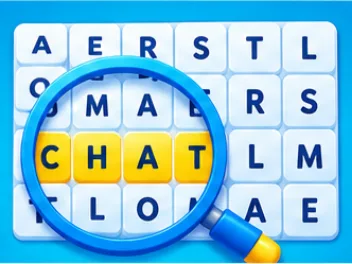
A word search comes down to a grid of letters and a list of words. Every word on the list hides somewhere in the grid, in a straight line: across, down or diagonally, forwards or backwards. Your job is to find them all.
Here, every grid hides words from a single theme. The English version has its own word list, written for it: 780 everyday American English words spread over 20 themes, including animals, birds, fruits, jobs, sports, the farm, the kitchen, musical instruments, weather, space, bugs, and colors and shapes. You choose from four levels: Easy, 8 words in a 10 × 10 grid, read only left to right or top to bottom; Medium, 10 words in a 12 × 12 grid, diagonals included; Hard, 12 words in a 12 × 12 grid in all eight directions, sometimes backwards; Expert, 14 words in a 14 × 14 grid, with all eight directions on an equal footing.
Everything plays in your browser, with no download, no sign-up and nothing to install. A grid takes a few minutes, and a new one is waiting for you right after. If you're looking for free word search puzzles you can play online, on a computer or a phone, with a fresh grid every time, this is the place.
How to play
The grid fills the top of the screen, the word list the bottom. To mark a word, swipe from its first letter to its last, with your finger or the mouse. The selection snaps to the nearest direction on its own: you don't need a perfect gesture to follow a diagonal.
If you'd rather not swipe, tap the first letter, then the last one. The first letter stays marked until you choose the second; tapping it again cancels the selection.
You can also play entirely with the keyboard. The arrow keys move the cursor around the grid, Enter marks the first letter and then the last, and Escape cancels.
The direction of your selection doesn't matter at all: a word written backwards in the grid can be marked from its last letter to its first, or the other way around. Only the letters you cover count.
What happens when you find a word
A word you find gets circled in color in the grid and crossed off the list. Each word gets its own shade, so words that cross each other stay readable. Words can share letters: the same E can belong to two words, one across and one on a diagonal.
A selection that doesn't give you a new word makes the grid shake and counts as a missed selection. That happens with a stretch of letters that doesn't spell any word on the list, or with a word you already found being marked a second time.
Sometimes a word shows up twice in the grid: once where it was placed, and once by chance, among the filler letters. Both count: find either one, and the word is checked off.
The grid is complete when every word has been found. Your time, your score and your number of selections are then shown.
How the words are written
As in printed word search books, the words are written in capital letters with no spaces or hyphens: compound words are joined together, so a blue jay becomes BLUEJAY, a black hole BLACKHOLE and a T-shirt TSHIRT. Every word is 4 to 10 letters long, and there are no proper nouns and no brand names.
Within a grid, no word is contained in another, forwards or backwards. So there's never any doubt about which word a selection points to.
The filler letters aren't purely random either. They follow how often each letter appears in the word list: lots of E, A, R, O and I, very few J, Q, X or Z. That way, the grid looks like ordinary text, and the words don't jump out from a jumble of unlikely letters.
How your score is calculated
The timer starts when the grid appears and stops with the last word found. The score starts at 10,000 points, and the game takes away:
- one point per tenth of a second that passes, so ten points per second;
- 100 points per missed selection, the equivalent of ten seconds.
That total is then scaled by the level's share, rounded down: 60% on Easy, 80% on Medium, 100% on Hard and 130% on Expert. So a Hard grid finished in three minutes with no mistakes is worth 8,200 points, and an Expert grid in the same time 10,660. After 16 minutes and 40 seconds, the score drops to zero. It never goes below zero.
Every selection counts for at least three tenths of a second, the time a human gesture takes. If you switch tabs, the timer pauses and picks up again when you come back.
On the leaderboard, every score is checked by the server. It rebuilds the grid, replays your selections one by one, checks that every word was really found, and works out the score itself.
The leaderboard
Every grid is new: a theme, words and positions drawn at random, at the level of your choice.
The English leaderboard belongs to English players alone: everyone on it searched the same English words, so the ranking compares like with like. The French version keeps its own leaderboard for its own grids.
The leaderboard keeps each player's best score, across all grids. When two scores are tied, whoever got there first ranks higher.
Eight tricks to find words faster
Hunt for the rare letters. A word with a J, X, Q or Z is easiest to find by that letter: there are very few of them in the grid, and each one is a real lead. Spot it first, then look around it.
Look for double letters. The RR of SQUIRREL, the LL of UMBRELLA, the EE of BUMBLEBEE form visible pairs that often give a word away.
Work from the first and last letters. For a given word, find every copy of its first letter, then check whether its last letter sits at the right distance, in one of the eight directions.
Start with the long words. A ten-letter word crosses almost the whole grid: it has few possible spots, and once you've found it, your eyes are free for the others.
Don't forget backwards. On Hard and Expert, the words written right to left or bottom to top are the ones people miss most. When a word won't show up, look for it in reverse.
Sweep the diagonals. Your eyes naturally read in rows and columns. Diagonals take a deliberate effort: go through them one by one when only a few words are left.
Use the theme. Knowing that the grid is about fruit helps you recognize a word you've only half seen, and guess words before you've even read the whole list.
Don't select at random. Every missed selection costs the equivalent of ten seconds. It's better to check the letters with a quick glance before you swipe.
If you like word games, try Hangman, or browse all the logic games.
A paper puzzle gone digital
Word search puzzles appeared in puzzle magazines at the end of the 1960s, and quickly became one of the most popular puzzles around. They fill whole books sold at newsstands and in supermarkets, and they are a classroom favorite for learning vocabulary.
Their success comes from their simplicity: no clue to decode, no special knowledge needed, just attention and method. The online version adds what paper can't: a new grid every game, a timer, and the chance to compare your score with everyone else's.
Frequently asked questions
Is the game really free?
Yes, completely, with no download and no sign-up.
Do I need an account to appear on the leaderboard?
No. A nickname is enough; you're asked for one the first time you submit a score.
Which directions are the words hidden in?
It depends on the level. On Easy, only left to right and top to bottom; Medium adds the two diagonals that run down or up to the right; Hard uses all eight directions, mostly in reading order or on a diagonal, with about one word in nine backwards; Expert uses all eight directions equally.
Do I have to select words in the right direction?
No. You can swipe from the first letter to the last or the other way around: only the letters you cover count.
Why are some words joined together?
That's the word search convention: the grid has no room for spaces or hyphens, so compound words are written as one, like BLUEJAY or TSHIRT.
How many themes are there?
Twenty: animals, birds, fruits, vegetables, jobs, sports, the farm, the kitchen, musical instruments, the human body, clothes, the house, transportation, the sea and ocean, flowers and the garden, weather, school, space, bugs, and colors and shapes. Each grid draws one at random.
Does the game work on a phone?
Yes. Swipe your finger from one letter to another, or tap the first and the last letter. The grid keeps its size from the moment the page loads, so nothing moves under your hand.
Are my scores kept if I switch devices?
Yes, if you set up your recovery key. Your player ID is stored in your browser, so clearing the site's data or moving to another machine starts you from scratch, unless you recover your profile on the profile page with your nickname and your key. Your nickname, scores and avatar then come back.
More logic games
Logic- Hangman
Guess the word letter by letter before the last balloon pops. - Exact Count
Six numbers, four operations: hit the three-digit target. - Queen Regions
Place one queen per row, column and region, with no two queens touching. - Arrow Escape
Tap the arrows out of the grid in the right order without bumping. - Binary Puzzle
Fill the grid with 0s and 1s: never three alike in a row, as many of each per line. - Naval Grid
Find a whole fleet from the edge numbers alone, solved by deduction. - Sudoku
One grid a day: every row, column and box of nine takes the digits 1 to 9, once each. - Nonogram
Follow the numbers, fill in the right cells: a color picture appears at the end. Solo, or in a race with friends.