Algebra Balance
Take away, add, divide — but always on both sides. The scale stays level until x stands alone.
Ages 10 and up
Leaderboard
Loading leaderboard…
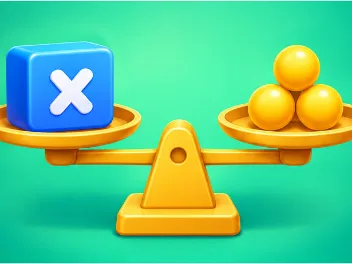
A balance scale with two pans. On the left, three blocks marked x and a weight of 2. On the right, a weight of 14. The scale is perfectly level, so both sides weigh the same. Your mission: find out how much one x block weighs, without ever tipping the scale.
You are allowed to do only one thing, and that is the whole lesson: whatever you do to one side, you do to the other. Take 2 off the left, take 2 off the right. Split the left pan into three, split the right pan into three. With every move the equation stays true, the scale stays level, and the unknown gets closer to the exit.
After two moves, all that is left is one x block on one side and a 4 on the other. You have just solved 3x + 2 = 14 without learning a single formula.
That is what this algebra balance game is about: a hands-on way to solve equations that shows why the rules work, not just what to write. It is free, it runs in your browser, and it needs no account.
How to play
At the top, the equation is written the way it would be on a classroom board: 3x + 2 = 14. Just below, the same thing appears as blocks on the balance scale. Both change together with every move, and that is on purpose: the game is built to bridge the gap between the object you handle and the line you write.
At the bottom are the moves offered for the level. There are always more than you need, and some of them are useless: knowing which one to pick is the game.
- − 2 or + 3: take away or add that many units of weight on both pans.
- − x or − 2x: take x blocks off both pans.
- ÷ 3: split each pan into three equal parts and keep only one.
Tap a move, the scale sways for a moment and settles back to level. It never tips, because you never broke the equality. The written equation updates at the same time.
You win when there is a single x block on one side and a number on its own on the other. That is what solving means.
Two buttons are there to help: Undo goes back one move, Restart brings back the starting equation. Neither one adds a move to your counter, but the moves you already played stay counted.
A split that does not come out even is refused
This is the rule that teaches the most, and it surprises people at first.
If the equation is 2x + 1 = 9 and you tap ÷ 2 right away, the game refuses. Why? Because 1 cannot be split into two whole parts. You would have to cut a weight in half, and this game never cuts anything.
The message tells you so, and points you in the right direction: first take the 1 off both sides. You get 2x = 8, and now ÷ 2 comes out even.
That leads to an order you end up absorbing without anyone reciting it to you: weights first, splitting last. It is exactly what you will later hear called "isolating the variable," and you will have found it by running into a refusal rather than by copying a rule from a textbook.
When there are x blocks on both sides
The third world changes the scenery. This time the right pan also holds x blocks: 4x + 1 = 2x + 9.
The reflex is the same as with weights. You cannot split while there are x blocks on both sides, so you start by taking the same number off each side: two x blocks leave the left pan, two leave the right pan, and you are left with 2x + 1 = 9. You are back to a problem you already know how to solve.
This is the moment when solving an equation stops being a recipe and becomes a method: gather the x terms on one side, the numbers on the other, then divide. Three moves, never more, for any linear equation in this game.
Negative weights
Some levels start with something missing rather than something extra: 4x − 3 = 9. On the scale, that − 3 is not a weight sitting on the pan, it is a gap. It is drawn with a dotted outline and its sign, so you never confuse it with an ordinary weight.
You do not take a gap away, you fill it: + 3 on both sides, and it disappears on the left while the right side becomes 12. A student who has understood that on the balance will no longer get the sign wrong when moving a term to the other side.
The twelve levels
One single move. Four levels, one move each: an extra weight to remove, a gap to fill, a split into two and a split into three. Enough to build the both-sides reflex before anything else. These are the classic one-step equations.
Remove, then divide. Four levels with two moves. This is where you discover the refused split and the order it forces on you. These are two-step equations.
x on both sides. Four levels, two or three moves each. x blocks appear on the right pan, and the full method falls into place.
Stars
Each level has a par: the smallest number of moves that leads to the solution. It is shown below the scale, and it is not there for decoration. Every par was checked one by one, by exploring every possible path with the moves of that level.
You earn three stars if you match par, two if you use up to two extra moves, and one beyond that. Undo and Restart do not count as moves, but a move you undo still counts: the counter keeps every move you played since the level opened. So searching freely is allowed, it just shows up in your stars.
There is no timer and no account to create. Your stars stay in your browser, a level unlocks as soon as you clear the one before it, and you can go back to any level you have opened.
Leaderboard
Every level you clear earns points, and your leaderboard score is the total of all your levels. Later worlds are worth more: in the first world, three stars earn 50 points, two earn 40 and one earns 30; the second world pays double, the third triple. Clearing all twelve levels at par adds up to 1,200 points.
Each level counts once, for your best solution. Replaying a level for more stars raises your total; replaying it worse costs you nothing. The leaderboard only keeps verified solutions: the server replays every move you made before it accepts the score. The first time you clear a level, the game asks for a nickname, and from then on your total is sent on its own without interrupting your game.
A few tips
Read the equation before you touch a button. What is in the way? An extra weight on the left? x blocks on the right? The right move often becomes obvious before you try it.
Numbers first, splitting second. That is almost always the right order. If you start by dividing, you will hit a refusal as soon as a lone weight is left over.
Count what is left after each move. The written equation at the top tells you. If you read it every time, you will see the solution coming instead of stumbling onto it.
Do not go around in circles. Adding something and then taking the same thing away brings back the same equation and costs you two moves on the counter.
When you are stuck, undo. Going back does not add a move and leaves you with a clearer equation. That is far more useful than piling up moves at random.
Say it out loud. "Take two from both sides" is a sentence worth hearing yourself say. It is exactly how teachers explain the method, and it sticks better than a silent tap.
If you enjoy learning math by handling it, try Prime Factor Tree and Multiplication Tables, or browse the whole educational games category.
Frequently asked questions
Do I need to know what an equation is? No. The game never asks you to write anything or to know any vocabulary. A scale, blocks, weights and the both-sides rule: everything you need is right there.
What age is it for? From ten, children can play on their own. The first world makes sense even earlier, and the third one matches the pre-algebra most students meet around age twelve or thirteen.
How long does a level take? Between thirty seconds and three minutes.
Why does the game refuse my division? Because it would not come out even: at least one number in the equation does not divide exactly. Take away or add what is in the way first.
Can I solve it some other way than the shortest path? Yes. Every path that respects the both-sides rule leads to the right answer. Par only matters for the stars.
Are negative numbers too hard for younger players? The game never asks you to calculate with them: it shows a gap to fill, which makes sense long before anyone learns about negative integers in class.
Is there a leaderboard? Yes: it ranks players by the total points of the levels they have cleared. The twelve levels are the same for everyone, and you play them at your own pace.
Do I need to install anything? No, nothing at all. Open the page and play, on a phone as well as on a computer.
More educational games
Educational games- Making Change
The customer pays too much: put the right coins in their hand, and as few as you can. - Prime Factor Tree
Split every number down to its primes, which light up like lanterns. Eight trees against the clock, solo or in a race. - Mental Math
Twenty sums that get harder and harder: answer right, and as fast as you can. - Europe Chase
A thief runs from city to city. Read the clues, follow the trail and name them. - Flag Quiz
Name the flag, or find the flag of the country: twenty rounds, 162 countries. - World Capitals
The capital of a country, or the country of a capital: twenty timed rounds. - Human Bones
A skeleton, a bone named: click the right one. Twelve bones, two levels. - Chemical Elements
Find the elements in the periodic table. Twenty rounds, three levels.