Fill the Grid, a Free 8 × 8 Block Game
Place the pieces on the grid and complete lines to clear them.
Ages 6 and up
Leaderboard
Loading leaderboard…
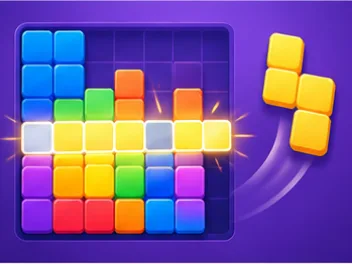
Fill the Grid comes down to one grid and three pieces. You drop the blocks wherever you like, every full row or column disappears, and the game goes on as long as there is room left. Nothing falls and nothing rushes you: it is a placement game, not a reflex game.
Everything happens in your browser, with no download, no sign-up and nothing to install. A game can last two minutes or half an hour, depending on your skill and the luck of the draw. If you are looking for a relaxing block game to play online for free, with a real leaderboard behind it, start here.
How to play
The grid is 8 squares by 8, empty at the start. Below it, three pieces are waiting for you. You place them in any order you like, wherever you like, as long as every one of their squares lands on a free square. Pieces do not rotate: each shape goes down exactly as it is offered.
When a row or a column is completely filled, it clears and frees up space. Several rows and columns can clear at once, if the same piece completes all of them.
Once all three pieces are placed, three new ones arrive. The game ends when none of the remaining pieces can fit anywhere on the grid. There is no timer to throw you out and no life to lose: space is the only thing that matters.
The pieces
The game draws from a catalog of 37 shapes, picked at random:
- the single block, one square;
- bars of 2, 3, 4 and 5 squares, lying down or standing up;
- 2 × 2 and 3 × 3 squares;
- 2 × 3 rectangles, both ways;
- small corners of 3 squares and big corners of 5 squares, in all four orientations;
- T, L and S shapes, in all their orientations.
Every shape has exactly the same chance of coming up. The big 3 × 3 square, the bulkiest piece of all, therefore shows up on average once every 37 pieces. The two 5-square bars, together, show up on average once every 18 or 19 pieces.
Controls
With a mouse or a finger, drag a piece onto the grid. A shadow shows where it will land, and the lines that would clear light up. Let go to place it. If the spot is not free, the piece simply goes back to where it was. On a touchscreen, the piece floats a little above your finger, so you can always see where you are putting it.
You can also tap a piece to select it, then tap the square on the grid where its top-left corner should go.
On a keyboard, the 1 to 3 keys choose a piece, the arrow keys move the preview around the grid, Enter places the piece and Escape cancels. The game announces every placement, every line cleared and the end of the game to screen readers.
How your score is calculated
The formula is public:
- each piece you place earns one point per square;
- clearing lines earns 10 points for one line, 30 for two, 60 for three, 100 for four, and so on;
- those clearing points are multiplied by your streak: the number of moves in a row that have each cleared at least one line.
The streak goes up with every move that clears something, and drops back to zero as soon as you place a piece without clearing anything. It appears above the grid from two moves in a row onward.
An example: you clear two lines in one move, then, on the next move, three lines at once. The first move earns 30 clearing points, the second earns 60 multiplied by a streak of 2, which is 120, on top of the squares placed. Chaining clears pays far more than spacing them out.
Time plays no part in the calculation. When two scores are tied on the leaderboard, whoever reached it first stays ahead.
Every score you send is checked: the server replays the game piece by piece, from the same random draw, and recalculates the total on its own. A score that does not match a game actually played never makes the leaderboard. You can play as many games as you like: only your best score is kept.
Seven strategy tips for Fill the Grid
Keep room for the big pieces. The 3 × 3 square and the 5-square bars are the pieces that end games. As long as the grid keeps a free 3 × 3 area and one clear line, you are safe.
Fill the edges first. The center of the grid is your reserve of freedom. Pieces placed along the edges and in the corners leave the middle open for whatever comes next.
Avoid isolated holes. An empty square surrounded by full squares can only take the single block, and that piece comes up only once every 37 pieces on average. Before placing, check that you are not boxing in a square.
Look at all three pieces before placing the first. Order matters. Placing the hardest piece first, while there is still room, often keeps you from getting stuck with it.
Set up multiple clears. One line earns 10 points, two lines at once 30, three 60, four 100: the scale climbs faster than the number of lines. Building up several lines side by side, then closing them with a single piece, pays off.
Keep your streak alive. The streak multiplier is the real engine behind big scores. When you can clear something on every move, even a single line, the streak climbs and every clear after that is worth more.
Do not trade survival for points. A spectacular clear is worth nothing if it leaves you with a cluttered grid. When space runs short, clear what you can, right away.
A genre born on phones
Block placement games on a grid became popular on phones in the mid-2010s, and today they rank among the most played mobile games in the world. They borrow from jigsaw-style puzzles the idea of fitting shapes into a space, and from falling-block games the thrill of watching the grid empty in one go.
Their strength lies in a rule you can learn in ten seconds and a game you can pause at any moment. Unlike games where pieces fall from the top, nothing here forces you to decide quickly: you can think about every placement for as long as you want.
If you like calm puzzles where every move counts, try Color Sort and Number Merge, or browse the whole puzzles category.
Frequently asked questions
Is the game really free?
Yes, completely, with no download and no sign-up.
Do I need an account to appear on the leaderboard?
No. A nickname is enough. You are asked for one the first time you submit a score.
Can I rotate the pieces?
No. Each piece goes down in the orientation it is offered in. The different orientations of the same shape exist as separate pieces.
When does the game end?
When none of your remaining pieces can be placed anywhere on the grid. As long as a single piece still fits, the game goes on.
Can I play as many games as I like?
Yes. Only your best score is kept on the leaderboard.
Does the game work on mobile?
Yes. You drag the pieces with your finger, and the play area keeps its size while the page loads so nothing shifts under your hand.
Are my scores kept if I switch devices?
Yes, if you set up your recovery key. Your player ID is stored in your browser, so clearing the site's data or moving to another machine starts you from scratch. On your profile page, you can create a recovery key, then enter your nickname and that key on your new device to pick up where you left off.
More puzzles
Puzzles- Number Merge
Slide the tiles, merge equal numbers and build the biggest tile you can. - Mahjong Solitaire
Clear all 144 tiles in matching pairs, taking only free tiles. - Number Match
Cross out equal digits or pairs that make ten, and clear the whole grid. - Nuts and Bolts
Unscrew the planks in the right order: each screw joins a box of its color, and the waiting slots fill up fast. - Blocked Parking
Free the red car: slide the vehicles, none of them turns, none of them jumps another. - Mummy on the Run
The little mummy runs straight on until it hits a wall: grab the tomb's gold, dodge the spikes and bats, and dash for the exit. - Sneaky Cat
The little orange cat sneaks through the house: swipe every fish without catching the dogs' eye, put them to sleep from behind, and slip out the cat door. - Fruit Cutter
Fruit flies up from everywhere: slice it with one swipe in a splash of juice, chain your combos, and whatever you do, don't touch the bombs.
