Hangman
Guess the word letter by letter before the last balloon pops.
Ages 6 and up
Leaderboard
Loading leaderboard…
Hangman comes down to one hidden word. You suggest a letter: if it is in the word, it drops into every box where it belongs; if not, that is a miss. Your job is to find the whole word before you make one miss too many.
Here, the gallows has given way to a little character holding seven balloons, and the words come from a hand-picked list of 796 everyday American English nouns, written for the English version of the game. Everything runs in your browser, with no download and no sign-up, on a computer as well as on a phone.
If you are looking for a free hangman game to play online — a quick word puzzle for a coffee break, a classroom warm-up or a daily habit — this one takes a minute or two per word.
How to play
The word appears as a row of empty boxes, one per letter. To suggest a letter, tap it on the on-screen QWERTY keyboard, or type it on your own keyboard.
Each letter can only be suggested once. As soon as it has been played, its key is disabled: a check mark if the letter is in the word, grayed out and crossed through if it is not. At a glance, you know what you have left to try.
A correct letter shows up everywhere it appears: if the word has two Es, both appear at once. You win as soon as every letter of the word has been found.
Seven balloons instead of a gallows
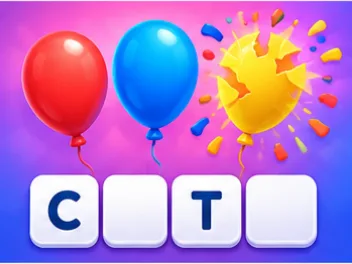
Classic hangman draws a gallows, line by line, with every miss. Here, each letter that is not in the word pops one of the character's seven balloons. A miss counter stays on screen for the whole game.
When the seventh balloon pops, the game is lost. The word is then shown in full, and the letters you missed are highlighted.
So you can afford six misses. That margin melts away fast: a word only uses a handful of different letters out of the twenty-six in the alphabet. The whole art is choosing the right ones, in the right order.
The balloons are only decoration: the miss counter and the screen reader announcements carry all the information, so the game is fully playable without seeing the picture.
The words to guess
The English game has its own word list, separate from the French one: 796 common nouns of American English, all words a six-year-old knows. Animals, food, things around the house, places in town, toys and sports: alligator, pancake, backpack, lighthouse, skateboard. There are no proper nouns, no brand names and nothing rude. Every word is one solid block of letters, with no hyphen or space to give you a free hint.
Every word is 7 to 11 letters long. Seven-letter words are the most common, about one in three, and eleven-letter words the rarest, fewer than one in twenty. Many of them are compound words, two short words glued together: bookworm, toolbox, birdhouse, firefighter.
Here is a surprise for many players: a long word is not harder than a short one. It usually contains more different letters, so each guess has a better chance of landing, and each correct letter often fills several boxes. The trickiest words are the ones built from just a few different letters: bumblebee only uses B, U, M, L and E, so almost every other letter you try costs a balloon.
How your score works
Only a won game earns a score. The timer starts when the word appears and stops at the last letter found. The score starts at 10,000 points, and the game takes away:
- 1,000 points per miss;
- one point per tenth of a second that passes, so ten points per second.
A word found with no misses in 40 seconds is worth 9,600 points; with two misses in the same time, 7,600. One miss costs as much as a hundred seconds of thinking.
Each guess counts for at least three tenths of a second, the time a human hand needs. If you switch tabs, the timer pauses and picks up again when you come back. A lost game does not go on the leaderboard.
Every score is checked by the server: it finds the word again from the same draw, replays the letters you suggested one by one, and works out the score itself.
The leaderboard
Every game draws a new word.
The English leaderboard belongs to English players alone: everyone on it guessed words from the same English list, so the ranking compares like with like. The French version keeps its own leaderboard for its own words.
The leaderboard keeps each player's best score. When two scores are tied, whoever got there first ranks higher.
Nine tips to save your balloons
Start with E. It turns up in nearly two words out of three in the game's list. A and R follow close behind, each in more than half of the words: three good opening guesses.
Follow up with the other common letters. O, T, I, N, L and S come next, roughly in that order, each in more than a third of the words. A couple of vowels early on usually reveal the shape of the word.
Do not forget the vowels you have not tried. Almost every word in the list has at least two vowels. If only one has shown up in a long word, another is almost certainly hiding.
Keep rare letters for the end. J, Q and X each appear in about one word in a hundred, Z in two, V in five. Suggesting them early nearly always means sacrificing a balloon.
Think of U after Q. In this list, a Q is always followed by a U, as in aquarium or squirrel. But Q itself is rare: do not guess it blindly.
Spot the endings. One word in eight ends in -er, like builder or toaster. Then come -y, -ing, -le and -ion, as in balcony, building, whistle and station. As soon as the last boxes start to sketch one out, you know what to suggest.
Look for the two halves. When a compound word shows up, such as back- or bird- at the start, the second half is often another everyday word: backyard, birdcage. Guess its letters as a word of its own.
Make a list of candidates. Once a few letters are in place, run through the words that fit the pattern. A letter shared by every candidate is a free hit; after that, the letter that appears in most of them is your best bet.
Take your time. A miss costs 1,000 points; ten seconds of thought only costs a hundred. When in doubt, count the candidates before you touch the keyboard.
If you enjoy word games, try the Word Search, or browse all the logic games.
An old pencil-and-paper game
Hangman is passed down without any written rules: a sheet of paper, a pencil, two players. One picks a word and draws a dash for each letter, the other suggests letters. Generations have played it at school, on the board or in the corner of a notebook.
Its origins are poorly documented. A version of it appears in a collection of traditional British games, Alice Bertha Gomme's Traditional Games, published in 1894, under the name "Birds, Beasts and Fishes." As the name suggests, players guessed the names of birds, animals or fish.
Frequently asked questions
Is the game really free?
Yes, completely, with no download and no sign-up.
Do I need an account to appear on the leaderboard?
No. A nickname is enough; you are asked for one the first time you submit a score.
Is the word list the same as in the French version?
No. The English game uses its own list of English words, and its leaderboard only includes players of the English version.
How many misses am I allowed?
Six. The game is lost when the seventh balloon pops, and each miss costs 1,000 points.
What kind of words can come up?
Everyday nouns of American English, 7 to 11 letters long, that a six-year-old knows: animals, food, objects, places. There are 796 of them, all in one piece, with no hyphens, no spaces, no proper nouns and no brand names.
Does the game work on a phone?
Yes. You tap your letters with your finger on the on-screen QWERTY keyboard.
Are my scores kept if I switch devices?
Yes, if you set up your recovery key. Your player ID is stored in your browser, so clearing the site's data or moving to another machine starts you from scratch, unless you recover your profile on the profile page with your nickname and your key.
More logic games
Logic- Exact Count
Six numbers, four operations: hit the three-digit target. - Queen Regions
Place one queen per row, column and region, with no two queens touching. - Arrow Escape
Tap the arrows out of the grid in the right order without bumping. - Binary Puzzle
Fill the grid with 0s and 1s: never three alike in a row, as many of each per line. - Naval Grid
Find a whole fleet from the edge numbers alone, solved by deduction. - Sudoku
One grid a day: every row, column and box of nine takes the digits 1 to 9, once each. - Nonogram
Follow the numbers, fill in the right cells: a color picture appears at the end. Solo, or in a race with friends. - Tricky Riddles
Fifty riddles that never work out the way you think: tap the question, move what's in the way, or just wait a little… The right answer is rarely one of the buttons.