Chimp Test
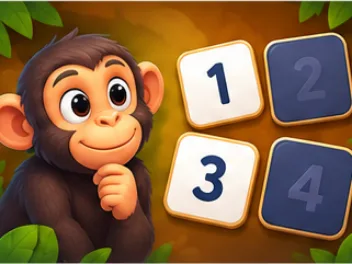
Memorize where the numbers are, then tap them in order from memory.
Ages 10 and up
Leaderboard
Loading leaderboard…
The chimp test comes down to one instruction: numbers appear on a grid, you remember where they are, then you tap them in order, from 1 to the last one, after they have been hidden. Every round you clear adds one more number, until the moment your memory lets go.
The test takes its name from a famous experiment in which a young chimpanzee outperformed university students on a task very much like this one. It runs right in your browser, with no download and no sign-up, on a computer as well as on a phone or tablet. A game lasts a few minutes, and at the end you find out how many numbers you can put back in place from memory. If you have been looking for a free chimp test online, or simply for a short, honest way to train your visual memory, this one is ready when you are.
How to play the chimp test
The playing field is a grid of eight columns and five rows, forty squares in all. On a tall phone screen, the grid stands upright and shows five columns and eight rows instead: the game is the same. At the start of each round, consecutive numbers, starting from 1, appear on squares picked at random.
The numbers stay on screen for as long as you have not tapped the 1. There is no rush: take the time to see where each number is. When you feel ready, tap the 1.
At that instant, all the other numbers are hidden. Their squares turn into plain white tiles, all identical, and nothing tells you anymore which one hides which number. You then have to tap the 2, then the 3, and so on up to the last one, from memory. When you have tapped the last number, the round is cleared and the next one begins with one more number.
You can play with a mouse, a finger or a keyboard. On a keyboard, the arrow keys move the selection around the grid, and the Enter key or the space bar taps the selected square. Home and End jump to the edges of the current line.
Rounds, levels and mistakes
The first round has four numbers, from 1 to 4. Each round you clear adds one to the next: five, then six, and so on up to forty at most, when the whole grid is taken. Every extra number is one more position to hold in your head, and the test quickly becomes demanding.
Tapping an empty square, one with no number on it, does nothing at all: no mistake, no penalty. The same goes for a square you have already tapped correctly. Once the 1 has been tapped, only the white tiles hide a number, and the rest of the grid is empty.
Tapping a numbered square that is not the right one counts as a mistake, also called a strike. The round stops right away, and the next one starts over with the same count of numbers, placed somewhere else on the grid. After three mistakes, the game is over and your result appears. A mistake never costs you a level: it only costs you one of your three tries.
How your score is calculated
Your result is the level you reached: the longest run of numbers you cleared in a single round. It is turned into a score like this:
- each number in the level you reached is worth 1,000 points;
- each second of play takes away one point, memorization time included;
- a game without a single cleared round does not make the leaderboard.
A player who reaches level 12 in 3 minutes and 20 seconds scores 12,000 − 200 = 11,800 points. Another, who stops at level 9 after 2 minutes, scores 9,000 − 120 = 8,880 points.
One more level is worth 1,000 points, which is more than sixteen minutes of play: the clock is only there to separate players who reach the same level. At level 12, finishing in 4 minutes rather than 3 minutes 20 gives you 11,760 points instead of 11,800.
In the game time, each tap counts for at least a little more than a tenth of a second, so nobody gains anything by tapping faster than a human can. If you switch tabs, the clock pauses until you come back.
Every score sent to the leaderboard is checked by the server. It rebuilds the position of every number from the same random draw as your game, replays each of your taps and works out the score itself, without trusting the one shown in your browser. A score that does not survive the replay is simply not recorded.
The leaderboard
The numbers land on different squares in every game.
The leaderboard keeps each player's best score of all time. When two scores are equal, the player who got there first stays ahead.
Eight tips to go further
Look over the whole grid before you tap the 1. Memorization time is up to you: run through the numbers in order once or twice. That time counts toward your total, but a second costs only one point, while a level is worth a thousand.
Split the sequence into groups. Remembering twelve separate positions is hard; remembering three groups of four is much easier. Memorize each group of three or four numbers as a single unit.
Memorize paths rather than squares. Link the numbers in order, as in a connect-the-dots puzzle: a line going down, a zigzag, a hook. A shape is easier to keep than a list of positions.
Spot the neighbors. The 5 right under the 4, the 8 touching the 7: those pairs are easy anchors. Save your attention for the jumps, where two consecutive numbers sit far apart.
Keep a steady pace. Once you have tapped the 1, keep going at a regular rhythm, a little under your top speed. Going too fast makes your hand slip; stopping halfway lets the memory fade.
Do not rush after a mistake. The next round gives you the same count of numbers on a new grid. Take a breath and give yourself the time to look at everything again.
Play somewhere quiet. What you hold in mind for a few seconds handles interruptions badly: a single notification can wipe out half the grid.
Mix it up with the other tests on the site. The Reaction Test measures how fast you answer a signal, and the Aim Trainer measures how fast and how accurately your hand reaches a target. Together with this memory test, the three complement each other well. You will find them all in the tests category.
The experiment behind the test
In 2007, two researchers from Kyoto University, Sana Inoue and Tetsuro Matsuzawa, published a study with young chimpanzees in the journal Current Biology. Numerals from 1 to 9 appeared, scattered across a screen, then were hidden, and the task was to touch their locations in order.
Among those young chimpanzees was Ayumu. In the version where the numerals stayed on screen for only a very brief moment, about a fifth of a second, Ayumu did better than the human students who were tested. The result traveled far and wide, and it is what gave this test its name.
Here, you choose how long you look at the grid. The challenge is not to capture positions in a flash, but to hold on to a longer and longer sequence. The game exercises your visual memory, the kind that reminds you where you left your keys, and your working memory, the kind that keeps a phone number in mind just long enough to dial it.
It is a game, not a medical or psychological assessment: your score depends on how you feel that day, on your focus and on how used you are to the exercise. Above all, it tells you how much you improve from one game to the next.
Frequently asked questions
Is the chimp test really free?
Yes, completely, with no download and no sign-up.
Do I need an account to appear on the leaderboard?
No. A nickname is enough, and you are asked for one the first time you submit a score.
How long do I get to memorize the numbers?
As long as you like: the numbers stay on screen until you tap the 1. That time costs one point per second, which is very little next to a level, worth a thousand.
How many mistakes am I allowed?
Two: the third one ends the game. Tapping a square with no number on it never counts as a mistake.
What is a good chimp test score?
At first, many players top out at around ten numbers, then improve with practice. The fairest comparison is still with yourself.
Does the test work on a phone?
Yes. You tap the squares with your finger, the grid turns upright on a tall screen, and the playing field keeps its size while the page loads so nothing shifts under your hand.
Are my scores kept if I switch devices?
Yes, if you set up your recovery key. Your player ID is stored in your browser, so clearing the site's data or moving to another machine starts you from scratch. On your profile page, you can create a recovery key, then enter your nickname and that key on your new device to get your nickname, your scores and your avatar back.
More tests
Tests- Click Speed Test
Click as fast as you can for ten seconds and measure your clicks per second. - Digit Memory
A number flashes, then disappears: type it back. One more digit every round. - Color Memory
Watch the sequence light up, then repeat it. One more color every round. - Aim Trainer
Hit 30 targets as fast as you can and measure your aiming speed and accuracy. - Reaction Test
Click as soon as the screen turns green: five tries to measure your reaction time. - Matching Pairs
Turn the cards over two at a time and find the twelve pairs in as few turns as you can.