Spider
Two suits, ten columns: build king-to-ace runs to clear them from the table.
Ages 10 and up
Leaderboard
Loading leaderboard…
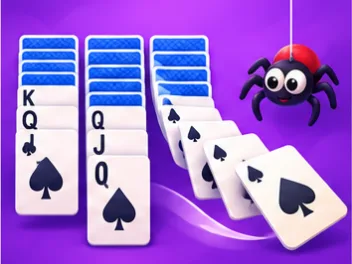
Spider is played with two decks shuffled together: 104 cards dealt into ten columns, most of them face down to start with. Your goal is to build eight complete runs, from king down to ace, each one in a single suit. As soon as a run is complete, it leaves the table; when the eighth one goes, you've won.
Spider became one of the world's favorite patience games when it started coming preinstalled on home computers in the late 1990s. Here, you play the two-suit version, spades and hearts, right in your browser, for free, on a computer, a tablet or a phone, with nothing to download and no account to create.
How to play Spider
Tap or click a card to pick it up. If the cards on top of it form a same-suit run with it, they come along. Then tap the column where you want them to go, or drag the whole group to its destination.
A double tap sends the card, or the run, to the best available spot. On a keyboard, the arrow keys choose a column, Enter picks the cards up and puts them down, and the D key deals from the stock.
The Undo button takes back your last move, but each undo counts as a move itself; Backspace or Ctrl+Z does the same. If the game is stuck, the Finish button ends it with two presses, and you keep the points for every run you have already completed.
The layout
The 104 cards make up eight complete sets, from ace to king: four in spades, which are black, and four in hearts, which are red. So every card exists in four copies: there are, for example, four kings of spades.
At the start, 54 cards are dealt into ten columns: six in each of the first four, five in the other six. Only the top card of each column is face up; the other 44 stay face down.
The remaining 50 cards form the stock. They come into play in rows of ten, whenever you decide.
Moving cards and building runs
Any face-up card can go on a card one rank higher, whatever its suit: a 7 of hearts goes on any 8. An empty column takes any card; it's also the only place a king can go.
To move several cards as one block, they have to form a descending run in the same suit. A 9, 8 and 7 of hearts stacked together travel together. If the 8 is a spade, the group breaks apart: the 7 of hearts can leave on its own, but the 8 of spades won't move until it is uncovered.
Putting a card on a different suit is allowed, but the pile becomes stiff: to get it moving again, you will have to take it apart card by card.
When a face-down card ends up at the top of a column, it turns itself over.
A complete run, from king to ace in the same suit, leaves the table automatically and counts as completed. You need eight to win. A run that mixes spades and hearts, even in perfect order, doesn't leave.
Dealing from the stock
One tap on the stock puts a face-up card on each of the ten columns. With 50 cards, the stock gives you five deals.
You can't deal while a column is empty. An empty column is valuable, but as long as it stays empty, the stock waits.
Every deal covers all ten columns at once, including your best runs. A run topped by a stray card can't move as a block until the intruder is gone.
How your score is calculated
Each completed run earns 1,000 points. If you complete all eight, a 2,000-point bonus is added. Then 2 points are taken off per move and 1 point per second, and the score never drops below zero.
Moves, deals and undos: everything counts as a move.
A game won in 180 moves and 15 minutes earns 8,000 + 2,000 − 360 − 900 = 8,740 points. A game stopped after three runs, in 120 moves and 10 minutes, earns 3,000 − 240 − 600 = 2,160 points.
So even a stuck game earns points: every completed run counts. One more run is worth as much as 500 moves, or 16 minutes and 40 seconds: it pays to take the time to finish one rather than play fast. A game that ends at 0 points doesn't go on the leaderboard.
The clock starts as soon as the deal appears and pauses while you are on another tab.
No score is taken at face value: the server rebuilds the deal and the stock from the same shuffle, replays every one of your actions and works out the score itself.
The leaderboard
Every game gives you a fresh deal.
The leaderboard keeps your best game. In case of a tie, whoever reached that score first stays ahead.
Eight tips to beat the spider
Aim for an empty column early. It's the biggest asset in Spider: it takes any card or run and works as a stopover to sort out a pile where spades and hearts are mixed. Put your effort into the column that is easiest to clear.
Turn over face-down cards first. Between two moves of equal value, pick the one that uncovers a card.
Build same-suit runs first. If two 8s could take your 7 of hearts, choose the 8 of hearts: the run stays mobile.
Only build on the other suit to free something. A 7 of spades on an 8 of hearts is allowed, but it locks the pile. Play it if it turns over a card or empties a column; otherwise, look for something better.
Save the kings for empty columns. A king can't go anywhere else, and a column that starts with a king can hold a whole run.
Don't deal too soon. Before you touch the stock, play the useful moves, gather your runs and fill the empty columns with whatever gets in the way least. Ten cards are about to land at once: make sure they land on a tidy table.
Don't bury a run that is almost complete. A run from the king down to the 3 of hearts is only waiting for the 2 and the ace. Avoid covering it: when those two cards show up, it should be able to leave right away.
Think before you undo. Each undo counts as a move and costs 2 points. Save it for real mistakes, not for second thoughts.
For more patience games, browse the card games category, or try Klondike Solitaire and FreeCell.
One, two or four suits
Spider comes in three versions. With one suit, all 104 cards are spades: every descending run is also a same-suit run, and the game forgives a lot. With four suits, spades, hearts, diamonds and clubs each appear in two sets, and clean runs become rare.
The two-suit version, the one on this site, keeps the real dilemma of Spider, choosing between the easy move and the clean move, without making it discouraging.
Frequently asked questions
Do I have to pay or sign up to play?
No. Spider is free, with no download and no sign-up: the game starts right on this page.
Do I need an account to be on the leaderboard?
No. You are asked for a nickname the first time you save a score; your player ID is then kept in your browser. To keep the same player on another device, create a recovery key on your profile page.
Why can't I deal?
Because at least one column is empty: put a card in it, then tap the stock again. If the stock is gone, all five deals have already been played.
Why won't this group of cards move?
A group only moves as a block if it forms a descending run in the same suit. If a spade has slipped in among the hearts, only the part sitting on top of it can leave.
Can every game be won?
No. Some deals can't be solved, however good you are: one face-down card in the wrong place is enough to block everything.
Does a stuck game still earn points?
Yes: 1,000 points per completed run, minus moves and time. End it with the Finish button, with two presses.
Can I play Spider on my phone?
Yes, just like on a computer or a tablet. Tap a card and then its destination, drag it, or tap it twice to send it to the best spot.
More card games
Cards- Pyramid Patience
Remove pairs of cards that add up to 13 to take the pyramid apart. - Belgian Solo Whist
Belgian four-player whist: propose trumps, team up, go solo or misère against three computer players. - Klondike Solitaire
The classic solitaire: seven columns, a stock, four foundations to build from ace to king. - Belote
Classic four-player belote: take the turn-up, trump, count your points and take your side to 501. - Couyon
The Ardennes four-player trick game: take the trump, win the points and rub out your five chalk lines. - Go Fish
The head-to-head pairs game: ask for a rank, listen to what you are asked, and lay more pairs than your opponent. - Oh Hell
The up-and-down trick-taking game: bid your exact number of tricks, from three players to eight. - Hearts
Trick-taking in reverse: dodge the hearts, duck the queen of spades, and finish on the lowest total.