French Tarot
Seventy-eight cards, twenty-one trumps and the excuse: take the dog and make your contract, alone against three.
Ages 14 and up
Leaderboard
Loading leaderboard…
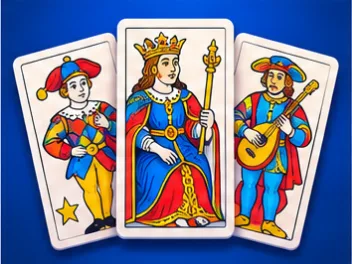
French Tarot is the great card game of France. Not fortune-telling tarot, with its arcana and readings: the trick-taking game played around family tables and in card clubs, with a pack of seventy-eight cards and a rule that fits in one sentence. One player announces what they are going to do, and the other three team up against them.
What sets tarot apart from every other trick-taking game is its fifth suit. On top of the four ordinary suits, with fourteen cards each, come twenty-one numbered trumps, plus the Excuse. Trumps beat everything, and their order doesn't depend on any convention: the 21 beats the 20, which beats the 19, all the way down to the petit, trump number one. The Excuse never wins a trick, and it can only be captured on the last one.
Three cards are worth more than all the others: the petit, the 21 and the Excuse. They are called the oudlers (bouts in French), and they do more than score points. They lower the contract: with three oudlers at the end of the hand, you only need thirty-six points to succeed; with none, you need fifty-six. That's the whole tension of the game. Bidding with two oudlers is comfortable; bidding with none is a gamble.
Here, you sit down at a full table right away. Three computer players fill the other seats: they size up their hands to bid, discard what gets in their way, pull trumps when they take, and band together against the taker when it isn't them. There is nothing to install and no account to open. The table fits your screen, and you can play with a mouse, a finger or entirely with the keyboard.
How to play French Tarot
Each player gets eighteen cards, and six cards form the dog (the chien), placed in the middle of the table. The cards are dealt in packets of three, and one card goes to the dog after each round of packets.
Then comes the bidding, and it only goes around once. Each player, starting with the dealer's right-hand neighbor, makes a bid or passes. There are four bids, from the most modest to the heaviest:
- Small (petite). You take the dog: it is shown to the whole table, you add it to your hand, and you set aside six cards that will count toward your points.
- Guard (garde). Exactly the same thing, but everything you win or lose is doubled.
- Guard without the dog (garde sans). The dog isn't shown and goes straight into your points, without you ever seeing it. Everything counts four times.
- Guard against the dog (garde contre). The dog goes to your opponents. Everything counts six times.
Each bid has to be higher than the one before. The highest bidder, the taker, plays alone against the other three. If all four players pass, the cards are gathered and dealt again.
The discard follows two bans: no king and no oudler can go in it. No trumps either, unless the other cards aren't enough to make six; a hand full of kings and trumps can be forced to.
The play itself has eighteen tricks. You must follow the suit that was led. If you can't, you must trump, and if a trump has already been played, you must play a higher one if you can. When you have neither the suit nor a trump, you can discard anything. The Excuse escapes all of this: it can be played at any moment, it never wins the trick, and, except on the last trick, it goes back to the side of the player who played it, who gives a low card in exchange to the side that wins the trick.
Counting the points
Cards are counted in half points, which always surprises newcomers. A king is worth four and a half points, a queen three and a half, a knight two and a half, a jack one and a half. All the others, the cards from one to ten in each suit and the ordinary trumps, are worth half a point. The three oudlers are worth four and a half points each, like kings. The whole pack adds up to ninety-one points.
The taker counts the cards in their tricks, discard included, and compares the total with the contract:
- no oudler: fifty-six points;
- one oudler: fifty-one;
- two oudlers: forty-one;
- three oudlers: thirty-six.
If the taker makes the contract, each of the three opponents pays them twenty-five points, plus one point for every point between what they made and what they needed, all multiplied by the bid. Landing exactly on the contract counts as made, with a margin of zero: twenty-five points, nothing more. If the taker goes down, they pay the same amount to each opponent. So a contract made by twelve points on a Guard earns twenty-five plus twelve, times two: seventy-four points from each of the three opponents, two hundred twenty-two in all.
That leaves the half point. The taker's total often ends in a half, and the official rules of the French Tarot Federation always give it to the winning side. With two oudlers, forty-one and a half is a contract made by one point: the taker takes the half point and counts forty-two. Forty and a half is a contract down by one point: the defense takes the half point, and the taker stays at forty. On a Small, that one point is worth twenty-six points per opponent, either way.
Two bonuses can be added. Petit au bout: if the petit is captured in the last trick, the side that takes that trick earns ten points multiplied by the bid, and that bonus keeps its own sign even when the contract fails. Slam: a side that wins all eighteen tricks earns two hundred points more.
A game has four hands, one full turn around the table: everyone deals once.
Your score and the leaderboard
Your leaderboard score is one thousand plus your total over the four hands. A game where you took twice and made your contracts can carry you toward fifteen hundred, and past two thousand with a Guard without or against the dog; a failed Guard without the dog can wipe out most of your thousand, and the score never goes below zero.
A game only counts once all four hands have been played. The server replays your whole game from your decisions alone, your bids, your discard and your cards, and works out everything else again: the other three hands, the dog, their bids, every one of their tricks. The points shown on screen are only a preview; the replay is what counts.
This version plays four-player tarot in its basic form. Handfuls (poignées), announced slams and misère hands aren't included; neither is calling a king, which belongs to the five-player game.
A few tips
Count your oudlers before your points. One more oudler means five to ten fewer points to make. An average hand with the 21 and the Excuse is better than a brilliant hand with no oudler at all. And the 21 can never be lost: nothing beats it.
The petit is a poisoned gift. It counts as an oudler, so it lowers your contract by five or ten points, but it is also the weakest trump in the pack, and you will lose it on the first round of trumps if you don't protect it. Keeping it takes length in trumps: five or six trumps to go with it, or it will fall.
Bid on length, not on honors. Alone against three, trumps are what win tricks. Eight trumps with an oudler are worth a bid; four kings with three trumps are not. Pulling trumps is the first thing a taker does: it empties the opponents' hands so the kings can get through later.
Discard by suit, not by points. Discarding a queen costs three and a half points, but ending up with a void suit lets you trump every time it is led. A void is often worth more than a queen you kept.
On defense, feed points to your side. When one of the other two defenders is winning the trick, load it up: play your king, your queen, your knight. Those points escape the taker, and that's exactly what you want. Never take a trick your own side is already winning.
Watch the Excuse. It is worth four and a half points and counts as an oudler, but it never wins a trick. Keep it for the moment you would otherwise have to trump against your will, or to avoid giving up a king on a big trick for the other side.
For other trick-taking games from Europe, try Belote or Coinche, or browse all the card games.
Frequently asked questions
Do I need an account to play? No. The game starts with one click, with no sign-up and nothing to install. Only sending a score to the leaderboard asks for a nickname.
How long does a game take? Four hands of eighteen tricks, about twenty minutes. It's one of the longest games on the site: tarot isn't played in five minutes.
Is this fortune-telling tarot? No. It's the card game, with its four suits, its twenty-one numbered trumps and its Excuse. It has nothing to do with card reading, despite the shared name.
Why half points? Because the cards are traditionally counted in pairs: one high card with one low card. A king and a low card make five points, a knight and a low card make three. The table holds ninety-one points, and there you go.
Can the Excuse win a trick? No, never. It can be played whenever you like, it lets you off following suit and trumping, and, except on the last trick, it goes back to the side of the player who played it, in exchange for a low card given to the side that wins the trick.
What happens if everyone passes? The cards are gathered and a new hand is dealt by the next dealer. The canceled hand doesn't count among the game's four.
Can I play handfuls and announced slams? No. This version sticks to the basic game: four bids, the discard, petit au bout and the unannounced slam. Handful announcements aren't included.
Do the computer players cheat? No. Each computer player only sees its own hand, the bids already made, the dog if it was shown, and the cards that have been played. It knows neither your hand nor anyone else's.
More card games
Cards- Tri Peaks Solitaire
Clear cards one rank above or below the discard pile, in long streaks, until all three peaks are gone. Solo, or racing other players. - President
Be the first to get rid of your cards, in pairs and three of a kind, against three players: five deals to finish President, not Beggar. - Nain Jaune – Yellow Dwarf
A classic French family card game: build runs from ace to king, collect the tokens on the board and empty your hand first. - Rikken
Dutch bidding whist for four: bid rik, troela, misère or piek, call an ace to find your partner, and set your own house rules. - FreeCell
Every card is face up: build the four suits from ace to king with four free cells. - Spider
Two suits, ten columns: build king-to-ace runs to clear them from the table. - Pyramid Patience
Remove pairs of cards that add up to 13 to take the pyramid apart. - Belgian Solo Whist
Belgian four-player whist: propose trumps, team up, go solo or misère against three computer players.