Nain Jaune: Rules and Online Play
A classic French family card game: build runs from ace to king, collect the tokens on the board and empty your hand first.
Ages 6 and up
Get it on Google Play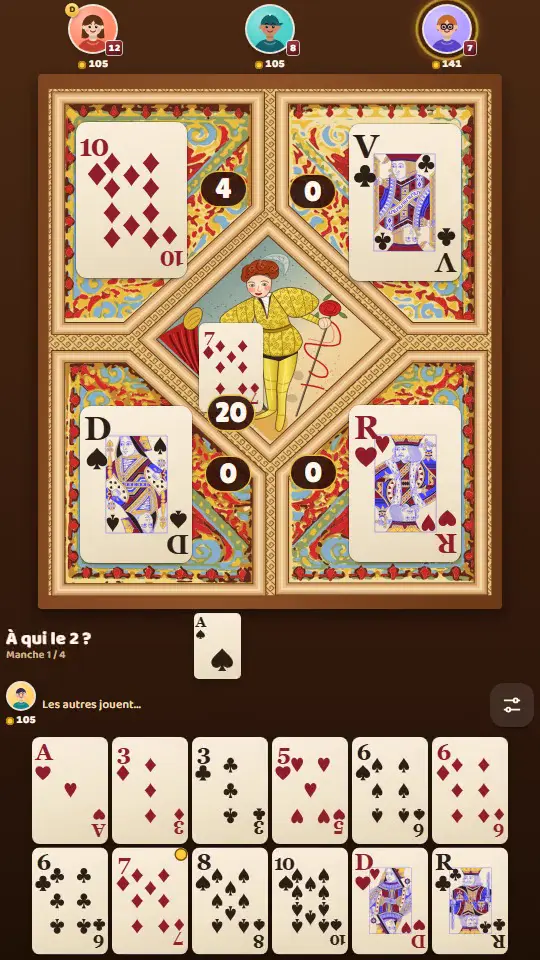
Leaderboard
Loading leaderboard…
Nain Jaune, French for "Yellow Dwarf," is a classic French family card game, known since 1760, and still barely known outside France. At home it comes in a box: a board with five spaces, a handful of tokens, a deck of cards, and everyone around the table. Here you can play it right away with nothing to set out, nothing to install and no account to open. The table opens in your browser, on a phone or a computer, and the tokens count themselves.
You can learn the rules in about a minute. You play your cards in order, from ace to king, without worrying about suits. Whoever empties their hand first receives tokens from everyone else for the cards they still hold. And five particular cards are worth more than the rest: play one and you scoop up the tokens in its space on the board. So there are really two games in one, a race to go out and a hunt for the spaces, and you are always weighing one against the other.
You play with three to eight players, four by default, and computer players fill every other seat. There is nobody to wait for, and they only see their own hand and the cards on the table, just like you. A round takes two to three minutes. A short game, four rounds with four players, takes about ten minutes.
Nain Jaune rules: how to play
The game uses a 52-card deck, ranked from the ace, which counts as 1, up to the king: ace, 2, 3 and so on up to 10, then jack, queen, king. Every player starts with 120 tokens. At the start of each round, everyone places 15 tokens on the board and the cards are dealt. A few cards stay out of play in a face-down stock that nobody uses and nobody ever sees.
Play goes clockwise, and the player to the dealer's left starts. Here is how a round goes:
- The first player opens. They play any card they like and call out its rank. Opening is never optional: you have to play at least one card.
- They keep going as long as they can. After a 5 they can play a 6, then a 7, in any suit.
- They stop when they can't or don't want to go on. After a 7, they call "no eight," and the next player can pick up the run with an 8, and so on around the table.
- If nobody can continue, whoever played the last card starts a new run with any card they choose.
- A king always ends the run. Whoever played it immediately plays again, with any card they choose, if they have cards left.
On screen, your opponents sit at the top with their card counts and tokens. The board takes up the middle, and the current run fans out right below it, showing the rank everyone is waiting for. Your hand is at the bottom, sorted by rank, with playable cards highlighted and the rest grayed out. The stop button lets you break off your run even when you are holding the next card. That is your right, and it is often a smart move. When your turn comes as a run resumes, you either play the rank it needs if you have it or pass; if you don't have it, the game moves on without asking you anything.
Before your first decision, you set up your game: the number of players, the length, the bête rule and how fast your opponents play, slow, normal or fast. A short game is 4 rounds, a normal game is 8, and a long game keeps going until someone runs low on tokens, with a ceiling of 30 rounds.
The board and its spaces
The board has five spaces: four in the corners and the yellow dwarf in the middle. Each space belongs to one exact card, and every player places the same number of tokens on it each round:
- 10 of diamonds: 1 token
- Jack of clubs: 2 tokens
- Queen of spades: 3 tokens
- King of hearts: 4 tokens
- 7 of diamonds, the yellow dwarf, in the center: 5 tokens
Playing one of these cards automatically scoops up every token in its space. The tokens slide from the board over to you, and the game announces the win. This is the one place suits matter, and only for these five exact cards: a 7 of hearts wins nothing.
Tokens that nobody wins stay in their space and carry over to the next round. A board card can easily sit in the stock, or in the hand of a player who never gets the chance to play it. The pile of tokens then grows round after round and shows up bigger and bigger on screen, so it is hard to miss. With four players, the yellow dwarf already takes in 20 tokens a round, out of the 60 placed in all.
End of the round and the grand opéra
The round ends as soon as one player has played all their cards. If that last card is a board card, they collect its space first. Then every other player gives them tokens for the value of the cards they have left: 1 for an ace, face value for 2 through 10, and 10 for a jack, queen or king. Nobody ever gives more than they have, so tokens never drop below zero.
The bête rule, on by default and easy to turn off, is a penalty for anyone caught holding a board card. A player who still has one in hand when the round ends also adds to that space as many tokens as it already holds. So the pile doubles, up to what the player has, and waits for the next round.
The grand opéra ("grand opera") is the game's rare showpiece. You have to empty your whole hand in one go, on your very first turn, before any other player has played a single card that round. Kings help, since each one lets you play again, but a whole hand running out in one stretch stays a real exception. The winner then takes the entire board on top of what the others give, including whatever the bête just added to it. The whole board empties toward them.
The next dealer is the player to the right of the last one, and a new round begins. The game ends when a player can no longer place 15 tokens, or after the number of rounds you chose. Whoever has the most tokens wins. The final table shows everyone's tokens, the biggest take and the number of grand opéras, with buttons to play again and share your score.
Score and leaderboard
Your leaderboard score starts at 1,000 points and gains 10 points for each token you are ahead of the table's average. It drops by the same amount for each token behind, and never goes below zero. Finish with 150 tokens at a table averaging 110, and you score 1,400 points. Measuring against the average lets tables of different sizes be compared, and your time doesn't count, so take as long as you need to think.
Any game played through to its end counts, even if you don't finish on top. The server replays the entire game from your decisions before accepting a score: the computer players and the cards are worked out again exactly the same way, and that replay is what counts.
You pick your table and your length, and you can start over as many times as you like.
Tips to win at Nain Jaune
Open with the card that starts your longest run. It is the basic habit: if you hold 4, 5, 6, 7, starting with the 4 gets rid of four cards at once and gives the others nothing. Look above all for a run that passes through a board card you hold, since you play it on the way and collect its space with no risk.
Dump your face cards as soon as an opponent is down to two cards. Each one will cost you 10 tokens if they go out, while an ace costs you just one. At that point, playing a jack or a queen beats a long run of small cards.
Keep a blocking card. If the table is waiting for a 9 and you have it, nothing forces you to play it. As long as nobody else has one, the run stops there, and an opponent's jack of clubs or queen of spades won't come out that way. Just weigh what you are protecting against what you are risking: any card you keep costs you tokens if someone else goes out.
With the bête rule on, don't sit on your board cards. A queen of spades still in your hand when the round ends costs you as much as the pile on its space, and the bigger the pile, the riskier the wait. Check the spaces before you open, too: avoiding an opening just below a board card you don't hold means not handing a big space to the next player.
If you are after other classics, Oh Hell has you bid your exact number of tricks, Hearts has you dodge the queen of spades, and Belote is waiting for four players. You will find the rest under card games.
Frequently asked questions
Which cards are on the board? There are five: the 10 of diamonds, the jack of clubs, the queen of spades, the king of hearts and the 7 of diamonds, which is the yellow dwarf, in the center. Each player places 1, 2, 3, 4 and 5 tokens on them every round, for 15 tokens in all.
What is the grand opéra? It is the rare big play of Nain Jaune: a player empties their whole hand in one go, on their first turn, before anyone else has played a card that round. They then take the entire board, on top of what their opponents give.
How many cards does each player get? It depends on the table, and the rest make up the stock:
- 3 players: 15 cards, stock of 7
- 4 players: 12 cards, stock of 4
- 5 players: 9 cards, stock of 7
- 6 players: 8 cards, stock of 4
- 7 players: 7 cards, stock of 3
- 8 players: 6 cards, stock of 4
Do suits matter? Not for runs: only the ranks follow on, and an 8 of any suit continues after a 7. Suits matter only for the five board cards: just the 7 of diamonds takes the yellow dwarf's space.
How long does a game take? A round takes two to three minutes. The short game, at four rounds, takes about ten minutes with four players. The normal game has eight rounds, and a long game continues until a player can no longer place their tokens, for thirty rounds at most.
Can I stop even when I have the next card? Yes, once you have played at least one card of your opening: that is what the stop button is for. Opening is still required, and after a king you must play again if you have cards left.
What is the bête rule, and can I turn it off? A player holding a board card when the round ends adds to its space as many tokens as it holds, on top of what they owe the winner. It is on by default, and you can turn it off in the settings.
What happens if I run low on tokens? You never give more than you have, so your tokens stop at zero. Before each round, if any player has fewer than 15 tokens, the game ends with no new round, and the ranking is based on everyone's tokens at that moment.
Music in our videos: Jean-Philippe Rameau, Musette from the Suite in E, harpsichord by Richard D Siegel, under CC BY-SA 4.0, on Wikimedia Commons.
More card games
Cards- Rikken
Dutch bidding whist for four: bid rik, troela, misère or piek, call an ace to find your partner, and set your own house rules. - FreeCell
Every card is face up: build the four suits from ace to king with four free cells. - Spider
Two suits, ten columns: build king-to-ace runs to clear them from the table. - Pyramid Patience
Remove pairs of cards that add up to 13 to take the pyramid apart. - Belgian Solo Whist
Belgian four-player whist: propose trumps, team up, go solo or misère against three computer players. - Klondike Solitaire
The classic solitaire: seven columns, a stock, four foundations to build from ace to king. - Belote
Classic four-player belote: take the turn-up, trump, count your points and take your side to 501. - Couyon
The Ardennes four-player trick game: take the trump, win the points and rub out your five chalk lines.