The Solar System
Order the planets and moons by distance or by size. Three levels, 30 bodies.
Ages 10 and up
Leaderboard
Loading leaderboard…
Everyone knows that Jupiter is the biggest planet. Far fewer people know that Ganymede, one of Jupiter's moons, is bigger than Mercury, and that Titan is too. Hardly anyone can tell you whether Venus is bigger or smaller than Earth, or what fits between Enceladus and Ceres. That is exactly what this game trains: not reciting numbers, but placing bodies in relation to one another.
You get one body at a time, a planet, a moon, a dwarf planet or an asteroid, and you slide it into the right spot in a lineup that keeps growing. The first body is given to you. The second goes before or after it. The fourteenth has fourteen possible spots. So the game gets harder all by itself, without the rules ever changing.
And as the lineup fills up, every body you place is drawn at its true relative size, on a logarithmic scale. The ranking stops being a list and turns into a picture. When Phobos, 22 kilometers across, sits at the top of a lineup that ends with the Sun, the gap in scale between the two suddenly makes sense.
It is a free solar system game that runs in your browser, on a phone, a tablet or a computer, with nothing to install and no account to create.
How to play
The lineup runs from top to bottom. Depending on the level, it goes from nearest the Sun to farthest, or from smallest to largest. Every body already placed shows its drawing, its name and its value: the distance in millions of kilometers, or the diameter in kilometers.
At the top of the screen sits the body to place: its drawing, its name, and what it is. "Moon of Jupiter," "Dwarf planet," "Asteroid." The drawing of the card in your hand always stays the same size: on the size scale, its size would give the answer away.
A cursor marks the spot you are aiming for. There are two ways to place the body:
- With your finger or a mouse. Drag the card down into the lineup: the lineup opens where you are aiming, and the body drops there when you let go. You can also simply tap the lineup at the spot you want.
- With a keyboard. The up and down arrow keys move the cursor one spot, Home and End send it to either end, and Page Up and Page Down jump three spots at a time. Enter or the space bar places the body.
A body placed in the wrong spot still moves to its true place, with a red cross, and its value is shown. You lose that body's points, not the accuracy of the lineup: you always reason about the next ones from a correct ranking.
The three levels
You choose the level before the first body, and it holds until the end. It sets two things: which scale you order by, and which pool the bodies are drawn from.
- Beginner: eight bodies orbiting the Sun, from nearest to farthest. Seven planets and one odd one out, a dwarf planet or a large asteroid. This is the level that teaches the order of the planets, and it never plays the same way twice. 60% of the points.
- Seasoned: twelve bodies from smallest to largest. Eight are drawn from the planets, the Moon and the Sun, and four from the great moons of the solar system and the best-known dwarf planets. This is where you find out that Ganymede beats Mercury, that Titan does too, and that Venus is slightly smaller than Earth. 80% of the points.
- Expert: fourteen bodies by size, drawn from all 30 in the catalog: icy moons, dwarf planets, asteroids. Enceladus, Mimas, Charon, Iapetus, Dione, Tethys, Vesta, Phobos. 100% of the points.
An easier level isn't worth less as a game; it is worth fewer points. All three levels share one leaderboard, and the percentage is there so that a perfect Beginner game doesn't rank above a well-played Expert one.
The pairs the game never puts together
Every body in the data carries, on top of its value, a margin: how far apart two bodies have to be before a person can honestly tell which one is bigger. Two bodies whose margins overlap are never drawn in the same game.
That rules out seven pairs, all of them by size. Here are four of them:
- Pluto and Eris: 2,377 versus 2,326 kilometers, and the uncertainty on Eris is larger than the gap. For years, Eris was thought to be the bigger one; it took a star passing behind it to settle the question.
- Haumea and Makemake: two distant dwarf planets whose sizes nobody knows to within a hundred kilometers.
- Haumea and Rhea: Haumea isn't even round. It spins so fast that it is stretched out like a football, and its "diameter" is an average. For the same reason, Haumea and Makemake never meet Iapetus either, and Makemake never meets Rhea.
- Enceladus and Vesta: 504 versus 525 kilometers. A 21-kilometer gap between a moon of Saturn and an asteroid would make the question a coin toss, not a matter of knowledge.
On the other hand, Ganymede and Titan are allowed to face off: 5,268 versus 5,150 kilometers, a gap of 118 kilometers, but both are measured to within a few kilometers, and which of the two is the largest moon in the solar system is a fact worth learning. It's a real question, not a lucky guess.
Your score and the leaderboard
Each body you place earns up to 600 points, and the points drop in steps depending on how far you are from its true spot:
- in the right spot: 600 points;
- one spot off: 400;
- two spots off: 200;
- three spots or more: nothing for that body.
From that total, the game takes away one point every two seconds. Time matters very little: this is a game for thinking. The total is then multiplied by the level's percentage, rounded down. The maximum is 2,520 points on Beginner, 5,280 on Seasoned and 7,800 on Expert.
Your score is never taken on trust. The server receives the list of your placements, replays the game from its seed and works out the total on its own. An abandoned game isn't ranked.
At the end, the full lineup is shown, with each body's value, what it is, what it orbits, and how long it takes to go around once: the number the ranking didn't ask for, and the one that sticks once you have read it. Mimas goes around Saturn in less than a day; Eris takes 558 years to go around the Sun. The panel doesn't close by itself: you close it with the "See my score" button, and that sends your score.
Why Pluto is no longer a planet
In August 2006, the International Astronomical Union set three conditions for being a planet: orbit the Sun, be massive enough for its own gravity to pull it into a round shape, and have cleared the neighborhood around its orbit. Pluto meets the first two but not the third: it shares its neighborhood with thousands of objects in the Kuiper belt.
What forced the decision wasn't Pluto, it was Eris, discovered in 2005 and measured at about the same size. A choice had to be made: either Eris became the tenth planet, with others to follow, or the definition got stricter. The second option won, and Pluto, Eris, Ceres, Haumea and Makemake became dwarf planets. All five are in this game, and the end-of-game summary says so every time.
Scale, and why no picture can show it
The drawings in this game are to scale relative to one another, but only for size, and on a logarithmic scale. Otherwise, you couldn't see a thing: the Sun is sixty-three thousand times the diameter of Phobos.
A comparison works better than a picture. If the Sun were a ball one meter across, about three feet:
- Mercury would be a pinhead 3.5 mm wide, 42 meters away;
- Earth a pea 9 mm wide, 107 meters away, about the length of a football field;
- Jupiter an orange 10 cm wide, 560 meters away;
- Neptune a walnut 3.5 cm wide, 3.2 kilometers away, about two miles.
That is why no poster of the solar system is ever to scale: with planets drawn at that size, you would need a sheet several kilometers long.
A few tips
Remember the order of the planets with a sentence. "My Very Educated Mother Just Served Us Nachos" gives you Mercury, Venus, Earth, Mars, Jupiter, Saturn, Uranus, Neptune. You can play Beginner almost with your eyes closed, except that the eighth body isn't a planet.
The first four are rocky, the next four are giants. Apart from the Sun, any body over 40,000 kilometers wide has to be Uranus, Neptune, Saturn or Jupiter. Below 13,000, you are in rocky territory.
The great moons line up around Mercury. Ganymede and Titan are bigger, Callisto comes just below, then Io, then the Moon, then Europa. Seven bodies between 3,000 and 5,300 kilometers, Mercury included: that is the heart of the Seasoned level.
Below 1,500 kilometers, the landmarks disappear. Charon, Iapetus, Dione, Ceres: you have to have seen them once. That is exactly what the end-of-game summary is for.
The Expert level mixes scales on purpose. One game can hold Phobos (22 km) and the Sun (1,392,700 km) in the same lineup. Don't look for precision: look for the family. Pebble, moon, planet, giant, star.
If you enjoy this kind of puzzle, put history in order with Inventions in Order, or browse all the educational games.
Frequently asked questions
Do I need to know the numbers by heart? No. You need to know how to put things in order, which is a different skill. The Beginner level can be played with nothing but the order of the planets.
What age is it for? The Beginner level suits kids from eight or nine: eight bodies, the order of the planets, drawings that are easy to recognize. The Expert level calls for a real taste for astronomy.
Where do the values come from? From the fact sheets published by space agencies, checked in September 2026. Equatorial diameters, or average ones for irregular bodies, average distances from the Sun, and orbital periods.
Why does the game never ask how many moons a planet has? Because that number keeps changing. Saturn had 83 known moons in 2022, 145 in 2023, and more than 270 since 2025. A question based on a count would be wrong before it was ever used. The game sticks to what doesn't change.
Why is the Moon ranked with the planets? Because the ranking is about size, not status. The Moon is 3,475 kilometers across: it fits between Europa and Io, and that is a useful fact to know.
Does time matter? Not much. One point every two seconds, when a body is worth six hundred. Take the time to think.
What if I get it completely wrong? The body still moves to its place, with a red cross, and you score nothing for it. You can't lose: you can only score low.
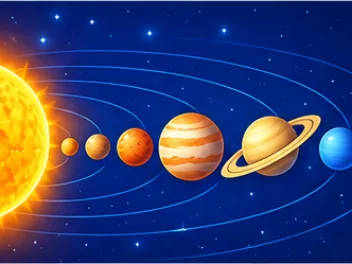
Are the pictures photographs? No, they are drawings, made by hand and kept simple on purpose. Each one keeps what makes its body recognizable: Jupiter's bands and its red spot, Saturn's rings, the two faces of Iapetus, the big crater on Mimas, Pluto's heart, Haumea's stretched shape. A spacecraft photo would weigh hundreds of kilobytes for a disk forty pixels wide.
More educational games
Educational games- Human Body Organs
An organ is named, click the right spot on the plate. Ten organs, two levels. - Code the Robot
Line up the instructions, run the robot and collect every star. Twenty-four levels, loops included, to learn how to code. - Game of Nim
Take turns picking up sticks, and don't let the fox take the last one. Twelve levels to learn the strategy that wins. - Multiplication Tables
Feed a hungry monster: tap the fruit with the right answer, and watch it grow. - World Map Quiz
A country is named, you tap it on the map. 162 countries, every continent, ten levels with stars to earn. - Tower of Hanoi
Move the tower disk by disk, never putting a big one on a small one. Ten levels, up to twelve disks and four pegs. - Plant Cell and Photosynthesis
Spot the organelles on a real textbook diagram, then switch on photosynthesis and watch the leaf come to life. - Wolf, Goat and Cabbage
The wolf eats the goat, the goat eats the cabbage: get everyone across. Twelve puzzles, and fails that make you laugh.
