Belgian Solo Whist Online
Belgian four-player whist: propose trumps, team up, go solo or misère against three computer players.
Ages 14 and up
Get it on Google Play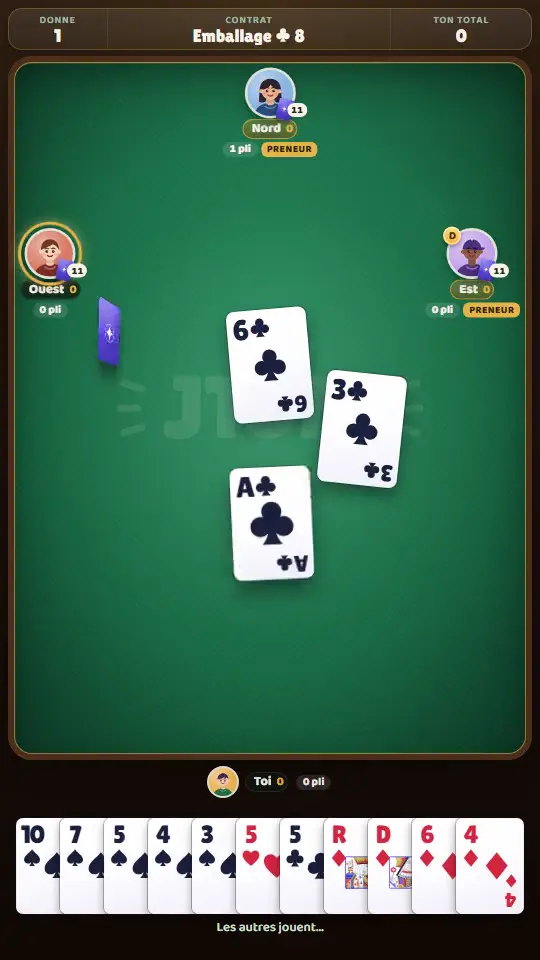
Leaderboard
Loading leaderboard…
Belgian Solo Whist, or color whist, is the great card game of Belgian cafés and kitchens, known in Flemish as kleurenwiezen. It is played by four, each player for themselves, and yet you team up on every hand: two players join forces for the length of a contract, then go back to being opponents on the next hand. The whole subtlety of the game lies in the moment when you bid, when you accept a proposal, and when you dare to play alone.
Here, you sit down at a full table without waiting for anyone: three computer players, West, North and East, take the other seats. You can also invite your friends and play the table with them, each on their own screen. There is nothing to install and no account to open: the table appears in your browser, on a computer as well as on a phone. A game lasts up to 40 hands, and you can stop whenever you like. If you know solo whist, you will recognize the family at once: proposals and acceptances, solo, abundance, misère and grand slam are all here.
Belgian Solo Whist rules: how to play
The game uses a standard 52-card deck. Each player receives thirteen cards, dealt in packets of four, four, then five. The deal passes to the next player after each hand played, and a small badge shows the dealer at the table.
A hand unfolds in two stages. First comes the bidding, which starts with the player on the dealer's left and goes around the table until a contract is set: who plays, with which trump suit and for how many tricks. Then comes the card play itself, over thirteen tricks.
During the bidding, a panel shows you the bids you are allowed to make, along with the number of tricks each one commits you to win. The rarer bids, abundance, the misères, piccolo and the slams, are behind the "More bids" button. To play a card, tap it in your hand: the cards you can play lift up, and the others stay dimmed. On a keyboard, the arrow keys move through your hand and Enter plays the selected card.
With or without tips
At the start of each game, you choose to play with tips or with no help, and the game remembers your choice for next time. Either way there is a single level: West, North and East play as experts, counting the cards that have fallen and working out their moves. Only what the game tells you changes.
With tips, a "Tip" bubble appears whenever you have a choice between several cards, and the suggested card rises in your hand. The bubble also says why, in one short sentence: "You're the declarer: draw trumps while the defenders may still hold some," "North, your partner this hand, is winning this trick: follow low," "You're out of clubs: trump it," or, against a misère, "West is winning this trick: play under their card." In this game your partner changes with every hand, so the tip talks about your partner this hand, the player whose proposal you accepted or who accepted yours, or about the player defending with you. During the bidding, the suggested button is ringed in gold and takes the focus, with its reason: propose your long suit, accept, say "I'll wait," pass, try a solo or a misère. The discard of a small misère is suggested the same way.
The tip does not cheat. It comes from the same calculation as the computer players, applied to your seat and to what you alone know: your hand, the bids and the cards already played. To choose a card, it imagines several possible layouts of the hidden cards and plays out the rest of the hand with each of your cards. The reason shown only states what is true at that moment; it never promises that the trick will be won. You stay free to play something else, and screen readers announce the tip along with your playable cards.
With no help, you face the three robots on your own, and a win without help weighs heavily on the leaderboard: any game you finish in the plus without tips earns a 200-point bonus, as much as twenty-five eight-trick proposals made. With tips, the bonus does not apply.
The bidding
Proposing and accepting
The most common contract is played by two. A player proposes a trump suit, hearts for example: they announce that they want to win at least eight tricks with a partner, with hearts as trumps. Another player can then accept, which means agreeing to play with them. You must hold at least one card of a suit to propose it or to accept it.
If nobody accepts before the proposer's turn comes around again, the proposal lapses. Its author then has several choices. They can keep their suit one last time: if nobody accepts it again, it is as if they had passed, and they say nothing more for the rest of the hand. They can play alone, in the suit of their choice, or bid a higher contract. Or they can accept another player, but only in a suit higher than their own: a player who proposed diamonds may accept hearts, but not clubs or spades. You only propose one suit per hand.
Once the team is formed, the player who accepted always speaks for it. If another bid outranks theirs, they can raise to nine tricks, then ten, and all the way up to thirteen.
I'll wait
The first player to speak, seated on the dealer's left, may say "I'll wait" on their first turn, and only then. They propose nothing and let the others bid. When their turn comes back, they can only accept a proposed suit or pass: no proposing, no playing alone, no other contract. If nobody has proposed anything in the meantime, all that is left is to pass. It is the bid of a hand that would happily accept, but has no suit long enough to propose.
Solo
Playing alone with a trump suit is a solo: five tricks at least, and the bid can go up to eight. It opens up for a player whose proposal found no partner, and that player then picks any trump suit, not necessarily the one they proposed. It also opens up when nobody else at the table can still accept. Finally, if the player who speaks for a team passes on a higher bid, their partner may play alone too, also in the suit of their choice.
Abundance and slams
Abundance commits you to winning nine tricks alone, with the trump suit of your choice; it can go up to eleven. The small slam asks for twelve tricks, the grand slam for all thirteen. For a slam, you choose a trump suit or play it with no trump; at the same level, a slam with trumps outranks the same slam with no trump. An abundance for eleven that has to go higher becomes a small slam in its suit. These bids can only be made on your first turn to speak, and the player who wins the auction with one of them leads the first trick.
With no trump, the trick always goes to the highest card of the suit led. A single suit where an opponent holds a card higher than yours can be enough to sink a slam.
The misères
In a misère, there are no trumps and the goal is turned upside down: you must win no tricks at all. Small misère lets you set one card aside before play: each of the four players discards one card, and the hand is played over twelve tricks. Grand misère is played with all your cards. In open misère, the first trick is played with hidden cards; then, before the second, the player's hand is laid face up, and the opponents can see it until the end of the hand.
Several players can bid the same misère: along with piccolo, it is the only bid you can match instead of beating. Each one then plays for themselves. On the other hand, a player already tied to a trump suit, because they accepted, were accepted or bid a solo, can no longer bid a misère.
Piccolo
Piccolo commits you to winning exactly one trick, alone, with no trumps and no discard. Zero tricks or two, and it fails: from the second trick on, the result is settled. Like a misère, it can be matched, and each player then plays for themselves. The player on the dealer's left leads. A player tied to a trump suit cannot bid it. If your small misère is outbid, you can go up to piccolo; if your piccolo is outbid, you can go up to a higher misère.
The hole
A player dealt three aces, or all four, cannot hide it. The game announces it right away: this is the hole. That player is automatically partnered with whoever holds the fourth ace, and the suit of that ace becomes trumps. The team must win at least eight tricks, and the partner leads with the ace of trumps. With all four aces, it is the royal hole: trumps are hearts, and the partner is the player holding the highest heart that the hole player lacks; they lead with that heart.
Before the partner makes themselves known, everyone may still bid higher than a hole, the player with the aces included: a grand misère, an open misère, an abundance of ten tricks or more, or a slam. During that round, nobody knows who holds the fourth ace. If everyone passes, the partner is revealed, trumps are known, and the hole is played.
The order of bids
Every bid must outrank the one before it. From lowest to highest:
- partnership for 8 tricks, solo for 5, partnership for 9, solo for 6;
- partnership for 10, solo for 7, partnership for 11, small misère;
- partnership for 12, solo for 8, piccolo, partnership for 13, abundance for 9;
- hole, grand misère, abundance for 10, abundance for 11;
- open misère, small slam, grand slam.
At the same level, the trump suit breaks the tie: hearts outrank diamonds, which outrank clubs, then spades, and any suit outranks no trump. That is why a team in spades sometimes has to bid one more trick than a team in hearts to stay in the race.
Passing is final: a player who passes does not speak again for the rest of the hand.
The queens
If everyone passes, the cards are not dealt again: the hand is played as it stands, with no trumps and each player for themselves. The goal is to take all four queens, or none. The player on the dealer's left leads, and play is normal: you must follow suit if you can, but nothing forces you to give up a queen. The hand stops as soon as all four queens have fallen.
The card play
The designated player leads the first trick, then each player puts down a card, going clockwise. You must follow the suit that was led if you can. Otherwise, you play any card you like: you are never forced to trump. The ace is the highest card, followed by the king, queen and jack, then the ten down to the two.
The trick goes to the highest card of the suit that was led, unless a trump was played: then the highest trump wins it. The winner of the trick leads the next one. As soon as the result of the contract can no longer change, the hand stops without the remaining tricks being played.
How scoring works
Points always balance out: what some win, the others lose. In a two-player contract, each member of the team wins or loses the value of the contract, and each opponent the opposite. In a contract played alone, the value applies per opponent, so the lone player collects three times as much, or pays three times as much.
- Partnership: 8 points for eight tricks, then 3 more per trick up to twelve tricks (20 points), and 30 points for all thirteen, whatever the bid. Failing by one trick, a partnership for eight costs 11 points; every trick bid above eight, and every additional missing trick, adds 3 points.
- Solo: 3, 4, 5 or 7 points per opponent for a bid of 5, 6, 7 or 8 tricks, plus 1 point per extra trick, up to the eighth. If it fails, it costs 4, 5, 6 or 8 points, plus 1 per missing trick beyond the first.
- Abundance: 10 points for nine tricks, 15 for ten, 20 for eleven, and 30 if it makes twelve or more. If it fails, it costs the value bid.
- Small slam: 30 points per opponent, lost if a single trick is missing.
- Hole: 16 points, or 30 if the team wins all thirteen tricks; 16 lost if it fails.
- Misères: 6 points for small, 12 for grand, 24 for open, won or lost per opponent.
- Piccolo: 8 points per opponent, won with exactly one trick, lost otherwise.
- Grand slam: 60 points per opponent, won or lost. With no trump, a slam is worth the same as with trumps.
- The queens: a player who takes all four wins 12 points, and the other three lose 4. Otherwise, each queen taken costs 3 points, and the players with no queen share 12 points: 12 for one alone, 6 each if there are two. With one queen each, nobody scores.
When several players play the same misère or piccolo, each one is scored separately, then the points add up.
After each hand
The hand summary shows the contract, its result and everyone's points, then the decisive trick: the one that made or set the contract, the one that cost a misère player their misère, or, in the queens hand, the one that gathered the most queens. A click on "Review the tricks" opens the whole hand, trick by trick: the four cards in the order they were played, the card that won and the player who took it, with the decisive trick highlighted. That is where you see why a hand tipped one way or the other.
During play, each finished trick stays on the table for a moment, with the player who takes it and their side's count: "Trick to North: 5 tricks for the declarers." By default the game takes its time, a little over half a second per computer card, so you can follow every trick. Once you know the game well, the "Fast play" button, to the right of your name below the table, cuts every pause to a quarter, and the game remembers it.
At the end of the game, the last summary adds your progress on this device: games played, wins, current streak and best streak. A win means finishing first at the table with a positive total.
Your game score
You play as many hands as you wish, up to 40. At the end of each hand, a summary shows the contract, its result and everyone's points; you then choose "Next hand" or "End the game." After the fortieth hand, the game stops on its own: the summary only offers "See the result," and your score goes to the leaderboard.
Your score is your total, plus 1,000 so it does not drop below zero, plus 200 if you played with no help and finished in the plus. It only makes the leaderboard after at least two hands. The longer the game, the wider the gap can grow, in either direction, so the leaderboard shows the number of hands next to each score. When two scores are equal, the player who got there first stays ahead.
Every game sent to the leaderboard is replayed by the server from the random seed and your decisions alone: the cards, the computer players' bids and every trick are recalculated, and only then is the score accepted.
Playing with friends
Belgian Solo Whist can also be played among friends, each on their own screen. On the game page, choose "Play together," then "Create a table": the table gets an eight-letter code, in two groups of four. Send it to whoever you want, as a link, as a code to type in, or by having them scan the QR code. Each friend enters it in the "Got a code?" field, or simply opens your link, and you are the one who accepts or turns down the requests.
You do not need four people to start. Empty seats are taken by the same computer players as in the solo game: wait for three friends, wait for just one, or start the table alone. A game with friends lasts four hands, the full round in which everyone deals once, and the hands follow one another without anyone having to click. With friends, there are no tips and no fast play: everyone plays at the same pace. At the end, the table's ranking appears, and everyone can ask for a rematch: the seats rotate and the cards are dealt again.
Your cards stay secret. The server keeps the whole deal and only sends each player their own hand, the number of cards the others hold, and what everyone can see: the bids, the tricks played and, in an open misère, the hand laid on the table after the first trick. In a hole, the partner is only revealed once the overbidding is over, to everyone at the same time. Games with friends do not count toward the game's leaderboard, which stays the one for the solo game.
How the computer players play
West, North and East never see your cards. To bid, they estimate how many tricks their hand can win with each trump suit: aces, well-guarded kings, length in trumps and short suits that will let them trump. With no trump, they only count sure tricks, aces followed by the next honors. For a misère, they check that their cards stay low enough in every suit; for piccolo, that only one high card stands out.
When they speak first, they say "I'll wait" if they have no suit to propose but enough to accept. Left without a partner, they accept a higher suit when their hand supports it, and otherwise play alone in their best suit.
During play, they remember the cards that have fallen and the suits a player has shown they are out of. They cash their winning cards, let a trick their partner has already won go by, and trump when an opponent is winning. In a misère, they slip under the highest card; against a misère, they try to force the player into taking a trick. In piccolo, they win their trick with a master card, then stay low. In the queens, they avoid taking tricks and discard their queens onto the others, without trying to take all four.
The declaring side also has two table habits. With the lead, it draws trumps up to three times to pull the opponents' trumps, and switches suit as soon as it counts that none are left. And partners signal: if your partner leads a suit you don't have and you don't need to trump, the small card you throw, a 9 or lower, points to your strong suit, and your partner leads it back low as soon as they regain the lead. This works both ways: a simulated partner reads your discard the same way, so don't throw a small card at random when you play as a pair.
Eight tips to play better
- Count your tricks before you bid. An ace is almost surely worth a trick, a guarded king is often worth one, and every trump beyond the third brings one in.
- Propose your longest suit. Five trumps with an honor are worth more than three big trumps: the small trumps end up winning tricks.
- Do not accept without support. To accept, you need trumps or aces in the other suits, because your partner is counting on you for half the contract.
- Beware of rising bids. A partnership for eleven tricks that fails by a single trick costs each of you 20 points; sometimes it is better to let someone else play.
- Draw trumps when you are in control. Once the opponents' trumps are gone, your winning cards in the other suits become safe.
- Keep your low cards for a misère. A misère is lost on a lone card that is too high: without a two or a three to go with it, a single jack is enough to sink it.
- Against a misère, play low. Lead a small card in a suit where the misère player still has cards: they may have to go over it.
- Think about the queens. Passing an average hand is no mistake, but if everyone passes, that hand is played for the queens: keep low cards to duck under, and discard your queens as soon as you cannot follow suit.
The rules of this game
There is no official rulebook for color whist: every region, sometimes every table, has its own habits. This game follows a common core, with piccolo, and the queens when everyone passes. A few local variants are not included: the "first" bid of the player on the dealer's left, the pass that hands the bidding back to the proposer, and changing trumps on a royal hole. If you like Belgian trick-taking games, Manille and Manillen are played by four in fixed teams, with the ten as the top card, and Couyon is the game of the Ardennes, with 24 cards. Rikken, the Dutch cousin of Belgian whist, has its own bids, and Oh Hell has you bid your tricks exactly. Every other table is in the card games category.
Frequently asked questions
Is Belgian Solo Whist free?
Yes. The game is completely free and plays with no sign-up and no download, right in your browser.
Do I need to know bridge to play?
No. Color whist shares tricks and the duty to follow suit with bridge, but its bidding is simpler and the teams change on every hand. The bidding panel only offers you the bids that are allowed.
Do I have to trump when I am out of the suit that was led?
No. If you cannot follow suit, you play any card you like. Trumping is often the right choice when an opponent is winning the trick, but it is never required.
Why can't I bid a solo?
A solo is only allowed after a proposal that found no partner, or when no other player can still accept. Propose your suit first: if nobody accepts it, the solo will open up on your next turn, in the suit of your choice.
What is "I'll wait" for?
It keeps a chance to accept when you speak first with no suit to propose. You let the others bid; if one of them proposes a suit where you have support, you accept it on your turn. Otherwise, you pass.
Can I propose another suit if mine is not accepted?
No. You only propose one suit per hand. You can keep it one last time, play alone, bid higher, or accept another player in a suit higher than yours.
Why did the misère disappear from my bids?
Because you are tied to a trump suit: as soon as you have accepted, been accepted or bid a solo, misères are no longer allowed for that hand. A simple proposal, on the other hand, does not tie you yet.
What happens if everyone passes?
The cards are not dealt again: the hand is played as it stands for the queens, with no trumps and each player for themselves. You want all four queens, or none. Nothing is doubled, neither that hand nor the next one, and the game then carries on with the next dealer.
How many hands do I have to play?
As many as you like, up to 40. Your game makes the leaderboard after two hands, and you can stop after any hand; after the fortieth, it stops on its own. A game with friends, on the other hand, lasts four hands: everyone deals once.
Are the tips always right?
They are true about the situation: each reason describes the table as it stands when the tip appears. But the calculation cannot see the opponents' hands, any more than you can, so it can be wrong just as a good player can. You are always free to play another card or make another bid.
Can I speed the game up?
Yes. The "Fast play" button, to the right of your name below the table, cuts every pause to a quarter, and your choice is kept for the next games. Tapping the table while the computer players are playing also skips the pauses until your turn.
Can the computer players see my cards?
No. They only know their own hand, the bids, the cards already played and, in an open misère, the hand laid open after the first trick, just like any player sitting at the table. In a hole, they do not know who holds the fourth ace either until that player is revealed.
More card games
Cards- Klondike Solitaire
The classic solitaire: seven columns, a stock, four foundations to build from ace to king. - Belote
Classic four-player belote: take the turn-up, trump, count your points and take your side to 501. - Couyon
The Ardennes four-player trick game: take the trump, win the points and rub out your five chalk lines. - Go Fish
The head-to-head pairs game: ask for a rank, listen to what you are asked, and lay more pairs than your opponent. - Oh Hell
The up-and-down trick-taking game: bid your exact number of tricks, from three players to eight. - Hearts
Trick-taking in reverse: dodge the hearts, duck the queen of spades, and finish on the lowest total. - Coinche
Belote with numbered bidding: call your points from 80 up to a slam, and double the contract opposite. - Manille
The trick-taking game of the North: the ten beats everything, and you must play higher whenever you can.