Making Change
The customer pays too much: put the right coins in their hand, and as few as you can.
Ages 6 and up
Leaderboard
Loading leaderboard…
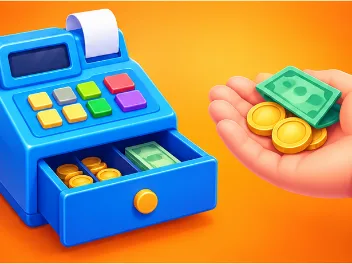
You are behind the cash register. The item costs €3.40, and the customer hands you a €5 bill. How much change do you give back, and above all, with which coins?
The game does not tell you the amount. It is up to you to work it out, then build it piece by piece from the cash drawer: one €1 coin, one 50-cent coin, one 10-cent coin. Three coins, and the change is right.
Nothing is counted for you. The customer's hand only shows what you have already put down, and it is by watching it grow that you see what is still missing. When you think you have it, you confirm.
This making change game uses euro coins and bills, the money of much of Europe, but the skill it trains is the same with any currency: subtract in your head, then count out the change with the fewest pieces. It is a free counting money game for kids learning to handle cash, and a quick mental math workout for everyone else.
How to play
At the top of the counter, two tags: the price of the item and what the customer paid. That is all the information you get, and the subtraction stays in your head; that is exactly the skill the game trains.
In the middle is the customer's hand, empty at the start. It fills up with whatever you put down, and a total appears next to it.
At the bottom is the cash drawer. The bills and coins are arranged from largest to smallest, because that is the order in which you give change: you always start with the largest piece that still fits.
Tap a coin or a bill, and it drops into the hand. Made a mistake? Tap it in the hand, and it goes back to the drawer. The Take it all back button empties the hand in one go. Neither counts against you: only the final pile is judged.
When you are done, tap Give the change. If the amount is right, the coins jump for joy. If not, the hand shakes and lets you fix it: compare its total with the amount you worked out.
Real coins and real bills
The coins and bills are drawn like the ones in a wallet, and that is not just decoration.
The 1, 2 and 5 cent coins are copper, a dark red. The 10, 20 and 50 cent coins are gold-colored. The €1 and €2 coins are made of two metals: the €1 has a gold ring and a silver center, and the €2 is the other way around. That is the first clue when you learn to recognize a coin without reading what is written on it.
The bills are rectangles, not discs, and each one has its own color: the €5 gray, the €10 red, the €20 blue, the €50 orange. The shape tells a bill from a coin even before the color does, so you can read the drawer at a glance.
Amounts are written the way they look on a price tag: €3.40 for a price, 50c for a small coin. Nobody says "€0.50" at the register, and the game does not write it that way either.
As few coins as possible
Giving the right change is good. Giving the right change with as few pieces as possible is what a cashier is expected to do.
For €1.60, you could put down sixteen 10-cent coins: the amount would be right. But one euro, fifty cents and ten cents do the same job in three pieces, and that is what any shopkeeper would do.
The method fits in one sentence: always take the largest bill or coin that still fits in what is left. €1.60 to go? The €5 bill does not fit, the €2 coin does not either, but the €1 coin does, so put it down. 60 cents left: 50 fits, put it down. 10 left: put it down. Done.
This method always gives the best result with euro coins and bills. The game does not just assume that, though: it calculates the true minimum on its own before handing out your stars.
The twelve levels
Whole euros. Four levels. No cents anywhere, only bills and the €1 and €2 coins. Enough to get the subtraction going and build the biggest-first habit.
Here come the cents. Four levels. The 5, 10, 20 and 50 cent coins join the drawer, and prices stop being round numbers. This is where you learn to split an amount in two steps: the euros first, then the cents.
The whole drawer. Four levels. The 1 and 2 cent coins join in, some prices end in 99, and the change sometimes takes five pieces. The last level has you give change from a €50 bill.
Stars
Three stars if you give the change with the fewest possible pieces. Two for up to two pieces too many. One beyond that.
Taking a coin back costs nothing, and neither does starting over: search as much as you like, only the pile you confirm counts. There is no timer and no account to create.
Your stars stay in your browser. A level unlocks when you clear the one before it, and you can go back to any level you have opened to aim higher. Everything works with a finger on a phone.
Leaderboard
Every level you clear earns points, and your leaderboard score is the total of all your levels. Later worlds are worth more: in the first world, three stars earn 50 points, two earn 40 and one earns 30; the second world pays double, the third triple. Clearing all twelve levels with the fewest possible pieces adds up to 1,200 points.
Each level counts once, for your best change. Replaying a level with fewer pieces raises your total; replaying it worse costs you nothing. The leaderboard only keeps verified change: before it accepts the score, the server recounts every piece you confirmed and works out the minimum on its own. Just like on screen, a coin you took back or a hand you emptied doesn't count. The first time you clear a level, the game asks for a nickname, and from then on your total is sent on its own without interrupting your game.
A few tips
Do the subtraction before you touch the drawer. Five euros minus three forty: first count up to the next euro, sixty cents to reach four euros, then one more euro to reach five. So one euro sixty. That is how shopkeepers count back change, and it saves you a long subtraction.
Always start with the largest piece that fits. If you start from small coins, you will put down too many and lose stars.
Cents last. Settle the euros first, and you will be left with a small remainder that is easy to cover.
Watch the total after each coin. It tells you where you stand. Compare it with the amount you worked out, and any mistake shows up right away.
A price ending in 99 always ends with one cent. When the price ends in 99 and the customer pays with a whole bill, the last coin of the change is a 1-cent coin. You might as well put it down first in your head.
Say the amounts out loud. "Three forty, three fifty, four, five": counting up from the price to what the customer paid is the oldest cashier trick there is, and it makes the subtraction almost automatic.
If you like math you can handle with your hands, try Algebra Balance and Mental Math, or browse every game in the educational games category.
Frequently asked questions
What age is it for? From six for the first world, which only uses whole euros. The cents suit children from about eight, and the last world from nine or ten.
Do I need to know decimals? No. Everything is done with coins, and the game writes amounts like a price tag in a store. Decimals make sense here before anyone puts a name on them.
Does the game tell me how much change to give? No, never: that would be doing the subtraction for you. It only shows the total of what you have already put down. After a wrong answer, the hand shakes, and finding what is missing or what is too much is up to you.
Can I give change with more coins than needed? Yes, the amount will be right and the level will count as cleared. You will just get fewer stars.
Why does the drawer change from one level to the next? Because the difficulty goes up: you start without cents and end with every euro coin and bill.
Can I make mistakes without consequences? Yes. Taking a coin back, emptying the hand, starting over: none of it counts. Only the hand you confirm matters.
Is there a leaderboard? Yes: it ranks players by the total points of the levels they have cleared. The twelve levels are the same for everyone, and you play them at your own pace.
Do I need to install anything or create an account? No, nothing at all. Open the page and take over the register. The leaderboard only asks for a nickname.
More educational games
Educational games- Prime Factor Tree
Split every number down to its primes, which light up like lanterns. Eight trees against the clock, solo or in a race. - Mental Math
Twenty sums that get harder and harder: answer right, and as fast as you can. - Europe Chase
A thief runs from city to city. Read the clues, follow the trail and name them. - Flag Quiz
Name the flag, or find the flag of the country: twenty rounds, 162 countries. - World Capitals
The capital of a country, or the country of a capital: twenty timed rounds. - Human Bones
A skeleton, a bone named: click the right one. Twelve bones, two levels. - Chemical Elements
Find the elements in the periodic table. Twenty rounds, three levels. - Inventions in Order
Put the great inventions in order of time. Three levels, 160 dates.