Manille: Rules and Online Play
The trick-taking game of the North: the ten beats everything, and you must play higher whenever you can.
Ages 14 and up
Get it on Google Play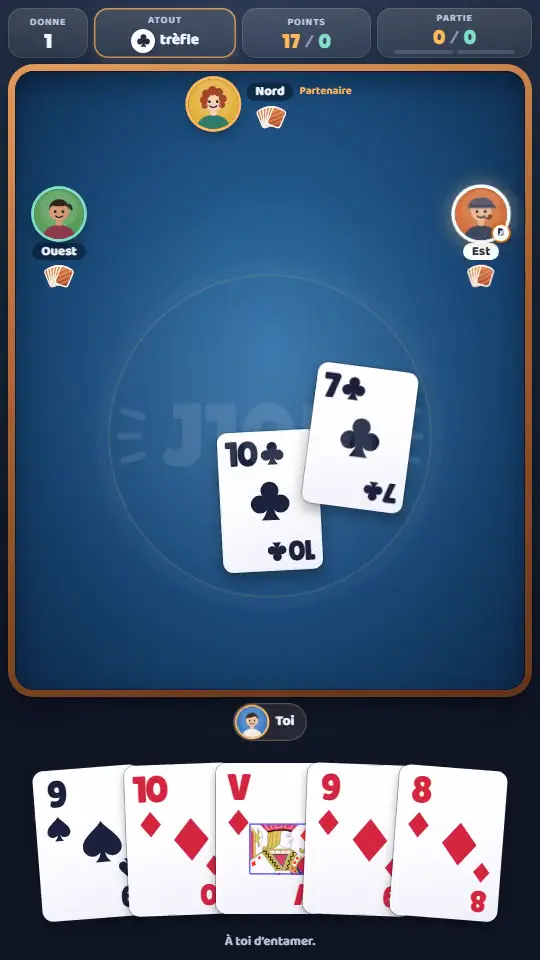
Leaderboard
Loading leaderboard…
Manille is a stubborn card game. No bidding, no contract, no table talk: the cards are dealt, the last one is turned face up to name the trump suit, and play begins. The whole game hangs on one duty you will not find in most other trick-taking games: when you can beat the card that is winning the trick, you have to. No cautious little card held back, no easy discard. If you have something better, you play it.
That rule gives manille its pace and its reputation. The game moves fast, tricks follow one another, and mistakes cost you right away. Skill does not show in flashy plays but in the cards you keep: knowing when to throw away, which trick to give up, which suit to open, and above all what your partner's cards are trying to tell you.
The name comes from the game's queen card: the manille, which is the ten. It beats every other card of its suit and is worth five points. Next comes the manillon, the ace, worth four. Flipping the usual ranking like this is the first thing you have to get used to — and soon the thing you cannot do without.
Manille is a traditional French card game. Here you sit down at a full table right away. Three computer players take the other seats: the one across from you is your partner, the two on your sides are the opponents. All three play at the same level, that of a good player who counts the cards. Nothing to install, no account to open. The table fits your screen, and you play with a mouse, a finger or entirely with the keyboard.
Manille rules: how to play
The deck has thirty-two cards: ace, king, queen, jack, ten, nine, eight and seven in each suit. Each player's eight cards go out three at a time, then three, then two, starting with the player on the dealer's right. The dealer is served last and shows the very last card: the suit of that card is trump for the hand. It stays in the dealer's hand and is played like any other card, but everyone knows who holds it.
Play goes counterclockwise, to the right. The player on the dealer's right leads the first trick. Then everyone plays one card in turn, and the trick goes to the highest trump if there is one, or else to the highest card of the suit that was led. The winner of each trick leads the next one.
Three duties govern every card you play, and you need to keep them in mind:
- Follow suit. If you have the suit that was led, you play it.
- Play higher. And if, on top of that, you can beat the card that is winning the trick in that suit, you must. On a king, you play the ace or the ten if you have them. This is the rule that makes manille what it is, and it changes everything. If someone has already trumped the trick, following suit is enough.
- Trump, then overtrump. If you do not have the suit that was led, you must play a trump; and if a trump is already on the table, you must beat it whenever you can. If you cannot, you still play a trump.
A single exemption lifts all three: when it is your partner who is winning the trick. In that case, you follow suit without having to play higher, and if you cannot follow, you play anything you like. That is the moment to load the trick with your big cards, or to get rid of a suit that has become a burden.
The game shows you which cards are allowed: only the legal ones can be played, and if you tap another one, a short message tells you why — you must follow, you must beat a card, you must trump or overtrump.
Counting the points
The ranking and the value of the cards stay the same in the trump suit, which keeps things simple. From highest to lowest: ten, ace, king, queen, jack, nine, eight, seven. In points: the ten is worth five, the ace four, the king three, the queen two, the jack one, and the three small cards nothing at all. That is fifteen points per suit, sixty points in all.
On top of those sixty points, the last trick earns one more. The total for a hand is therefore sixty-one, an odd number — and that is on purpose: it makes a tie impossible. One team always takes more than thirty, and that team scores.
What it scores is its margin over thirty. A hand won thirty-eight to twenty-three is worth eight points. A hand crushed forty-eight to thirteen is worth eighteen. And if one team sweeps all eight tricks, it scores thirty-one, the maximum. The other team never scores anything: manille does not reward second place.
The game goes to forty points, which takes about six hands on average. The first team to reach the mark wins.
Playing with your partner's tips
At the start of each game you choose: with your partner's tips, or no help. The computer players play the same way in both cases; only what your partner tells you changes.
With tips on, your partner whispers the card to play whenever you have a choice, and above all why: "I'm winning this trick: load it with points!", "You can't take this trick: throw a low card", "It's the top card: cash it now". The suggested card lifts in your hand, and you are free to play another one. It is the fastest way to learn the reflexes of manille: load your partner's trick, don't waste a trump, keep a low card to follow suit.
The tip comes from a calculation, not from cheating. Your partner imagines several possible layouts of the cards nobody has seen yet, plays out the rest of the hand with each card you could play, and keeps the one that scores best on average. Since it cannot see the opponents' hands, it can be wrong, just like a good player.
With no help, you play on your own, and a win counts for more on the leaderboard.
After each hand
The hand's count comes with the trick that counted most: the one where a ten fell, or the one a trump turned around. The list of all eight tricks unfolds with one tap: who led, the four cards in the order they were played, who took it and what it was worth. That is where you see why a hand swung.
At the end of the game you also get your progress on this device: games played, games won, current streak and best streak. And once you know the game well, the Fast play button next to your name shortens the pauses between the other players' cards.
Playing with friends
Click "Play together", create a table and send the code, the link or the QR code to your friends: they join from their phone or computer, and you accept each one as they arrive. Empty seats are taken by expert computer players, so a table can start with just two people. Everyone sees only their own hand. With friends there are no partner tips and no fast play: everyone plays at the same pace. These games don't count toward the leaderboard; the result is shown to the whole table at the end.
Your score and the leaderboard
Your leaderboard score is one thousand, plus ten points for every point of difference between your team and the opponents at the end of the game. Winning forty-two to eighteen gives one thousand two hundred forty. A lost game is ranked too, below one thousand: losing by three points is worth far more than losing by thirty. A win with no help is worth seven hundred more; with your partner's tips, that bonus does not apply.
A game only counts if it was played all the way to the end. The server replays your entire game from your cards alone and works out everything else on its own: the other three hands, the turn-up card of every hand, each of their plays. The points shown on your screen are only a preview; the replay is what counts.
You can start a new game as many times as you want.
Tips to win more hands
Count the manilles. Four tens are in play, one per suit, and together they are worth twenty of the sixty points. Knowing which one has fallen, and who took it, is worth more than any other count. A manille still sitting in an opponent's hand is worth a whole suit.
Do not lead a suit where you hold the ace without the ten. It is the classic trap. Your ace, the manillon worth four points, will be taken by someone else's ten, and you will have handed them nine points. Wait for the manille to fall, or for someone else to open the suit.
Pull trumps when you are long. With four trumps or more, leading trumps dries out the opponents' hands and clears the way for your big cards in the other suits. With two, you only waste your time and your chances to trump.
Load your partner's trick. This is the move that wins hands. When your partner is winning the trick and you play last, drop your most valuable card: the manille, the manillon, the king. Those points are safe, and the duty to play higher no longer applies.
Listen to what the duty to play higher is telling you. When an opponent drops a small card on a trick they could have taken, it means they had nothing stronger in that suit. The rule that binds everyone makes every card talk: it always says something about the hand of the player who plays it.
Keep a small card in each suit if you can. The seven and the eight are worth nothing, but they are the only cards that let you follow without giving anything away. Throw them too early, and you will be forced to hand over points on every trick.
Manille has Belgian cousins. Manillen, its Flemish variant, drops the turned-up card: the dealer picks trump, and players double with "I'm in." Belgian Solo Whist has you propose trumps and find a partner on every hand, and Couyon, the game of the Ardennes, is played with 24 cards and scored in chalk. Every other table is in the card games category.
Frequently asked questions
Do I need an account to play? No. The game starts with a click, with no sign-up and nothing to install. Only sending a score to the leaderboard asks for a nickname.
How long does a game take? About six hands of eight tricks on average, so roughly ten minutes. There is no bidding: as soon as the cards are dealt, you play.
Why does the ten beat the ace? Because that is the rule that gives the game its name: the manille is the ten. It beats every card of its suit and is worth five points, ahead of the ace, called the manillon, which is worth four.
Do I really have to play higher? Yes, as long as an opponent is winning the trick. When your partner is, the duty drops: you follow suit, but you choose the card.
Is there any bidding? No. This version is silent manille: trump comes from the card turned up by the dealer, and play starts right away. The talking variants, where partners tell each other about their suits, are not included here.
Can a hand end in a tie? No. The point for the last trick brings the total to sixty-one, an odd number: one team always takes more than thirty.
Does a lost game count on the leaderboard? Yes, as long as it went all the way to forty points. The score measures the gap between the two teams, not just the win.
Do the computer players cheat? No. Each computer player, your partner included, only sees its own hand, the turn-up card, the cards already played and the suits each player has shown they are out of. It knows neither your hand nor its partner's.
Does my partner play well? Yes. It plays at the same level as the opponents: it counts the cards, loads your tricks when they are safe and keeps its trumps for the right moment. With tips on, it also tells you which card it would play in your place, and why.
Can I play faster? Yes. The Fast play button next to your name cuts the pauses between cards to a quarter. Tapping the table while the others play also skips the pauses until your turn.
More card games
Cards- Manillen
The Flemish card game: the dealer picks trump, players double with “I’m in”, and the game runs to 101. - French Tarot
Seventy-eight cards, twenty-one trumps and the excuse: take the dog and make your contract, alone against three. - Tri Peaks Solitaire
Clear cards one rank above or below the discard pile, in long streaks, until all three peaks are gone. Solo, or racing other players. - President
Be the first to get rid of your cards, in pairs and three of a kind, against three players: five deals to finish President, not Beggar. - Nain Jaune – Yellow Dwarf
A classic French family card game: build runs from ace to king, collect the tokens on the board and empty your hand first. - Rikken
Dutch bidding whist for four: bid rik, troela, misère or piek, call an ace to find your partner, and set your own house rules. - FreeCell
Every card is face up: build the four suits from ace to king with four free cells. - Spider
Two suits, ten columns: build king-to-ace runs to clear them from the table.