Tock Board Game Online
The Quebec marble and card game, played in teams of two: bring your marbles out, send rivals back to start and set your own house rules.
Ages 10 and up
Get it on Google Play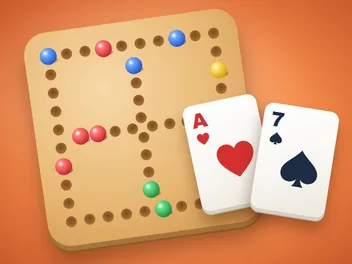
Leaderboard
Loading leaderboard…
Tock, sometimes spelled toc or tok, is the great table game of Quebec. Families play it at the kitchen table, at the cottage and in clubs, often on a homemade wooden board drilled with holes, with colored marbles and an ordinary deck of cards. It belongs to the same family as the classic dice race games where you move your pieces around the board and home, but there is no die: the cards move the marbles. And tock is a team game. Four players, two against two, partners sitting across from each other: you only win together, once all eight of your team's marbles are home. The game has traveled beyond Quebec, and you will find local variants in Saskatchewan, on Cape Breton Island and in Vermont, and it has crossed the Atlantic too: in western France, people play it under the name toc. In the Netherlands and in Flanders, the same family of games goes by another name: keezen.
Here, you sit down at a full table right away. Your partner is a computer player sitting across from you, and together you face two computer opponents. There is nothing to install and no account to open: the board appears in your browser, on a computer as well as on a phone. And because no two tock tables play exactly alike, the game adapts to the way you play: pick your own house rules, or one of the two presets, Quebec or Netherlands.
Tock rules: how to play
Each player has four marbles of their color. At the start, they all wait in that player's base, next to the board. The track runs around the board in 72 spaces, 18 per player, and each player has a start space right in front of their base. On the space just before it, the player's home opens up: four spaces in a dead end leading toward the center of the board. The goal is easy to state: bring your four marbles out, take them all the way around the board, and get them into your home before the other team gets theirs in.
The game uses a standard 52-card deck plus two jokers. Each player is dealt five cards, starting with the player on the dealer's left, who also plays first. Play goes clockwise. On your turn, you play one card, make the move it allows, then draw to get back to five cards. When the draw pile runs out, everyone plays their last cards; once every hand is empty, all 54 cards are shuffled again and the next dealer, to the left, deals five new cards to each player.
Two rules frame every turn. First, you must play if you can: if one of your cards has a legal move, you have to play a card that has one, even if you don't like the move. You choose which card, but you can't sit on your whole hand. Second, if none of your cards has any legal move at all, you discard the card of your choice, then draw.
To bring a marble out of your base, you need a starter card, which players in Quebec call the parteu: an ace, a king or a joker. The marble goes onto your start space.
What each card does
- Ace: bring a marble out, or move forward 1.
- 2, 3, 6, 8, 9 and 10: move forward that many spaces.
- 4: move backward 4.
- 5: move an opponent's marble forward 5.
- 7: seven steps split however you like among your marbles, for example 4 and 3, or 3, 2, 1 and 1.
- Jack: swap one of your marbles with any other marble on the track.
- Queen: move forward 12.
- King: bring a marble out, or move forward 13, capturing every marble along the way.
- Joker: bring a marble out, or move forward 18; then you play again right away.
Moving your marbles
A marble moves one space at a time, in the direction of play. It passes other marbles with no effect, but it captures the marble sitting on the space where it lands, whoever owns it: an opponent's marble, your partner's, even one of your own. A captured marble goes back to its owner's base and has to come out again with a starter card. The king goes further: when it moves forward 13, it captures every marble it passes on the track, plus the one on its landing space, including your own.
A marble that has just come out is fresh until it moves. Nobody can capture it, swap it with a jack, or even pass it, moving forward or backward. Not even you, with another of your own marbles: it blocks the whole track at that spot. It stops being fresh as soon as it moves. While it sits there, you can't bring another marble out onto the same space. A marble that comes back around to its start space after a full lap is not fresh: it can be captured like any other.
The 4 moves a marble four spaces backward, on the track only. It is the card for fresh starts: a marble that backs up from its start space ends up four spaces behind it, right near the entrance to its home, and its lap counts as done. A marble that is already home never moves backward, and you never back up into your home.
The 5 doesn't move your marbles, it moves your opponents'. You choose an opponent's marble on the track and push it five spaces, under the usual rules: it captures the marble on its landing space, and it goes into its own home if the count is exact. If there is no opponent's marble to push, the 5 can't be played.
The 7 can be split any way you like among your marbles, in chunks played one after the other in the order you choose. Each chunk captures the marble on its landing space, and all seven steps must be used. The jack swaps one of your marbles on the track with any other marble on the track, an opponent's, your partner's or your own, as long as neither one is fresh. Each marble keeps its owner: only their places change.
Getting home with the exact count
After a full lap, your marble reaches the space just before its start. The next step doesn't take it onto the start space but into the first space of your home. To get in, you need the exact count: the card has to land the marble on one of the four home spaces, and that space, along with every home space it crosses, must be empty. You can't jump over a marble inside your home. So fill your home from the back.
If the count isn't right, your marble doesn't go in: it passes its home, goes past its start space and sets off on another full lap, unless a fresh marble blocks the way. A marble that is home never leaves and can never be captured. It can still move deeper into the home, always with the exact count and without jumping.
Playing as a team
As long as you still have a marble outside your home, you only play your own marbles, except with the 5. But as soon as your four marbles are home, you take over for your partner: your cards now move their marbles. You can bring them out, move them forward or backward, swap them with a jack, or split a 7 among them. If your last marble gets home in the middle of a 7, the remaining steps are played on your partner's marbles. That is the heart of tock: a player who finishes early keeps playing, with two hands working for the same side.
The first team to get all eight marbles home wins, and the game ends right there. Here, your partner is a computer player who plays for the team: it protects your marbles when it can, avoids capturing yours, and helps you out once its own marbles are home.
Your score and the leaderboard
One game is one complete race, until a team has all eight marbles home. Your score is only sent at the end, win or lose.
- When you win: 1,000 points, plus 100 points for each opposing marble that isn't home yet, plus a speed bonus of 300 points minus the number of cards your team played, never below zero.
- When you lose: 100 points for each of your team's marbles that made it home.
A win always scores more than a loss, and a fast, lopsided win against opponents who are still far from home scores the most.
Only the standard table, with the default settings, counts for the leaderboard. That is also the Quebec preset. A game with house rules plays just as well, but its score is not sent. For a ranked game, the server replays everything from the random seed and your decisions alone: the cards, the computer players' moves and every step are recalculated before the score is accepted.
House rules: the game adapts to the way you play
In tock, every family and every club has its own house rules, and people care about their version. So instead of forcing one set of rules on you, the game lets you set up the table, and your browser remembers your choices. Two presets get you there in one click:
- Quebec: the standard table described above, the one used for the leaderboard.
- Netherlands (keezen): the way the game is played in the Netherlands and Flanders. No jokers, so 52 cards; no drawing, but three deals of five, then four, then four cards; at the start of each deal, everyone passes one card face down to their partner. The ace counts as 1 or 11, the king is only for bringing marbles out, the 5 moves one of your own marbles like any other card, and each chunk of a 7 also captures the marbles it passes.
And setting by setting, here is everything you can change:
- Jokers: two jokers, or none; without jokers, the starter cards are just the ace and the king.
- Dealing: draw after every card, or deals of five, four and four cards with one card passed to your partner. After the third deal, the cards are shuffled and the next dealer deals again. With deals, the joker doesn't draw a card.
- Ace: 1, or your choice of 1 or 11.
- King: 13 capturing everything, 13 without capturing what it passes, or bringing a marble out only.
- Five: an opponent's marble, any marble (yours, your partner's or an opponent's), or an ordinary 5.
- Seven: split freely, or across two marbles at most.
- Seven captures everything: no, or yes; each chunk then also captures the marbles it passes.
- Jack: swap, or your choice of swap or move forward 11.
- Ten: 10, or 10 and the player on your left loses their turn; they discard a card instead of playing, without drawing.
- Joker: it moves forward 18, 13 or 25.
- Shortcuts: a feature of some boards. A marble that ends its move on the seventh space of a quarter of the board may jump to the same space in the next quarter, capturing any marble there, but never over a fresh marble.
- Stuck: discard one card, or your whole hand; in draw mode, you then draw five new cards.
Keep in mind that a table set up differently from the standard one does not count for the leaderboard.
How the computer players play
All three computer players, your partner and both opponents, play at expert level, the only level in the game. They see only their own hand, the cards already played and the board. They keep track of the cards played since the last shuffle, to know what might still be left in the other hands.
To choose a move, they compare where both teams stand after each possible move: how far each marble has traveled, the marbles already home, the ones still waiting in base, and above all the danger. A marble sitting within reach of an opponent, one to thirteen spaces ahead of them, eighteen spaces for a joker, or four spaces behind them for a 4, may well end up back in base. The computer players weigh that risk against the cards still in play. They never capture their partner if they have another move, and they hold on to their most valuable cards for the right moment.
Eight tips to play better
- Keep a starter card. As long as you have a marble in base, don't waste your ace, king or joker on moving a few spaces.
- Come out when the coast is clear. The best time to bring a marble out is when your start space is free and no opposing marble sits right behind it, ready to capture it as soon as it moves.
- Let your fresh marble block. A marble that has just come out blocks the track for everyone. If an opponent is coming up behind it, leave it there: they are stuck.
- Save the 4 for a fresh start. A fresh marble that backs up four spaces lands four spaces from its home. A 7 then sends it straight to the back.
- Save the 7 for the finish. It is the card for exact counts: it can bring two marbles home at once, or rescue a threatened marble by splitting its steps.
- Push them past their home. With the 5, send an opposing marble just past the entrance to its home: it has to go around again. Never push it in.
- Swap with care. With the jack, trade your marble that is furthest behind for the most advanced opposing marble, but never make a swap that brings an opponent closer to home.
- Watch out for the king. Moving forward 13 captures everything along the way, your marbles and your partner's included. Look at the track before you play it.
If you like team games around a table, also try Belote or Manille, both played two against two, or Nain Jaune, another board you play with cards. You will find every other one in the board games category.
Frequently asked questions
Is tock free to play online?
Yes. The game is completely free and plays with no sign-up and no download, right in your browser.
How is tock different from a dice race game?
In a dice race game, the roll decides everything. In tock, you hold a hand of cards and choose which one to play: back up with a 4, swap with a jack, push an opponent with a 5. And you play as a team, two against two, until all eight of your team's marbles are home.
What is a parteu?
It is the Quebec name for the starter cards: the ace, the king and the joker. Without one, a marble can't leave its base. Without jokers, the starter cards are just the ace and the king.
Why can't I move past that marble?
Because it is fresh: it has just come out and hasn't moved yet. A fresh marble can't be passed, captured or swapped, not even by its owner. It stops blocking as soon as it moves.
My marble went right past its home: why?
Because the count wasn't exact, or a marble already home was in the way. A marble only goes in by landing exactly on a free home space, without jumping over another marble. Otherwise, it sets off on another lap.
What happens when I have no legal move?
You discard the card of your choice, then draw. In the table settings, you can choose to discard your whole hand instead.
Why didn't my game make the leaderboard?
Because one of your settings differs from the standard table. The Quebec preset is the standard table. House rules are yours to play as often as you like, but only the standard table compares every player on equal terms.
Can the computer players see my cards?
No. They only know their own hand, the cards already played and the board, just like any player sitting at the table. They all play at expert level, the only level in the game.
More board games
Board games- Five Dice
Five dice, three rolls, thirteen boxes to fill: go for five of a kind and the bonus. - Secret Code
Crack the four-color code in ten guesses, guided by the clues. - Fleet Duel
Sink the computer's five ships before it sinks yours. - Disc Turnover
Outflank and flip the computer's discs to own most of the board. - International Checkers
Checkers on the big 10×10 board, against the computer or a friend. - Chess
Chess against the computer at four strengths, or with a friend: castling, en passant, promotion.