Car Parking Puzzle
Free the red car: slide the vehicles, none of them turns, none of them jumps another.
Ages 6 and up
Leaderboard
Loading leaderboard…
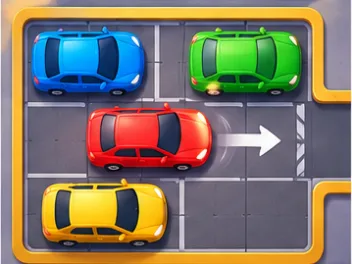
Blocked Parking is a car parking puzzle played on a six-by-six lot, packed with cars and trucks parked every which way. There is a single exit, on the right, in the middle — and a red car stuck in front of it. Your goal: clear its path by sliding the other vehicles out of the way, and drive it out.
Each vehicle only moves along its own direction: a car lying across goes forward or back, a car standing up and down goes up or down. None of them turns, none of them jumps over another. The whole game rests on that one constraint, and that is what makes it a brain teaser rather than a test of dexterity.
This version opens right in your browser, free, with no sign-up and no download, on a computer, a tablet or a phone.
If you are looking for a free car parking puzzle to play online, a traffic jam brain teaser that gets you thinking several moves ahead, or a quick logic game for your coffee break, Blocked Parking gives you three hundred verified lots, none of them easy.
How to play the car parking puzzle
Tap a vehicle: it gets selected, and the spaces it can reach light up. Then tap one of those spaces: it slides there in one go, even across several squares. Tapping the selected vehicle again puts it back down. You can also simply drag a vehicle along its axis with your finger or the mouse.
On a keyboard, the arrow keys go from one vehicle to the next; once you reach a vehicle, the arrows along its direction push it one space. Enter selects or puts down the vehicle.
A move across several spaces counts as a single move: pushing a car three squares in one stroke is better than three little moves, and your score shows it.
The game ends as soon as the red car reaches the exit, on the right side of its row.
What the counters tell you
Under the title, three numbers: the moves you have played, the best known solution for the lot, and the time.
The best known solution is the number of moves in the shortest solution, worked out once and for all when the lot was built. It is never lower than fourteen and goes up to twenty-one: no lot in the game can be solved in a handful of moves.
Nothing forces you to match it — but a shortest path is worth a lot of points, and it is the only goal this game sets for itself.
Where the parking lots come from
The game's three hundred lots are not drawn at random when you play. They were built in advance, one by one, then put through a sieve: for each of them, every reachable position was explored, the distance from each one to the exit was measured, and only the farthest were kept.
That gives you two guarantees. Every lot has a solution, since its distance to the exit was calculated. And none of them is easy, since it takes at least fourteen moves to get out.
The game's seed only picks one of those lots. The server picks the same one when it validates your score: same bank, same number, same layout.
Where this puzzle comes from
Sliding-block puzzles are an old family. Their best-known ancestor is the fifteen puzzle, which appeared in the 1880s, where fifteen numbered squares slide around a frame with sixteen spaces. The principle is already there: one empty space, and pieces that can only slide.
In the early 20th century, makers of wooden games came up with dozens of variants with pieces of different sizes. One of the most famous, often called Klotski, asks you to get a big square out of a frame crowded with rectangles; its Chinese version tells the story of a besieged general's escape. You find exactly today's mechanics in it — one piece to free, pieces that do not turn, a single exit.
The version with cars and trucks dates from the 1970s. It adds one more decisive constraint: each vehicle only drives along its own direction, never sideways. The number of possible positions collapses, and the puzzle becomes readable: you can see at a glance who is blocking whom.
That explains its staying power on phones: the rules fit in one sentence, the grid fits under a thumb, and the difficulty comes only from the order of the moves.
Score and leaderboard
The score rewards economy:
- you have to get the car out; an abandoned game is not ranked;
- you start with 10,000 points;
- each move costs 50 points;
- each tenth of a second costs 1 point.
A shortest-path exit, say fifteen moves in one minute, is worth 8,650 points. Twenty extra moves cost you a thousand: thinking before you push pays more than pushing fast.
Every new game draws a different lot, and the leaderboard keeps your best score.
The server replays every game it receives, move by move, from the starting layout. A forged score does not get through.
Tips for solving faster
Start from the end. First look at who is blocking the red car's way, then at what keeps those vehicles from moving aside. The solution often reads backward, by working up the chain of blockages.
The trucks call the shots. A three-space vehicle has very little room: it only fits in a column in three positions. Place the trucks first, and the rest follows.
Do not push what is already fine. Every move costs, and a vehicle moved for no reason will often have to come back. Before you touch anything, ask yourself what that move opens up.
Make room in the right place. One empty space in the right spot is worth more than three elsewhere. Aim for the columns that the vehicles blocking the exit need to cross.
Count your moves against the best known solution. If you are at twenty-five moves on a fifteen-move lot, you are going around in circles: start reading again from the red car.
A long slide is one move. Push a vehicle all the way to the end of its run rather than square by square: it is the same move on the counter, and the room you gain often comes in handy right away.
Frequently asked questions
Is the game free, and do I need an account? Yes, it is completely free, with no sign-up and no download: it opens in your browser. A nickname is enough to appear on the leaderboard, and you choose it when you send a score.
Can vehicles turn? Never. A car lying across stays across, a car standing up and down stays that way. That rule is what makes the whole puzzle.
Can a vehicle jump over another one? No. Every space it crosses has to be empty, not just the one where it stops.
Does every parking lot have a solution? Yes, all three hundred. Each one was solved before it went into the game, and its minimum number of moves is shown while you play.
What if I get completely stuck? Nothing is ever lost for good: no move is final, and you can always slide a vehicle back. Only your moves and your time count toward the score.
Can I play with a keyboard? Yes. The arrow keys go from one vehicle to the next, then push it along its direction; Enter selects or puts it down.
Can I replay the same parking lot? Every game draws a new one.
More puzzles
Puzzles- Mummy on the Run
The little mummy runs straight on until it hits a wall: grab the tomb's gold, dodge the spikes and bats, and dash for the exit. - Sneaky Cat
The little orange cat sneaks through the house: swipe every fish without catching the dogs' eye, put them to sleep from behind, and slip out the cat door. - Fruit Cutter
Fruit flies up from everywhere: slice it with one swipe in a splash of juice, chain your combos, and whatever you do, don't touch the bombs. - Territory Conquest
Leave your zone, draw a loop and come back: everything inside it is yours. But watch out for rivals cutting your trail! - Snake Feast
Eat the pellets to grow your crowned snake, and make rivals crash into your body: they turn into a feast. - Color Sort
Pour colors from tube to tube until every tube holds a single color. - Fill the Grid
Place the pieces on the grid and complete lines to clear them. - Number Merge
Slide the tiles, merge equal numbers and build the biggest tile you can.
