Europe Chase
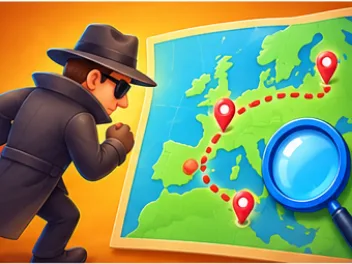
A thief runs from city to city. Read the clues, follow the trail and name them.
Ages 10 and up
Leaderboard
Loading leaderboard…
A priceless object has vanished. The thief slipped out of town overnight, and ever since, they have not stopped moving: a train, an airport, a bus station, a new city every day. You are on their trail, with limited time and a string of witnesses who saw someone pass through without knowing who it was.
That is the whole game. At every stop, you get three to five cities to choose from. Only one is right. To find it, you read the clues — a river, a currency, a language, a landmark, the direction they took when they left — and cross them with what you know about Europe. Nothing else. No reflexes, no clicking speed, no luck to push: you win this game by thinking.
If you are looking for a free European geography game that feels like a detective story rather than a school quiz, this is it. It suits curious kids from about ten years old, and adults who like to test what they really know about the continent.
Thirty cities, fifteen kinds of clue
The map holds thirty cities, from Lisbon to Tallinn and from Oslo to Athens. Twenty-seven of them are capitals, and three are big cities that are not: Barcelona, Milan and Munich. They are there because the most convincing false leads are exactly those.
Each city carries around fifteen verifiable facts: the river that runs through it, or the lack of one; the sea it looks out on, or the fact that it is inland; the currency people pay with; the language spoken there and the family that language belongs to; its region of Europe; whether it is a capital; its most recognizable landmark; and sometimes its signature dish.
Five more facts are about the city itself rather than the country: the time there compared with Paris, whether the country belongs to the European Union, whether the city has a metro, the name of its airport — Schiphol, Kastrup, Ferenc Liszt, Chopin — and the figure the city is forever linked to: Kafka in Prague, Gaudí in Barcelona, Andersen in Copenhagen. The airport and the famous name each point to a single city on their own, so the last clue of a stop can be a landmark, an airport or a name.
Not every clue is a statement. Some tell you what the city is not — "people do not speak a Slavic language there," "their city is not on the Baltic Sea" — and those often trim a list where naming the exact fact would close it at once. Others are not about the target city at all but about the journey: the compass direction they took leaving the city you are in, or how far they traveled. Those two you read on the map, not from memories of geography class.
How to play
The game opens with a choice of difficulty, and you cannot change it halfway through.
- Easy: four cities to track down, three destinations to choose from at each stop, three suspects.
- Normal: six cities, four destinations, four suspects.
- Hard: eight cities, five destinations, six suspects — and the clues have more work to do, since there are more candidates to rule out.
You start in the city where the theft took place. A witness is waiting there and gives you the first clue for this leg. Say they tell you the suspect will not need to change money. Four cities appear: Vienna, Budapest, Prague and Bratislava. Only two use the euro — Vienna and Bratislava — while Budapest pays in forints and Prague in korunas. The clue rules out half the list, and you still have to choose between the last two.
That is on purpose. The first clue is never enough. At best it cuts the list in half, and it leaves you with a decision: take your chance with what you already know, or pay to learn more.
You can ask for a second clue, then a third. The second one settles it: only one of the offered cities still fits. The third practically names the city, through its landmark, its airport or its famous figure. Each extra clue costs ten time points and two hundred fifty score points.
When you choose right, you arrive in the new city, a witness talks to you, and the next leg begins. When you choose wrong, that city is crossed off, you lose fifteen time points, and you try again with the same clues and one option fewer.
The time counter starts at one hundred. A right answer costs five, a wrong one fifteen, a clue ten. If it hits zero, the trail goes cold and the game ends: that run does not go on the leaderboard.
The suspects
You can open the case file at any time. Each card shows a portrait, a name, an age range, a hair color, a distinguishing feature, two languages spoken and a line of work — the antiques trade, art restoration, watchmaking, the antique map trade.
The witness reports pile up next to them. "The witness saw a woman." "The witness noticed red hair." "The suspect is said to have worked in archives." Each statement is true of the culprit; the first ones each rule out at least one innocent person until a single name is left, and any that follow only confirm it. That is also why the game calls the thief "they" until the very end: whether it is a man or a woman is one of the clues.
The game never crosses anyone out for you. You rule out the cards yourself, with a button on each one, and you can put someone back on the list if you change your mind. A game that struck suspects off on its own would hand you the culprit and take all the fun out of the arrest. Here, matching the reports to the files is your job.
In the last city, the Destination button becomes Arrest. You open the file one last time and point to someone. Right answer: case closed, and two thousand points are added. Wrong answer: the thief gets away, and the run still counts on the leaderboard, just without the bonus.
Score and leaderboard
Each city where you pick up the thief's trail earns one thousand five hundred points, and the rest is added or taken away:
- minus five hundred for each wrong destination;
- minus two hundred fifty for each extra clue you ask for;
- minus one point per second that goes by;
- plus two thousand if you arrest the right suspect.
A longer case is worth more: a perfect game comes to roughly eight thousand points on Easy, eleven thousand on Normal and fourteen thousand on Hard, and a Hard case solved with a few mistakes still beats a flawless Easy one. The score never goes below zero. A case played through to the arrest always counts, solved or not; a case cut short because time ran out does not.
The ticking seconds are what give the game its real tension. Without them, everyone who knows their geography well would finish on exactly the same score, and the leaderboard would only rank who got there first. With them, you have to know and decide quickly: a minute of hesitation costs a quarter of a clue.
The server replays your whole game from your decisions alone — the difficulty, the cities you picked, the clues you asked for, the suspect you arrested — and recalculates everything else: the route, the cities on offer, the clues, the pool of suspects and the culprit. The points on your screen are only a preview; the replay is what counts.
Every case is drawn fresh: you will not see the same route twice.
Tips for catching the thief
Read the cities on offer before the clue. Looking at the four names first tells you which facts set them apart. If three of them sit on the Danube, the clue will not be about the river; it will be the currency, the language or the direction they took.
A negative clue is worth as much as a positive one. "It is not a Slavic language" does not tell you what they speak there, but it rules out as many cities as a statement would. Read it as a filter, not a dodge.
Look at the map when the clue is about the journey. "They left the city heading northeast," "less than six hundred kilometers from here": you can check both by eye on the map, without knowing anything about the cities on offer. They are the easiest clues to use if you do not know your geography by heart.
Language families are gold. Plenty of people know that Czech, Polish and Croatian are Slavic languages without being able to name the river in Zagreb. That clue often cuts a list in two at a stroke.
Be wary of currencies. The euro covers twenty-one of the thirty cities, so "no need to change money" rules out almost nothing. On the other hand, "they will need crowns" narrows things down at once to Denmark, Sweden, Norway and the Czech Republic.
A mistake costs more than a clue. Fifteen time points against ten, and five hundred score points against two hundred fifty. When in doubt, pay for the clue: it is cheaper than a bad bet.
Open the suspect file from the second city on. Waiting until the end to cross-check everything means rereading five reports in a row with the clock running. Ruling people out as you go costs nothing and saves time where time counts.
The third clue is a last resort, not a first move. Landmark, airport or famous name, it gives the city away — and it is the most expensive clue overall, since you have to pay for the second one first. Save it for the legs where the first two leave you truly in the dark.
If you like this kind of reasoning, try World Capitals or the Flag Quiz, or browse every game in the educational games category.
Frequently asked questions
Do I need an account to play? No. The game starts with one click, with no sign-up and nothing to install. Only sending a score to the leaderboard asks for a nickname.
How long does a game take? From about five minutes on Easy to around ten on Hard. It is a thinking game, not a speed game — but time is part of the score, so hesitation has a price.
Should I look up the answers online? No, and it would backfire: every second costs a point. The clues are about widely known facts — major rivers, currencies, languages, famous landmarks — and two of them, the direction and the distance, can be read straight off the map. Facts that were too obscure were left out on purpose.
Is the information in the game accurate? Yes. The facts about the thirty cities come from public sources and were checked one by one. Ambiguous clues were removed: a city whose river only crosses its suburbs gets no river in the game.
Why does the game not cross off suspects automatically? Because that would give you the answer. By the end, the witness reports always point to a single person; making the connection is up to you, and that is exactly what the arrest bonus rewards.
What happens if I arrest the wrong suspect? The thief gets away and you lose the case, but your score still goes on the leaderboard — without the two thousand bonus points. A case played to the end always counts.
Can I replay the same case? No. Every game draws a new route, new suspects and a new culprit.
Can I play with just a keyboard? Yes, entirely. Everything can be reached with the Tab key, the panels close with Escape, and every event is announced to screen readers. No information is carried by color alone.
More educational games
Educational games- Flag Quiz
Name the flag, or find the flag of the country: twenty rounds, 162 countries. - World Capitals
The capital of a country, or the country of a capital: twenty timed rounds. - Human Bones
A skeleton, a bone named: click the right one. Twelve bones, two levels. - Chemical Elements
Find the elements in the periodic table. Twenty rounds, three levels. - Inventions in Order
Put the great inventions in order of time. Three levels, 160 dates. - The Solar System
Order the planets and moons by distance or by size. Three levels, 30 bodies. - Human Body Organs
An organ is named, click the right spot on the plate. Ten organs, two levels. - Code the Robot
Line up the instructions, run the robot and collect every star. Twenty-four levels, loops included, to learn how to code.