Number Memory Test
A number flashes, then disappears: type it back. One more digit every round.
Ages 10 and up
Leaderboard
Loading leaderboard…
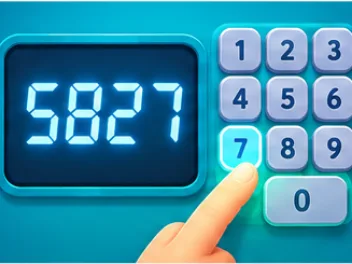
Digit Memory is a number memory test in three beats: a number appears, it disappears, you type it back. If you get it right, the next one has one more digit. The first round shows three digits, the second four, and so on all the way to fifteen.
Many players stop somewhere between seven and nine digits. Beyond that, it is no longer a matter of raw memory: it is a matter of splitting. Nobody remembers fifteen digits in a row; you remember five groups of three.
The game opens straight in your browser, for free, with no sign-up and no download, on a computer, a tablet or a phone. If you have been looking for a number memory test or a quick digit span test to see how many digits you can hold in your head, this one takes a couple of minutes and tells you exactly where you stand today.
How the number memory test works
The number appears in large type in the middle of the screen, for as long as it takes to read it: about six tenths of a second per digit, never less than 1.6 seconds. Then it disappears, and the number pad becomes active.
Type the number back in order, digit by digit. What you type appears under the display, so you can see where you are.
On a keyboard, the number keys along the top or the ones on the numeric keypad work directly, with no need to aim for a button. On a phone or a tablet, you tap the on-screen pad with your finger; with a keyboard, you can also move across that pad with the arrow keys.
A single mistake ends the game, and the digit that was expected appears one last time. There is no correction: a digit typed is a digit played.
Time barely counts
The clock runs while you type, but not while the number is on display: the game does not make you pay for the time it spends showing it to you. Each round, the clock starts again only when the number has disappeared.
And time costs only one point per second, against a thousand points per round. In other words: there is no rush. Take the time to repeat the number to yourself before you start typing.
Score and leaderboard
Your score follows the length you reached:
- each round typed back in full is worth 1,000 points;
- each second of typing costs 1 point;
- you need at least three rounds, so five digits remembered, to appear on the leaderboard;
- the score never drops below zero.
An example: you type back seven rounds, up to nine digits, and miss on the eighth, after 45 seconds of typing in all. You score 7 × 1,000 − 45 = 6,955 points. Another player who reaches the same round but takes a minute and a half scores 6,910. Time only separates players who remembered just as much.
Seven digits is a good game; nine is very good; eleven is remarkable. The game stops on its own at fifteen digits, a limit almost nobody reaches.
Each new game draws new numbers, and the leaderboard keeps your best score.
The server replays every game it receives, digit by digit, from the seed of the numbers. It works out the rounds and the time itself, so a forged score does not get through.
What this game really measures
Holding a string of digits for a few seconds calls on your working memory: the short-term memory that keeps a small number of items just long enough for you to use them. Its capacity is limited, and the figures often quoted are around four to seven items, depending on the person and on how you count.
But an "item" is not necessarily a digit. That is the whole trick: 1 9 6 9 is four digits and a single item if you read it as a year. Players who go past ten digits do not hold ten things, they hold three or four, each made of several digits grouped together.
This game is neither a test in the clinical sense nor an exam: it is an exercise, and your score says nothing more than how you did today.
Where this game comes from
Having someone repeat a string of digits is one of the oldest exercises in experimental psychology. It goes back to the late nineteenth century, when the first laboratories set out to measure attention and short-term memory, and psychologists still call it the digit span. The principle has not changed: a sequence, a pause, a repetition.
Electronic games picked it up, then phones. The formula works because it is immediate: no rules to explain, nothing to learn, and a result you can compare from one person to another and from one day to the next.
The version here keeps the heart of it and adds what the exercise never had: a leaderboard.
Two memories, two games
This game has a cousin on the site: Color Memory, where a sequence of pads lights up and you repeat it. The two look alike, but they do not ask the same thing of you.
In Color Memory, the sequence never changes: it grows, and every round replays everything from the start. Your memory builds up by accumulation, and the tension rises as the sequence gets longer.
Here, every round brings a brand-new number. Nothing builds up from one round to the next: you have to forget everything and start again, one digit longer. It is drier and faster, and it rewards a method of splitting rather than repetition.
Many players are clearly better at one of the two. Try both: the gap is often surprising. The Chimp Test, which asks you to remember where numbers sit on a grid, makes a good third.
Tips to remember more digits
Split by threes. 4 8 2 9 1 7 is far easier to remember as "482" and "917." Grouping by three or four is the basic technique, and it is enough to take you from seven digits to ten.
Look for meaning. A year, an age, a price, a date: as soon as a group of digits means something, it costs almost nothing to remember.
Say it under your breath. Repeating the number silently keeps it alive in your short-term memory. Go over it during the seconds after it disappears, before your first keystroke.
Do not type too fast. Time costs one point per second; a mistake costs the whole game. Start typing when you are sure, not before.
Take in the whole number. Many players read digit by digit and lose the beginning. Take it in at a single glance, like a word, then split it in your head.
Keep the same grouping. If you remembered "482-917," type it back with that rhythm. Changing your grouping halfway through makes you lose the thread.
Frequently asked questions
Is the game free? Yes, completely, with no sign-up and no download. It opens in your browser.
Do I need an account to play? No. A nickname is enough to appear on the leaderboard, and you choose it when you send a score.
How long does the number stay on screen? About six tenths of a second per digit, with a minimum of 1.6 seconds: a long number stays on screen longer.
Can I fix a typo? No. A digit typed is played, and a mistake ends the game: that is what makes scores comparable.
Is the number the same from one round to the next? No. Unlike Color Memory, every round draws a new number, one digit longer.
How far can I go? Fifteen digits, which is thirteen rounds. A very good human game stops around nine or ten.
Can I play with a keyboard? Yes, entirely: the number keys or the numeric keypad type directly.
Why is my score not on the leaderboard? You need at least three rounds, so five digits remembered. Below that, the game does not mean much.
More tests
Tests- Color Memory
Watch the sequence light up, then repeat it. One more color every round. - Aim Trainer
Hit 30 targets as fast as you can and measure your aiming speed and accuracy. - Reaction Test
Click as soon as the screen turns green: five tries to measure your reaction time. - Matching Pairs
Turn the cards over two at a time and find the twelve pairs in as few turns as you can. - Chimp Test
Memorize where the numbers are, then tap them in order from memory. - Click Speed Test
Click as fast as you can for ten seconds and measure your clicks per second.
