Klondike Solitaire
The classic solitaire: seven columns, a stock, four foundations to build from ace to king.
Ages 10 and up
Leaderboard
Loading leaderboard…
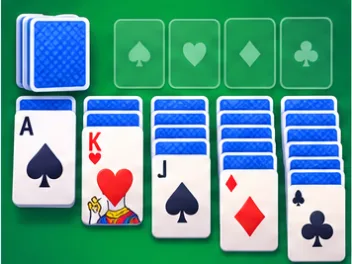
Klondike is the solitaire everyone knows: seven columns laid out like a staircase, a stock pile, and four foundations to build up suit by suit, from ace to king. You win by getting all fifty-two cards onto them. A game lasts between five and fifteen minutes, and plays just as well with a mouse as with a finger.
This version runs right in your browser, for free, with no sign-up and no download, on a computer, a tablet or a phone. It deals a new hand every game and keeps a leaderboard.
If you are looking for classic solitaire to play online for free — the card game many people simply call "solitaire" — with the choice between draw one and draw three, this is it.
How to play Klondike Solitaire
At the start, twenty-eight cards fill seven columns: one card in the first, two in the second, and so on up to seven. Only the last card in each column is face up; the others wait, face down. The remaining twenty-four cards form the stock, at the top left.
Tap a face-up card to pick it up, then tap where you want to put it down; you can also drag it. If the card has a sequence below it — cards going down one rank at a time and alternating red and black — the whole sequence moves with it. A second tap on the same column picks up one more card, so you can choose exactly what moves.
In the columns, a card goes on a card one rank higher and of the other color: a red 7 on a black 8. An empty column only accepts a king.
On the foundations, at the top right, cards go up in order and by suit: first the ace, then the 2, all the way to the king. A double tap on a card sends it straight to its foundation if it fits there.
The stock turns over onto the waste pile, right next to it. Only the top card of the waste can be played. When the stock is empty, tapping it turns the waste back over for another pass.
Draw one or draw three. Before your first move, two buttons let you choose the draw. With draw three, the stock turns over three cards at a time and only the last one is playable: it is the classic rule, the more demanding one, and you can go back through the waste as many times as you like. With draw one, every card shows up one after another, but the waste can only be turned over twice: three passes in all. As soon as you make your first move, the draw is locked for that game.
As soon as a column has no face-up card left, its top hidden card turns over by itself. That is what the whole game is about: uncovering the hidden cards before you run out of moves.
On a keyboard, the arrow keys move from one pile to another, Enter picks up or puts down, Enter again picks up one more card, and Escape puts back what you were holding.
Where this solitaire comes from
The name comes from the Klondike, the region of the Yukon where a whole generation of gold prospectors rushed at the end of the nineteenth century. Legend has it that the miners spent their long evenings playing this solitaire, alone in their cabins; the first card game books that describe it date from that period.
For a long time it was just one solitaire among hundreds of others, until the personal computers of the 1990s put it in front of the whole world. Since then, "solitaire" almost always means this one, so much so that people forget there are whole families of other solitaire games — this site already offers four more, including one where every card is visible from the start.
Its strength lies in a rare balance: the rules take thirty seconds to explain, luck plays a part without crushing the game, and every deal asks a slightly different question.
Undo, and stopping
The Undo button reverses your last move, as many times as you like, all the way back to the start of the game. An undo counts as a move and so costs a few points: that is the price of trying something out.
The Finish button ends the game and sends the score you have earned. It asks for confirmation, because it cannot be reversed. If no move is possible anymore — stock used up, no card to move — the game ends on its own.
Score and leaderboard
A solitaire game does not always come out, and that is normal: not every deal can be won. The score takes that into account.
- Each card moved to a foundation is worth 150 points.
- A completed game adds 2,200 points.
- Each move costs 5 points, each second 1 point.
- A game played with draw one keeps only 70% of the total: it is much easier.
- The score never goes below zero, and a game worth zero points is not ranked.
A complete game, played cleanly, comes to around 9,000 points. A game stopped halfway, with about twenty cards on the foundations, earns roughly 2,500: so there is always something to play for, even when victory slips away.
Every new game deals a different hand, and the leaderboard keeps your best score.
The server replays every game it receives, move by move, from the deal's seed. A forged score does not get through.
Tips to win more solitaire games
Aces and twos go up right away. They are no use in the columns and they unlock the foundations. Everything else, on the other hand, should go up carefully.
Do not build up too fast. A card on a foundation does not come back down easily. A black 6 kept in a column can take a red 5 and free a hidden card: sent up too early, it is no use anymore.
Go for the most loaded columns. Every hidden card you turn over opens up the game. Between two equal moves, choose the one that uncovers a card in the column hiding the most.
Keep a spot for a king. Emptying a column is only worth it if a king is waiting. Emptying a column with no king available wastes a space.
Draw to see, not to play. With draw one, your three passes are counted: before starting a new one, play everything you can on the table. With draw three, the stock never runs out, but every pass costs moves, and so points.
With draw three, count in threes. A card buried second in a group of three will only become playable again if the order shifts: play a card from the waste to shift the whole next pass.
Undo without regret. A deal reads better after two or three tries. Five points per undone move is little compared with a game you fail to finish.
If you like Klondike, try FreeCell, Spider, Pyramid Patience or TriPeaks Solitaire, or browse all the card games.
Frequently asked questions
Is the game free, and do I need an account? Yes, it is completely free, with no sign-up and no download: it opens in your browser. A nickname is all you need to appear on the leaderboard, and you choose it when you send a score.
Can every deal be won? No. In Klondike, roughly one deal in five cannot be finished, even with perfect play. That is why the score counts the cards you moved up and not just the win.
How many times can I go through the stock? With draw one, three passes in all: the original stock, then two turnovers. With draw three, as many times as you like, as in the classic card game.
Why does draw one earn fewer points? Because it makes the game much easier: every card in the stock becomes playable. So a draw-one game is worth 70% of the points of the same game with draw three. You choose the draw with the two buttons before your first move.
Can I move a card back down from a foundation? Yes, the top card of a foundation can come back to a column if it fits there. It is rare, but sometimes decisive.
What happens if I cannot play anything else? The game ends on its own and the score for the cards you moved up is sent.
Can I play with a keyboard? Yes. The arrow keys move from one pile to another, Enter picks up or puts down, Enter again picks up one more card, and Escape cancels what you picked up.
More card games
Cards- Belote
Classic four-player belote: take the turn-up, trump, count your points and take your side to 501. - Couyon
The Ardennes four-player trick game: take the trump, win the points and rub out your five chalk lines. - Go Fish
The head-to-head pairs game: ask for a rank, listen to what you are asked, and lay more pairs than your opponent. - Oh Hell
The up-and-down trick-taking game: bid your exact number of tricks, from three players to eight. - Hearts
Trick-taking in reverse: dodge the hearts, duck the queen of spades, and finish on the lowest total. - Coinche
Belote with numbered bidding: call your points from 80 up to a slam, and double the contract opposite. - Manille
The trick-taking game of the North: the ten beats everything, and you must play higher whenever you can. - Manillen
The Flemish card game: the dealer picks trump, players double with “I’m in”, and the game runs to 101.