Couyon: Rules and Online Play
The Ardennes four-player trick game: take the trump, win the points and rub out your five chalk lines.
Ages 14 and up
Get it on Google Play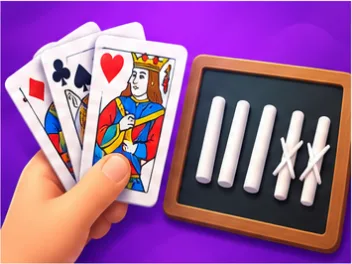
Leaderboard
Loading leaderboard…
Couyon is a trick-taking card game from the Ardennes and Wallonia, the French-speaking south of Belgium, played in cafés and kitchens since the late nineteenth century. Twenty-four cards, four players, two teams, four tricks per hand: it moves fast, you understand it in two minutes, and you keep playing until the chalk is rubbed out. It is a village game, passed down from table to table, and every valley keeps its own variant. This one is the most common version, the one you find from one end of the region to the other.
Here, you sit down at a full table without waiting for anyone. Three computer players take the other seats: North is your partner, West and East are your opponents. There is nothing to install and no account to open. The table appears in your browser, on a computer as well as on a phone, and the game plays with a mouse, a finger or entirely with the keyboard. If you know euchre, couyon will feel familiar from the first hand: the same twenty-four-card deck from nine to ace, the same turned-up trump card, but four cards each, a different ranking and even stricter rules on what you must play.
Couyon rules: how to play
A game is played over several hands, until one team has rubbed out its five chalk lines. Play goes clockwise: after you, it is the player on your left who bids and plays.
The dealer gives two cards to each player, then two more, starting with the player on their left. So everyone ends up with four cards, and only four. The dealer then turns over the seventeenth card of the deck: its suit is the proposed trump. The last seven cards stay in the stock, face down, and are never dealt. That is on purpose, and it is what gives couyon its flavor: nobody knows exactly what is still lying around, and a hand is never worth the full forty points.
Starting with the player on the dealer's left, each player in turn either accepts the turned-up suit as trumps or passes. The first player to accept becomes the taker, and the taker leads the first trick. Their partner plays alongside them without having had a say: that is the spice of couyon, you take for two.
If all four players pass, the next card of the stock is turned over and the round starts again, always from the player on the dealer's left. The stock can offer up to seven more proposals this way. If nobody takes after the last one, all the cards are gathered up and dealt again, and it is the next player's turn to deal.
To play a card, tap it in your hand or drag it to the middle of the table. On a keyboard, the left and right arrow keys move through your hand and Enter plays the selected card. The cards you are allowed to play lift up, and the others stay dimmed: you can never make an illegal play by accident.
The cards and what they are worth
The deck holds only twenty-four cards: the ace, king, queen, jack, ten and nine of each suit. Nothing else.
The ranking is the same everywhere, in trumps as in the other suits, and that is what sets couyon apart from belote: ace, king, queen, jack, ten, nine, from highest to lowest. The jack never takes over, and neither does the nine. An ace of trumps stays an ace of trumps, and nothing beats it.
Points are found only in the court cards and the ace:
- the ace is worth 4 points;
- the king is worth 3 points;
- the queen is worth 2 points;
- the jack is worth 1 point;
- the ten and the nine are worth nothing at all.
The whole deck therefore adds up to forty points. But since eight cards are never dealt, the turned-up card and the seven in the stock, a hand only puts about twenty-seven points into play on average, and never all forty. There is no bonus for the last trick: it brings in nothing more than the cards it contains.
What you must play
Couyon is not played freely. On every trick, the rules tell you what you are allowed to put down, and they are strict, without a single exception.
You must follow the suit that was led if you have it. And that is not all: you must play higher than the highest card of that suit already on the table, if you can. No keeping your ace for later when the king has just fallen.
If you do not have the suit that was led, you must trump, which means playing a trump. And if a trump has already been played, you must overtrump, which means playing a higher one. If you cannot, you play a lower trump: undertrumping is allowed when nothing else is possible.
Watch out: here, your partner changes nothing. Even when your partner is winning the trick, you must trump. This is not belote: in couyon, there is no exemption, ever. That rigor is what makes the hands so tense, and it explains why you sometimes lose a hand you thought was won.
If you have neither the suit that was led nor a trump, you discard the card of your choice. The trick goes to the highest trump if there is one, otherwise to the highest card of the suit that was led. Its winner leads the next trick. Four tricks, sixteen cards, and the hand is over.
Keeping score in chalk
Each team starts with five lines drawn in chalk, and wins when it has rubbed them all out. That is the heart of the game, and it is where its vocabulary comes from.
At the end of each hand, each team adds up the points of the cards it has collected. The taker's team succeeds if it scores strictly more points than the opponents:
- the taker makes it: their team rubs out one line, and the opponents do not move;
- the taker fails: their team adds one line, and the opponents rub out one. Taking without making it therefore costs you twice.
And then there is the case everyone remembers: a perfect tie on points. The players say the chalk is "in the hole." The hand is void, nobody scores, the cards are dealt again, and the next hand counts double: two lines instead of one, on both sides, under exactly the same rules. If that replacement hand also ends in a tie, the doubling carries over but does not stack: you never play for four lines.
The first team to rub out its five lines wins the game. Since a hand never brings both teams down at once, there is never a tie to break.
Your score and the leaderboard
Your score depends on the gap between the two teams at the end of the game: a thousand points, plus a hundred points for every line your opponents still had, minus a hundred for every line you still had. Winning without letting your opponents win a single hand is therefore worth at least fifteen hundred points, and more if they had to add lines by failing as takers; winning by a hair is worth eleven hundred. A lost game ranks too, below a thousand: defeat is honorable, and it counts.
The game has to be played to the end to be recorded. The leaderboard shows how many hands it took you: a short game is a well-played game. The server replays the whole game from the random seed and your decisions, deals the same cards again, has the three computer players play exactly the same way and recalculates the score: nothing can be faked.
Couyon strategy tips
Count your trumps first. Four cards is short. Two solid trumps, or an ace of trumps with company, are often worth taking. An ace in another suit is an almost certain trick, because only five weaker cards remain behind it.
Think about where you sit in the bidding. If you speak first, you know nothing about the others and you are taking a real risk; if you speak last, three players have already turned down that suit, which is precious information.
Remember that eight cards are asleep in the stock. The card you are missing may not be in anyone's hand. A lone king can very well be the top card if the ace was never dealt.
Give away as little as possible. When you cannot win the trick, let go of your cheapest card: every court card you put down goes to the opponents. On the other hand, feed your partner when the trick is theirs, especially if you play last: their points are your points.
Beware of the double hand. After the chalk lands in the hole, taking becomes twice as rewarding and twice as dangerous. That is the moment to count twice.
If you enjoy Belgian trick-taking games, Manille and its Flemish variant Manillen are also played by four in two teams, with the ten as the top card, and Belgian Solo Whist has you look for a partner on every hand. Belote is another partnership classic, and every other table is in the card games category.
Frequently asked questions
Is couyon really played with twenty-four cards? Yes. Everything from two to eight is taken out of the deck, and you keep the ace, king, queen, jack, ten and nine, six cards per suit.
Is the jack the strongest trump, as in belote? No, and it is the first thing to forget if you come from belote. In couyon, the order never changes: the ace rules, in trumps as everywhere else.
Why are eight cards never dealt? Because the rule says each player gets only four. The turned-up card and the seven cards of the stock stay aside, which always leaves some unknown in the count.
What does "the chalk is in the hole" mean? It is the game's expression for a hand where both teams score exactly the same number of points. The hand is void, the cards are dealt again, and the next hand counts double.
Can I refuse to trump when my partner is winning the trick? No. Couyon knows no exemption: without the suit that was led, you trump, and you overtrump if you can, no matter who is winning the trick.
What happens if nobody takes? The next card of the stock is turned over and the bidding starts again, always from the player on the dealer's left. If the stock runs out without a taker, the cards are dealt again and the deal passes on.
Can I play with a keyboard? Entirely. The arrow keys move through your hand, Enter plays the card, and Tab reaches the take and pass buttons. The focus is always visible, and a live region describes every card played for screen readers.
Does a lost game count on the leaderboard? Yes. Every game played to the end is recorded, won or lost. A narrow defeat earns more than a rout, and far more than an abandoned game, which earns nothing.
More card games
Cards- Go Fish
The head-to-head pairs game: ask for a rank, listen to what you are asked, and lay more pairs than your opponent. - Oh Hell
The up-and-down trick-taking game: bid your exact number of tricks, from three players to eight. - Hearts
Trick-taking in reverse: dodge the hearts, duck the queen of spades, and finish on the lowest total. - Coinche
Belote with numbered bidding: call your points from 80 up to a slam, and double the contract opposite. - Manille
The trick-taking game of the North: the ten beats everything, and you must play higher whenever you can. - Manillen
The Flemish card game: the dealer picks trump, players double with “I’m in”, and the game runs to 101. - French Tarot
Seventy-eight cards, twenty-one trumps and the excuse: take the dog and make your contract, alone against three. - Tri Peaks Solitaire
Clear cards one rank above or below the discard pile, in long streaks, until all three peaks are gone. Solo, or racing other players.