Human Bones
A skeleton, a bone named: click the right one. Twelve bones, two levels.
Ages 10 and up
Leaderboard
Loading leaderboard…
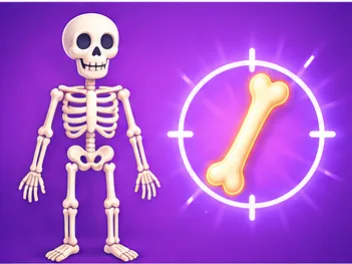
A front view of a human skeleton fills the screen. A line appears above it: "Click the femur." You click the bone you think is right, and the game answers you instantly. Twelve bones per game, drawn at random, never the same one twice.
That is the whole game. No checklist to tick, no answer to type, no reflexes required: you have to know where the bone is, and point to it. That is very different from recognizing a name in a multiple-choice quiz. Plenty of people know the collarbone exists and that it sits near the shoulder; far fewer can tell it apart from the shoulder blade on the first try, without hesitating.
You pick one of two levels before your first click: the simple level, with fifteen bones taught in elementary school, and the advanced level, with twenty-five bones, most of them under their modern anatomical names. The game opens in your browser, for free, with no sign-up and no download, with a finger on a phone or a mouse on a computer. It is one of the site's educational games, and a handy way to study the bones of the human body for a biology test or just out of curiosity.
How to play
The start screen first asks for your level, and that choice cannot be changed partway through. The question then appears at the top: the game names a bone, and you find it on the skeleton. If you are right, the bone lights up and the next question arrives.
If you are wrong, the bone you clicked is marked as wrong and the question stays open. You get three tries; on the third missed click, the game shows you the bone it wanted, long enough for you to take a good look, then moves on.
A click on empty space, next to no bone at all, costs nothing. You can move the cursor around, zoom in, search: only a click on another bone counts as a mistake. The game does not punish exploring, it punishes mixing things up.
Paired bones count on both sides. When the question says "the femur," the left one and the right one are both correct answers, and the same goes for the collarbone, the shoulder blade, the humerus or the tibia. The game tests location, not left and right.
A game always goes all the way to the twelfth question. There is no elimination and no early ending after a mistake: even a game that starts badly gets finished, and your score goes to the leaderboard with the twelfth answer.
Everything also works with a keyboard: Tab moves from one area to the next, and Enter or Space selects the one you are on. Areas are announced by a number, never by a name, otherwise the keyboard would give the answer away. Every result is written in a text area that screen readers read aloud.
The two levels
The simple level matches what children learn in elementary school: fifteen bones or groups of bones, with the names everyone uses.
- The skull: the bony case of the head, made of several fused bones, which protects the brain.
- The jaw: the bone at the bottom of the face, the only movable bone of the head.
- The spine: the stack of vertebrae that runs from the base of the skull to the pelvis and shelters the spinal cord.
- The ribs: the arches of the rib cage, twelve pairs, curving from the spine toward the front.
- The sternum: the flat bone in the middle of the chest, where the ribs attach. It is also called the breastbone.
- The collarbone: the long, curved bone just below the base of the neck, between the sternum and the shoulder.
- The shoulder blade: the large, flat, triangular bone at the back of the shoulder.
- The humerus: the single bone of the upper arm, from the shoulder to the elbow.
- The radius: one of the two bones of the forearm, on the thumb side.
- The bones of the hand: the whole wrist, palm and fingers.
- The pelvis: the bowl-shaped bony ring that carries the trunk and receives both femurs.
- The femur: the thigh bone, from the hip to the knee, and the longest bone in the human body.
- The kneecap: the small round bone sitting in front of the knee.
- The tibia: the thick bone at the front of the lower leg, the one you bang on the corner of the coffee table. It is also called the shinbone.
- The bones of the foot: the whole heel, arch and toes.
The advanced level uses today's anatomical vocabulary and cuts things more finely: the hand and the foot into three tiers each, the spine into four segments, the pelvis and the forearm into separate bones.
- The skull: the cranium itself, without the jaw.
- The mandible: the lower jaw, hinged just in front of the ear.
- The cervical vertebrae: the seven vertebrae of the neck, the highest and most mobile.
- The thoracic vertebrae: the twelve vertebrae of the middle of the back, the ones the ribs attach to. The drawing shows them in front of the rib cage, along the midline of the body.
- The lumbar vertebrae: the five vertebrae of the lower back, the most massive.
- The sacrum: the triangular bone that closes the spine at the bottom: five fused vertebrae, wedged between the two hip bones.
- The coccyx: the small bony tip at the end of the sacrum, the tailbone, made of a few tiny vertebrae.
- The collarbone: the S-shaped bar of bone between the sternum and the shoulder, the clavicle.
- The scapula: the flat, triangular bone lying against the upper back, better known as the shoulder blade.
- The sternum: the flat, vertical bone in the center of the chest.
- The ribs: the twelve pairs of arches of the rib cage.
- The hip bone: the large flat bone on each side of the pelvis; two hip bones, the sacrum and the coccyx make up the whole pelvis.
- The humerus: the bone of the upper arm, between the shoulder and the elbow.
- The radius: the forearm bone on the thumb side; it is the one that rotates when you turn your hand over.
- The ulna: the other forearm bone, on the little finger side; its tip forms the point of the elbow.
- The carpal bones: the eight small bones of the wrist, arranged in two rows.
- The metacarpals: the five long bones of the palm, one per finger.
- The finger bones: the phalanges, three per finger and two for the thumb.
- The femur: the thigh bone, the longest in the skeleton.
- The patella: the round bone at the front of the knee, the kneecap.
- The tibia: the inner, weight-bearing bone of the lower leg, the larger of the two.
- The fibula: the thin bone on the outside of the leg, running alongside the tibia.
- The tarsal bones: the seven bones at the back of the foot, including the heel bone and the ankle bone.
- The metatarsals: the five long bones of the sole, between the tarsals and the toes.
- The toe bones: the phalanges of the foot.
The spine reads from top to bottom: seven cervical vertebrae in the neck, twelve thoracic in the back, five lumbar in the small of the back, then the sacrum and the coccyx. At the simple level, the first three segments all count as one answer, the spine, and the sacrum counts as part of the pelvis; at the advanced level, you have to hit the right one.
Score and leaderboard
The scoring rewards certainty more than persistence:
- a bone found on the first try is worth 1,000 points;
- each click on another bone takes 300 points off that question;
- on the third missed click, the game shows the bone and the question earns nothing;
- time costs 1 point per tenth of a second;
- a click on empty space costs nothing.
A question found on the second try is still worth 700 points, and 400 on the third: correcting yourself still pays. But clicking at random costs more than thinking ten seconds longer, since ten seconds are worth a hundred points and a mistake three hundred.
The simple level counts for 70% of the total; the advanced level is the reference, with a theoretical maximum of 12,000 points. There is a single leaderboard for both levels, and that coefficient is precisely what makes it possible. Playing at the simple level is therefore no shortcut to a better rank: with equal knowledge, the advanced level earns more. It is still the right choice to warm up, for a child, or to play quickly without stumbling over vocabulary.
Every game draws its twelve bones fresh.
Memory tricks so you stop mixing them up
Radius and ulna. The radius is on the thumb side, the ulna on the little finger side. The surest clue: the radius rotates, like the spoke of a wheel, and that rotation is what turns your palm over; the ulna stays put and forms the point of the elbow.
Tibia and fibula. The tibia is the inner, thick bone, the one that carries your weight and that you can feel under the skin at the front of your leg. The fibula is the outer, thin bone, like a stick tucked alongside the tibia. "Fibula, fine and on the side" is enough to stop swapping them.
Sacrum and coccyx. The sacrum is wide and triangular, wedged between the two hip bones and made of five fused vertebrae. The coccyx is much smaller, right at the bottom, at its tip. The order never changes: lumbar, sacrum, coccyx.
Carpals, metacarpals, phalanges. Three tiers, always in that order going from the arm to the fingertips: the carpals in the wrist, the metacarpals in the palm, the phalanges in the fingers. The prefix "meta-" means "after." The same logic applies to the foot, with tarsals, metatarsals and phalanges, so knowing one gives you the other for free.
Scapula and collarbone. Together they form the shoulder, but the collarbone is in front, horizontal, visible under the skin at the base of the neck; the scapula is behind, flat and wide, on the upper back. From the front, the collarbone is the clean bar running from the sternum to the shoulder, and the scapula is what sticks out further to the sides.
Finally, scan the skeleton from top to bottom before you click, instead of jumping to wherever your eye landed: most mistakes are clicks made too fast on the bone next to the right one.
If you like learning anatomy by pointing, try Human Body Organs, which works the same way for the heart, the lungs and the rest of what the skeleton protects.
Frequently asked questions
Is this skeleton quiz free?
Yes, completely, with no sign-up and no download. It opens in your browser on a computer, a tablet or a phone. You are only asked for a nickname when you send a score to the leaderboard.
Do I need to know anatomical terms to play?
No. The simple level uses only everyday names: skull, jaw, ribs, pelvis, kneecap. The advanced level brings in anatomical names such as scapula, ulna, patella and fibula, so you can move from one to the other step by step.
How many bones are in the human body?
An adult has 206. A newborn has more, since several of them fuse as the body grows; the sacrum, for example, starts out as five vertebrae that fuse together. The longest is the femur; the smallest is the stapes, or stirrup, one of the tiny bones of the middle ear, just a few millimeters long.
How can I tell the three groups of vertebrae apart?
By where they sit and what attaches to them. The seven cervical vertebrae hold up the head and form the neck, above the collarbones. The twelve thoracic vertebrae fill the back and carry the ribs: one pair per vertebra. The five lumbar vertebrae, the most massive, stand alone between the last rib and the pelvis. At the simple level, all three groups count as a single answer.
Do paired bones count on both sides?
Yes. For the femur, the collarbone, the humerus, the radius, the tibia and every bone that comes in pairs, the left and right sides are both accepted. The question is about where the bone sits in the body, not about telling right from left.
Can I play with a keyboard?
Yes, entirely. Tab moves from one bone area to the next, and Enter or Space selects the one you are on. Areas are announced by a number rather than a name, otherwise the keyboard would give the answer away. Every result is written in a text area read by screen readers.
Can a game end early?
No. All twelve questions are always asked, even after several mistakes in a row: on the third missed click, the game shows the bone and moves on. Your score is calculated and sent with the twelfth answer. If you enjoy this kind of exercise, Digit Memory works the other way around: a single mistake ends the game.
More educational games
Educational games- Chemical Elements
Find the elements in the periodic table. Twenty rounds, three levels. - Inventions in Order
Put the great inventions in order of time. Three levels, 160 dates. - The Solar System
Order the planets and moons by distance or by size. Three levels, 30 bodies. - Human Body Organs
An organ is named, click the right spot on the plate. Ten organs, two levels. - Code the Robot
Line up the instructions, run the robot and collect every star. Twenty-four levels, loops included, to learn how to code. - Game of Nim
Take turns picking up sticks, and don't let the fox take the last one. Twelve levels to learn the strategy that wins. - Multiplication Tables
Feed a hungry monster: tap the fruit with the right answer, and watch it grow. - World Map Quiz
A country is named, you tap it on the map. 162 countries, every continent, ten levels with stars to earn.