Tangram
Seven pieces, one shadow to fill: thirteen shapes and an album to complete.
Ages 6 and up
Leaderboard
Loading leaderboard…
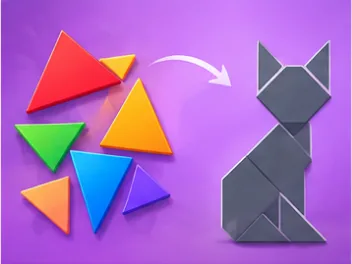
A dark shadow appears in the middle of the screen: a sitting cat, a swan, a rocket, a plain square. Below it, seven colored pieces wait on a tray. Your job fits in one sentence: fill the shadow with all seven pieces, with no gaps and no overlaps. Every piece has to be used, none can stay on the tray, and there is almost always more than one way to do it.
The tangram was born in China more than two centuries ago. Seven pieces cut from one square, and thousands of possible shapes: it's one of the few puzzles that fits in a pocket and can fill an entire evening. This version is built for touch screens. You never drag a piece with your fingertip, hoping it lands in the right spot: you tap the piece, then tap where you want it, and it snaps by itself onto the nearest corner. That small detail is what makes tangram playable on a phone.
It's free, it runs in your browser on a phone, a tablet or a computer, and there is nothing to install and no account to create.
How to play
- Tap a piece. It lifts slightly and gets a white outline: it's in your hand. You can pick up a piece from the tray at the bottom, or one that is already placed on the shape.
- Tap the shape. The piece settles there with a little bounce. It doesn't land exactly where you tapped: it slides on its own so that one of its corners meets the nearest corner, whether that is a corner of the shadow, a corner of a piece already in place, or the middle of an edge. So you don't need pixel-perfect aim.
- Turn and flip. While a piece is in your hand, the Turn button rotates it by an eighth of a turn with each press, smoothly. The Flip button turns it over like a mirror. The parallelogram really needs it: it's the only piece that isn't symmetrical, and some shapes call for its flipped version. The other pieces accept it too; trying costs nothing.
- Fix things without breaking anything. A piece in the wrong spot stays where you put it: nothing disappears, nothing jumps back on its own. Pick it up and put it somewhere else, or send it back with the To the tray button.
- The shape checks itself. As soon as the seven pieces cover the shadow, the shape takes on its colors, lifts up and comes to life (the cat stretches, the swan flaps a wing, the rocket takes off), then it joins your album.
On a keyboard, everything works without a mouse: Tab moves from one piece to the next, the arrow keys move the piece in your hand by half a step, R turns it, F flips it, and Enter sets it down at the nearest snapping point.
The seven pieces, and why they always fit
The seven pieces all come from the same square, cut once and for all:
- two large triangles, the bulkiest pieces: together, they take up half the area of any shape;
- one medium triangle, exactly half the size of a large one;
- two small triangles, the only pieces you can swap without thinking;
- one square, which most often shows up standing on its point, like a diamond;
- one parallelogram, the piece that makes everyone grumble, because it comes in two mirror-image versions.
The proportions aren't approximate: the long side of a small triangle is exactly the diagonal of the square, the large triangle is twice the medium one, and the total area never changes. That's why a tangram shape can always be filled exactly: if there is a gap somewhere, a piece is sticking out somewhere else.
The game doesn't compare your solution with its own. It checks that your pieces cover the whole shadow, exactly once: no gap, no overlap, nothing sticking out. In other words: any valid solution is accepted, including ones nobody thought of. Swap the two small triangles, mirror the shape in your head, find a different way to split it up: if the shadow is full, you win.
Thirteen shapes, three worlds
The shapes unlock one after another: a single star is enough to open the next one.
- Shapes opens the game: the square (the original one, the square all the pieces come from), the big triangle, the rectangle and the arrow. Clean outlines, sharp angles, and everything you need to learn the moves in thirty seconds.
- Animals already takes a bit of flair: the sitting cat, the rabbit with its ears up, the fish and the swan. Here, the pieces no longer line up neatly; you have to accept setting a large triangle at a slant.
- The wide world closes the album: the candle, the sailboat, the mountain, the rocket and the dancer. These are the tallest and thinnest shapes, the ones where a piece turned the wrong way stands out right away.
Every shape is a real arrangement of the seven pieces, checked to a thousandth: exact area, no overlap, and a shape in one single piece. None of them is a rough drawing the pieces only more or less fit into.
Stars and the album
Each shape earns one to three stars:
- one star as soon as the shape is solved, however you got there;
- two stars if you solved it without taking a single hint;
- three stars if, on top of that, you never sent the same piece back to the tray more than once: in other words, a clean first try.
The hint is there to get you unstuck, not to cheat: it puts one piece in its place, telling you which one, and it simply costs you the higher stars. You can always come back to a shape later to earn all three.
The album keeps everything: thirteen slots, one per shape. A gray slot is still waiting, a colored slot is solved, and the stars show underneath. The button at the top left opens it at any time, and you can replay any shape you have already unlocked. Your progress is saved in your browser: it will still be there tomorrow, with no account to create. The thirteen shapes are the same for everyone, and you play them at your own pace.
Leaderboard
Every shape you solve earns points, and your leaderboard score is the total of all your shapes. Later worlds are worth more: in Shapes, three stars earn 50 points, two earn 40 and one earns 30; Animals pays double, and the wide world triple. Solving all thirteen shapes with three stars adds up to 1,350 points.
Each shape counts once, for your best solution. Replaying a shape for more stars raises your total; replaying it worse costs you nothing. The leaderboard only keeps verified solutions: the server replays every move you made (every piece set down, moved or sent back to the tray, every hint) and checks that the shadow is filled exactly before it accepts the score. The first time you solve a shape, the game asks for a nickname, and from then on your total is sent on its own without interrupting your game.
Tips that work
- Start with the large triangles. They fill half the shape and have only a few possible spots: once they are down, the rest becomes clearer.
- Look for the right angles in the shadow. A crisp square corner calls for either the square or two triangles joined along their long side.
- Count the points. A very sharp point can only come from a triangle or the parallelogram; a wide one, from a large triangle.
- If one area stays empty and only the parallelogram is left, flip it. Nine times out of ten, that's the answer.
- Don't fight a piece that's almost in place. If the shape doesn't check out while everything looks placed, a piece is sticking out slightly: pick it up and set it down again, and the snapping will line it up cleanly.
- Look at the shadow, not the pieces. The habit that makes you better is reading the outline as a set of triangles, not hunting for a spot for the piece in your hand.
For more shape and logic puzzles, try the Tower of Hanoi, or browse all the educational games.
Frequently asked questions
Do I have to use all seven pieces? Yes, always. The area of the seven pieces is exactly the area of the shape: there is no piece too many and no space left over.
Is there only one right answer? No. Many shapes accept several arrangements, if only because the two small triangles and the two large ones are interchangeable. The game accepts every solution that fills the shadow.
What age is it for? The first four shapes work from age five or six, with an adult to read the names. The animals and the wide world are just as much fun for adults: tangram was never only a kids' game.
Why does my piece move a little on its own when I set it down? That's the snapping. It looks for the nearest corner within a small radius and brings the piece there. Without it, you would have to aim to the pixel, which is impossible with a finger.
How do I turn a piece with the keyboard? Select it with Tab, then press R to turn it and F to flip it. The arrow keys move it by half a step, and Enter sets it down.
Only the parallelogram flips, not the other pieces? Every piece accepts the Flip button. For the triangles and the square, it doesn't change the shape: their symmetry gives back the same piece. The parallelogram, though, has two faces.
Are my solved shapes saved? Yes, in your browser, on this device. If you clear the site's data or play on another phone, the album starts over from scratch.
Is there a leaderboard? Yes: it ranks players by the total points of the shapes they have solved. The thirteen shapes are the same for everyone, and you play them at your own pace.
How long does it take to finish the album? About twenty minutes for the first four shapes, a little over an hour for all thirteen. Earning three stars everywhere means coming back: that's the whole point.
More educational games
Educational games- Logic Gates
Place the right gates, flip the switches and make the lamp follow the whole truth table. - Telling Time
Set both hands to the time you're given, from o'clock times to the exact minute, PM times included. - Algebra Balance
Take away, add, divide — but always on both sides. The scale stays level until x stands alone. - Making Change
The customer pays too much: put the right coins in their hand, and as few as you can. - Prime Factor Tree
Split every number down to its primes, which light up like lanterns. Eight trees against the clock, solo or in a race. - Mental Math
Twenty sums that get harder and harder: answer right, and as fast as you can. - Europe Chase
A thief runs from city to city. Read the clues, follow the trail and name them. - Flag Quiz
Name the flag, or find the flag of the country: twenty rounds, 162 countries.