Tri Peaks Solitaire
Clear cards one rank above or below the discard pile, in long streaks, until all three peaks are gone. Solo, or racing other players.
Ages 6 and up
Leaderboard
Loading leaderboard…
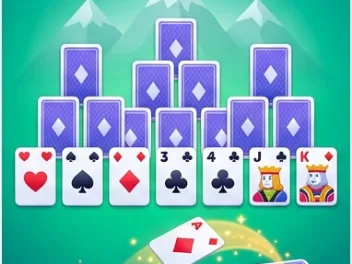
Tri Peaks Solitaire is a fast, lively patience game, and one of the most played in the world. Twenty-eight cards form three mountains side by side; below them wait a stock and a discard pile. The idea fits in one sentence: you remove any free card that is exactly one rank higher or lower than the face-up card on the discard pile. A 7 on a 6, then an 8, then a 9: every card you remove becomes the new card to follow, and your streak keeps growing as long as you find the next one.
Here, you play it free in your browser, with no download and no sign-up, on a computer, a tablet or a phone. A game lasts two or three minutes, which makes it the perfect solitaire for a quick break. You can also start a race for two to four people on the same deal, each on their own screen, to see who builds the best streaks.
How to play Tri Peaks Solitaire
Tap or click a face-up card: if it follows the discard pile, it goes there right away. There's nothing to drag, a single tap is enough, which makes the game comfortable on a phone. If the card doesn't follow, it shakes and a message reminds you which card you need to follow.
When no card on the table follows the discard pile anymore, tap the stock: it turns its top card over onto the discard pile, which becomes the new card to follow. The stock starts to pulse gently when drawing is the only move left, so you don't search in vain.
A game ends in one of two ways. Either you remove all twenty-eight cards of the three peaks, and you win. Or the stock is empty and no card follows the discard pile: the game stops, and you keep every point you've already scored.
On a keyboard, the arrow keys move the cursor between the cards, the discard pile and the stock; Enter or the space bar removes the selected card, and the T key turns over a card from the stock. Every move is announced to screen readers, and a card is never identified by its color alone: its rank and suit symbol are always written on it.
The layout
The 52-card deck is shuffled, then laid out like this:
- Three peaks, one card each, at the very top.
- A second row of six cards, two under each peak.
- A third row of nine cards, which links the three peaks together.
- A base of ten cards, the only row dealt face up at the start.
- One card turned over to start the discard pile.
- The remaining twenty-three cards form the stock, face down.
Every card in the top three rows is covered by two cards of the row below, one on its left and one on its right. It stays face down as long as those two cards are there, and turns itself over as soon as they're gone. So you discover the game as you go: that's what makes every move interesting, because removing one card can reveal another that will extend your streak.
Which cards follow each other
Only the rank matters, never the suit: an 8 of spades follows a 7 of hearts just as well as a 9 of clubs. The ranks run in this order: ace, 2, 3, 4, 5, 6, 7, 8, 9, 10, jack, queen, king. The jack follows the 10 and the queen, the queen follows the jack and the king.
The ranks form a circle: the king and the ace follow each other. So an ace can go on a king, and a king on an ace. A streak can keep wrapping around, for example queen, king, ace, 2, 3. That's the rule in the most popular versions, and it makes long streaks far more common.
On the other hand, two cards of the same rank don't follow each other: a 6 doesn't go on a 6. And a gap of two ranks doesn't work either: on a 5, only a 4 or a 6 will do.
The stock only goes around once
You go through the stock a single time. Every card you turn over covers the discard pile and breaks your current streak. There's no second pass: once the twenty-third card is turned over, you can only count on the table.
There's no undo button either. Every card you turn over tells you something, and going back after seeing it would distort the game, especially in a race, when everyone is playing the same deal. So take the time to look at the table before you touch the stock.
How your score is calculated
The scoring rewards long streaks, meaning cards removed one after another without touching the stock:
- The first card of a streak earns 100 points, the second 200, the third 300, and so on: the tenth card in a row is worth 1,000 points on its own.
- A five-card streak earns 100 + 200 + 300 + 400 + 500, which is 1,500 points, while five cards removed one at a time between draws only earn 500.
- Every time you remove the top card of a peak, that peak is cleared: 500 more points.
- When all three peaks are gone, the win adds 1,500 points, plus 250 points for every card still left in the stock.
A lost game keeps all its points: the streaks you played and the peaks you cleared count even if the stock runs out before the end. The streak counter, to the right of the discard pile, shows how many cards you've chained; it drops back to zero with every card you draw. The three little triangles to the left of the stock fill with color as the peaks fall.
The time is shown for reference, but it isn't part of the score: only your streaks count.
The leaderboard
Any finished game with at least one card removed can go on the leaderboard, won or not. With your first score, you choose a nickname. The server replays your game move by move from the deal before accepting it, and works out the score itself: a score edited by hand never makes it onto the leaderboard. The "Cards" column shows how many cards you removed, 28 for a won game.
Playing Tri Peaks with friends, as a race
Tri Peaks can also be played as a race, for two to four people, each on their own screen. On the game page, choose "Play together," then "Create a table": the table gets a code of eight letters. Send the link, read out the code or have people scan the QR code; each person enters the code with "Join," and you're the one who accepts or declines the requests before starting the game.
Everyone gets the same deal, drawn at random for the table, and plays it at their own pace, without turns. At the top of the screen, a box for each person shows their score and a bar that moves forward with the cards they've removed. You never see the other players' cards, and nobody sees the face-down cards: they stay on the server, which only reveals them when you uncover them. There's no way to cheat by reading the table off another screen.
The race stops as soon as one person has cleared all three peaks, or when everyone has finished their game. The standings follow the score, not the order of arrival: a slower game made of long streaks can beat a win pieced together in short bits. In case of a tie, the person who cleared the table ranks first, then the one who finished first. Everyone can then ask for a rematch, with a new deal. Multiplayer games don't go on the game's leaderboard, which stays the leaderboard for solo games.
Eight tips to clear all three peaks
Look before you play. Before each move, count the cards that follow the discard pile, and the ones that will follow after them. The right card isn't always the first one that fits, but the one that opens the longest run.
Think in both directions. On a 7, you can go up to the 8 or down to the 6. A streak that goes up and then back down, 7, 8, 7, 6, is allowed and is often the longest.
Free the face-down cards. Between two base cards that both fit, choose the one that uncovers a card in the rows above. A revealed card is one more chance to extend the streak, and every peak has to fall eventually.
Keep a card in reserve. If two 9s are free and your streak passes through the 8, remove only one of them. The other one can restart a streak later, right after a draw.
Hold off on the stock. Every draw breaks your current streak and uses up a card that would be worth 250 points if you win. Only touch it when the table truly has nothing left to offer.
Aim for the peaks. A peak card earns 500 points on top of its place in the streak. Clearing a peak early also opens up room to read the rest of the game.
Balance the three peaks. If you dig into a single peak, the other two stay covered and your options shrink. It's better to nibble at all three bases at once to keep several cards face up.
Remember the circle. With a king on the discard pile, an ace works just as well as a queen. Lots of streaks are lost by forgetting it.
For more patience games, try Pyramid Patience or Klondike Solitaire, or browse all the card games.
Frequently asked questions
Is Tri Peaks Solitaire free?
Yes. The game starts right on this page, with nothing to install and no account to open, on a computer as well as a phone.
Which cards can I remove?
Any face-up card that is one rank higher or lower than the top card of the discard pile, whatever its suit. The king and the ace follow each other.
Why won't this card move?
Either it's still covered by one or two cards of the row below and is face down, or its rank doesn't follow the discard pile by one, in either direction.
How many times can I go through the stock?
Once. The twenty-three cards of the stock are turned over one after another, with no going back.
Can I undo a move?
No. Every card turned over reveals information, and undoing would let you play while knowing what comes next. That way, the game stays the same for everyone.
Does a lost game earn points?
Yes. All your streaks and cleared peaks stay on your score. Only the win bonus and the points for cards left in the stock require clearing all three peaks.
Can every deal be won?
No, but most can, especially thanks to the king and the ace following each other. Some deals bury essential cards too deep, and no way of playing can save them.
How does a multiplayer race work?
Create a table with the "Play together" button, share the code, then start the game. Everyone plays the same deal at the same time, each on their own screen, and the best score wins at the end of the race.
More card games
Cards- President
Be the first to get rid of your cards, in pairs and three of a kind, against three players: five deals to finish President, not Beggar. - Nain Jaune – Yellow Dwarf
A classic French family card game: build runs from ace to king, collect the tokens on the board and empty your hand first. - Rikken
Dutch bidding whist for four: bid rik, troela, misère or piek, call an ace to find your partner, and set your own house rules. - FreeCell
Every card is face up: build the four suits from ace to king with four free cells. - Spider
Two suits, ten columns: build king-to-ace runs to clear them from the table. - Pyramid Patience
Remove pairs of cards that add up to 13 to take the pyramid apart. - Belgian Solo Whist
Belgian four-player whist: propose trumps, team up, go solo or misère against three computer players. - Klondike Solitaire
The classic solitaire: seven columns, a stock, four foundations to build from ace to king.