Number Match
Cross out equal digits or pairs that make ten, and clear the whole grid.
Ages 6 and up
Leaderboard
Loading leaderboard…
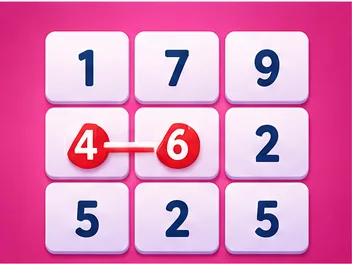
Number Match is played on a grid full of digits from 1 to 9. You cross out two digits when they are equal or when they add up to 10, as long as they can see each other. Rows that are completely crossed out disappear; when you run out of pairs, you copy what is left and the hunt starts again. The goal: cross out everything.
The idea comes from an old paper-and-pencil game that has become a huge hit on phones. Here it plays for free in your browser, with no download and no sign-up, on a computer, a tablet or a phone. No clock weighs on your score.
If you are looking for a free number matching game to play online, a relaxing puzzle that trains your eye for pairs that make ten, or a brain game you can play at your own pace without a timer pushing you, Number Match keeps the rules simple and leaves all the strategy to you.
How to play
The grid has 9 columns. At the start, it holds 36 random digits from 1 to 9, which makes four full rows.
Tap a digit, then a second one. If the two make a valid pair, they get crossed out. If not, a slight shake tells you so, and a short message explains why: "4 + 5 doesn't make 10," or "these two digits can't see each other." On a keyboard, the arrow keys move the cursor, Enter picks a digit, Escape lets go of your selection, and the A key adds digits.
A crossed-out digit stays in its place, grayed out, but it no longer blocks the view. When all nine squares of a row are crossed out, the row disappears and the rows below move up, which often creates new pairs.
At the top of the screen, the counters show your points, the time, and the number of open pairs you could cross out right now. When that number drops to zero, it is time to think about adding digits.
You win when every digit is crossed out. Otherwise, the game ends when there is no pair and no add left, which the game detects on its own, or when you press the Finish button twice.
Which pairs can you cross out?
Two digits make a pair if they are equal, like 7 and 7, or if they add up to 10. There are only five ways to make 10: 1 and 9, 2 and 8, 3 and 7, 4 and 6, 5 and 5. So each digit has two partners, itself and its complement — except 5, which has just one: another 5.
The two digits also have to see each other: between them, there can only be crossed-out squares, or nothing at all. They can see each other in four ways:
- in the same row, side by side or separated by crossed-out squares;
- in the same column, one above the other;
- on a diagonal;
- from one row to the next: the grid reads like a page of text, and the last digit still in play on one row sees the first digit still in play on the next row.
A few examples. In a row, a 3 followed by two crossed-out squares and then a 7: they see each other and make 10, so the pair is good. In a column, an 8, a 5, then another 8: the two 8s cannot see each other, because the 5 is in the way. Cross out that 5 with another 5 first, and the two 8s make a pair.
On a diagonal, a 6 and a 4 with a single square between them see each other if that square is crossed out. And if one row ends with a 9 while the next one starts with a 1, those two digits see each other, even though they sit at opposite edges of the grid. On the other hand, a 4 and a 5 never go together, even side by side: they only add up to 9.
Adding digits
Sooner or later, no pair is left. The Add button, which stays inactive as long as a pair is possible, then lights up: it copies every digit still in play, in reading order, to the end of the grid.
An example: you have crossed out 14 pairs from the 36 starting digits, so 8 are left. After an add, 16 digits are in play, and the copies, surrounded by new neighbors, offer new pairs.
You get four adds per game. An add costs no points, but it doubles the number of digits in play.
How the score is calculated
The scoring is simple and public:
- 10 points for each pair crossed out;
- 40 points for each row that disappears;
- a 500-point bonus if you cross out every digit.
So a pair that finishes a row earns 50 points at once. A game of 30 pairs with 4 rows cleared is worth 300 + 160 = 460 points. A grid cleared completely in 42 pairs, with 9 rows removed along the way, is worth 420 + 360 + 500 = 1,280 points: the final bonus alone is worth fifty pairs.
The clock plays no part in the calculation: take all the time you need. Your playing time is shown and recorded, but when two scores are equal, the one recorded first stays ahead. A game without a single pair does not go on the leaderboard.
The server checks every score: it rebuilds the digits from the same random draw, replays every pair and every add, checks that each one was allowed and works out the score on its own.
The leaderboard
Every game draws a new grid. Since adds only copy what is left, luck stops at the draw: what counts is how you read the grid and the order of your pairs.
The leaderboard keeps each player's best score.
Seven tips to clear the grid
Go for the nearly empty rows. When a row has only two or three digits left in play, look first for the pairs that finish it: 40 extra points, and new lines of sight when the rows below move up.
Plan your adds. An add only unlocks once every pair is used up, and it copies everything that is left, including the digits that get in your way. Before your last pair, ask yourself which digits will be copied: the fewer there are, the shorter and easier to read the copy will be.
Keep an eye on the 5s. A 5 has only one partner, another 5. When two 5s can see each other, grab the chance: a lonely 5 risks hanging around until the very end.
Do not forget the diagonals. Your eye naturally follows rows and columns. Yet diagonals often hide the pair that unlocks everything, especially after a row disappears.
Remember the end-of-row link. The last digit of one row and the first of the next can see each other, even at opposite edges of the grid. That pair is easy to miss.
Pick the pair that frees up others. When several pairs are possible, look at what each one opens up. Crossing out a digit stuck between two 8s opens the view between them; crossing out two isolated digits changes nothing else.
Train your eye on the pairs that make ten. With practice, the five pairs that add up to 10 jump out at you without any calculation. The Mental Math game trains that same reflex.
Frequently asked questions
Do I need to be good at math to play?
Not at all. The only operation is checking whether two digits add up to 10, and there are only five possible pairs. The real challenge lies elsewhere: in the order of your pairs, which decides what each add will copy.
Why is a pair refused?
The message on screen tells you: either the two digits are neither equal nor add up to 10, or a digit still in play sits between them.
How many times can I add digits?
Four times per game, and only when no pair is possible. Once all four adds are used, the game ends as soon as no pair is left.
Does time count in the score?
No. The score depends only on pairs, cleared rows and the final bonus.
Do I need to sign up to be on the leaderboard?
No. With your first score, the game only asks you for a nickname. Your player ID is then kept in your browser: if you clear the site's data or switch devices, you start from scratch — unless you created a recovery key on your profile page. With your nickname and that key, you get your nickname, your scores and your avatar back on another device.
Can I play on a phone?
Yes, just like on a computer or a tablet, with nothing to install. You tap the digits with your finger.
Where does this game come from?
From an old paper-and-pencil pastime: you wrote rows of digits on a sheet, crossed out the pairs, then copied the survivors at the end. Known over the years under several names, it has found a second life on phones.
More puzzles
Puzzles- Nuts and Bolts
Unscrew the planks in the right order: each screw joins a box of its color, and the waiting slots fill up fast. - Blocked Parking
Free the red car: slide the vehicles, none of them turns, none of them jumps another. - Mummy on the Run
The little mummy runs straight on until it hits a wall: grab the tomb's gold, dodge the spikes and bats, and dash for the exit. - Sneaky Cat
The little orange cat sneaks through the house: swipe every fish without catching the dogs' eye, put them to sleep from behind, and slip out the cat door. - Fruit Cutter
Fruit flies up from everywhere: slice it with one swipe in a splash of juice, chain your combos, and whatever you do, don't touch the bombs. - Territory Conquest
Leave your zone, draw a loop and come back: everything inside it is yours. But watch out for rivals cutting your trail! - Snake Feast
Eat the pellets to grow your crowned snake, and make rivals crash into your body: they turn into a feast. - Color Sort
Pour colors from tube to tube until every tube holds a single color.
