Arrow Escape
Tap the arrows out of the grid in the right order without bumping.
Ages 10 and up
Leaderboard
Loading leaderboard…
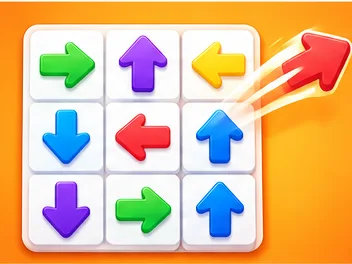
Arrow Escape is played on a grid of 7 columns and 9 rows, packed with about forty-five arrows that point up, down, left or right. Tap an arrow: if its path is clear all the way to the edge, it slides off the grid; if not, it bumps into whatever is in the way and snaps back to its square. Your goal is to empty the whole grid, with as few mistakes as possible and without wasting time.
This kind of arrow escape puzzle, where you clear arrows off a board one by one, has become hugely popular on phones. It belongs to the large family of unblocking puzzles, where pieces have to leave the board in the right order. This version opens right in your browser, free and with no sign-up, on a computer, a tablet or a phone.
How to play
The grid has 63 squares. Most of them hold an arrow; the others are empty from the start. Each direction has its own color, and every arrow draws its tip clearly: even if you cannot tell the colors apart, you always know where an arrow is headed.
Tap or click an arrow and it always moves in the direction of its tip. If its route is open, it shoots to the edge and disappears. If another arrow sits on its path, it moves up to that obstacle, bounces off and returns to its square. That bounce counts as a mistake.
On a keyboard, the arrow keys move the selection around the grid, and Enter or Space launches the selected arrow.
The game ends on its own when the last arrow leaves the grid. There is no limit on mistakes that can stop you: you play until the grid is empty, and mistakes only cost points. Only a cap of 1,000 taps, far beyond any normal game, would end it sooner.
When can an arrow escape?
One single rule decides everything: an arrow escapes if every square between it and the edge, in the direction of its tip, is empty. An arrow pointing right only cares about its own row, to its right; an arrow pointing up only cares about its own column, above it. The direction of the arrow in the way makes no difference: being there is enough to block.
Here is an example. One arrow points right, and further along its row sit two other arrows, one pointing up and one pointing down. The right-pointing arrow can only escape once those two have left, each through its own column. If one of them is blocked in turn, you will have to free it first. The grid forms a chain of dependencies, and clearing it means working your way back up that chain.
The easiest case is the border. An arrow on the outer edge that points outward has no square to cross. It always escapes, on the first try.
Every grid can be solved
Every grid is built by placing the arrows in an escape order that works. So there is always at least one way to clear it without a single mistake, and often several.
Better still, you can never get stuck. An escape only frees up space: an arrow that can leave now will still be able to leave later, and the grid keeps a solution after every escape. No successful escape is ever a bad move; the only possible mistake is tapping an arrow that is still blocked.
This guarantee has a visible consequence. Two arrows never point at each other on the same row or column: each would be in the other's way, and since an arrow only leaves its square by escaping, neither could ever go. For the same reason, dependencies never loop back on themselves: as long as arrows remain, at least one of them has a clear road out.
The real challenge is not finding a way out. It is tapping only free arrows, without letting the clock run.
How your score is calculated
You start at 10,000 points. Each mistake takes away 500, and each tenth of a second takes away one, which means ten points per second. The counter stops at zero and never goes below it.
- A grid cleared with no mistakes in 1 minute is worth 10,000 − 600 = 9,400 points.
- With 2 mistakes in 1 minute 20 seconds, it is worth 10,000 − 1,000 − 800 = 8,200 points.
So one mistake weighs as much as fifty seconds of play. Taking five seconds to follow a row with your eyes costs you 50 points; getting it wrong costs you 500.
The clock starts as soon as the grid appears, and it freezes while you are looking at another tab. Every tap counts for at least a little more than a tenth of a second.
No score is accepted at face value. The server rebuilds the grid from the same random draw, replays your taps one by one, escapes and mistakes alike, and calculates the score on its own side.
The leaderboard
Every game starts on a brand-new grid. The leaderboard keeps each player's best score; when two scores are tied, the one recorded first stays ahead. You pick your nickname with your first score, and your browser keeps your player ID.
How to get better: eight tips
Start with the edges. Arrows on the border that point outward always escape. Sending them off first clears the border and opens the road for the arrows they were holding back.
Follow the line before you tap. Scan the row or column in the direction of the tip, all the way to the edge. One single arrow on that path, whatever its direction, and you will bounce.
Read the dependencies. When an arrow is blocked, find out which arrow is in its way, then what is blocking that one. By working back up the chain, you always reach a free arrow: start with it.
Free the long corridors first. One arrow sitting in the middle of a long row can hold back several neighbors on its own, in its row as well as in its column. Spot those locks and clear them first.
Think in order, not in motion. An arrow never changes squares before it escapes, so there is no point waiting for an obstacle to shift. The whole puzzle is about the order of departures.
Stay in the same area. After each escape, look at the arrows it was blocking: one of them has often just been set free. That way you avoid scanning the whole grid after every move.
Do not rush. Three bounces cost as much as two and a half minutes of play. The right rhythm is steady: look, check, tap.
See the grid as a set of corridors. With practice, you stop seeing single arrows and start seeing rows and columns that empty one after another, each open corridor pointing you to the next.
If you enjoy unblocking puzzles, you will feel at home with Blocked Parking and Nuts and Bolts, and you will find more grids to crack in the logic games category.
Frequently asked questions
Is the arrows puzzle really free?
Yes, from start to finish: no download, no sign-up, no payment.
What happens if I tap a blocked arrow?
It moves up to the obstacle, bounces off and goes back to its square. The grid does not change, but the mistake costs you 500 points.
Is there a maximum number of mistakes?
No. The game goes on until the grid is empty; each bounce only weighs on your score.
Can I get stuck with no solution?
Never. Every grid has at least one solution, and an escape only ever frees up space.
Can I play if I cannot tell colors apart?
Yes. Color goes along with direction but never replaces it: every arrow draws its tip clearly.
How do I play with a keyboard?
The arrow keys move the selection around the grid, and Enter or Space sends the selected arrow on its way.
Do I need an account to appear on the leaderboard?
No. A nickname chosen with your first score is enough, and your browser keeps your player ID. To keep the same player on another device, or after clearing the site's data, create a recovery key on your profile page and enter it there with your nickname.
More logic games
Logic- Binary Puzzle
Fill the grid with 0s and 1s: never three alike in a row, as many of each per line. - Naval Grid
Find a whole fleet from the edge numbers alone, solved by deduction. - Sudoku
One grid a day: every row, column and box of nine takes the digits 1 to 9, once each. - Nonogram
Follow the numbers, fill in the right cells: a color picture appears at the end. Solo, or in a race with friends. - Tricky Riddles
Fifty riddles that never work out the way you think: tap the question, move what's in the way, or just wait a little… The right answer is rarely one of the buttons. - Word Search
Find the words hidden in the grid across four levels, forwards, backwards or diagonally. - Hangman
Guess the word letter by letter before the last balloon pops. - Exact Count
Six numbers, four operations: hit the three-digit target.
