Matching Pairs Game
Turn the cards over two at a time and find the twelve pairs in as few turns as you can.
Ages 6 and up
Leaderboard
Loading leaderboard…
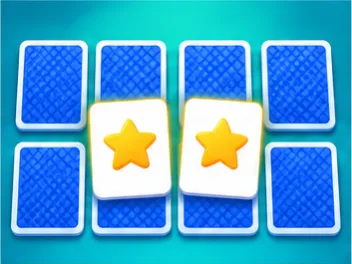
A matching pairs game is played with cards laid face down. You turn two of them over. If they show the same symbol, they stay face up: you have found a pair. If not, they flip back over, and it is up to you to remember what you saw and where.
Here, the board holds 24 cards, which makes twelve pairs, laid out in four columns and six rows. Everything happens in your browser, with no download, no sign-up and nothing to install. A game lasts one to three minutes: short enough for a break, long enough for a good method to make the difference.
If you are looking for a free card matching game to play online, a quick memory test to see how sharp your recall is today, or a concentration game for kids and grown-ups alike, Matching Pairs gives you a fresh board every game.
How to play Matching Pairs
Tap or click a card: it flips over and shows its symbol. Turn over a second one. Then one of two things happens.
If both cards show the same symbol, they stay face up and get a green check mark. The pair is found, and it stays put until the end of the game.
If the symbols are different, both cards stay visible for a brief moment, then flip back over on their own. You do not have to wait: tapping a third card flips them back right away and starts your next turn.
The game ends when all twelve pairs are found. Your time, your score and your number of turns are then displayed.
The game also plays entirely with the keyboard: the arrow keys move the selection from one card to the next, and Enter or the space bar flips the selected card.
At the top of the board, three counters keep you posted: the pairs found out of twelve, the turns you have played and the time.
The symbols
Each game draws twelve symbols from sixteen simple shapes: circle, square, triangle, diamond, star, heart, moon, lightning bolt, drop, hexagon, cross, ring, leaf, crown, arrow and clover. Each shape has its own color, but the shape alone is always enough to recognize it: two cards of the same color never make a pair if their shapes are different.
The layout of the cards changes with every game. No spot is reserved for any symbol, and the same shape can turn up in two opposite corners of the board just as well as on two neighboring cards.
How the score is calculated
A turn means two cards flipped over. You need at least twelve turns to finish a game, one per pair, which only happens with a lot of luck. Every turn that does not make a pair counts as a miss.
The clock starts with the first card you flip and stops at the last pair. The score starts at 10,000 points, minus:
- one point per tenth of a second that goes by, so ten points per second;
- 100 points for every turn without a pair.
A game finished in a minute and a half with ten misses is therefore worth 8,100 points. The score never drops below zero. Every turn counts as at least four tenths of a second, the time it takes to flip two cards. If you switch tabs, the clock pauses and picks up again when you come back.
On the leaderboard, every score is checked by the server. It deals the cards again, replays your turns one by one, checks that all twelve pairs were really found and works out the score on its own.
The leaderboard
The cards are dealt again for every game.
The leaderboard keeps each player's best score, across all games. When two scores are equal, the one recorded first stays ahead.
Seven memory tricks to find pairs faster
Turn over unknown cards first. As long as you do not have a pair in sight, pick cards you have never seen. Every card you uncover is one more piece of information for later.
Move with a method. Go through the board in a fixed order, row after row. It is much easier to remember a card when you know in what order you uncovered them.
Name the symbols. Saying to yourself "star top left, moon in the middle" anchors the memory far better than a picture alone. Linking a shape to its position with a short phrase works very well.
Split the board into zones. Four columns and six rows is a lot. Think in blocks: the top left corner, the center, the bottom. Remembering "the cross is in the bottom block" narrows the search.
Flip the card you are less sure of first. When you think you know where a pair is, turn over the card you are least certain about first. If it is not the right symbol, you can keep the second card for a useful flip.
Do not rush. Every missed turn costs the equivalent of ten seconds. A second of thought before flipping a card is worth more than a wasted turn.
Make the most of the endgame. When only a few cards are left, the pairs almost fall into place on their own. That is the moment to speed up: the clock counts just as much as the misses.
A card game as old as cards
The pairs game has long been played with an ordinary deck of cards spread face down on a table, by two or more players, each one turning over two cards in turn. Children often discover it with picture cards; adults come back to it for the simple pleasure of watching a pair come together. You may know it as concentration, pelmanism or simply pairs.
The online version keeps the essentials, flipping two cards and remembering, and adds what a table cannot offer: a new layout every game, a clock, and a leaderboard.
Frequently asked questions
Is the game free, and do I need an account?
Yes, it is completely free, with no download and no sign-up. To appear on the leaderboard, a nickname is enough: you are asked for one the first time you submit a score.
How many pairs do I need to find?
Twelve, spread over 24 cards. The game ends with the twelfth pair.
What is the lowest possible number of turns?
Twelve: one turn per pair. To get there, every second card you flip has to be right, which at the start of a game is mostly down to luck.
Do I have to wait for the cards to flip back?
No. Two different cards stay visible for a brief moment, but tapping another card flips them back right away and starts your next turn.
Are the colors enough to recognize a pair?
No, it is the shape that counts. Each shape has its own color, but two different shapes can share the same color.
Does the game work on a phone?
Yes. Cards flip with a simple tap, and the board keeps its size while it loads so that nothing moves under your finger. On a phone held upright, the board is enlarged on screen when the game starts, and a button under the board lets you shrink or enlarge it whenever you like.
Do I keep my scores if I switch devices?
Yes, if you set up your recovery key. Your player ID is stored in your browser, so clearing the site's data or moving to another machine starts you from scratch. On your profile page, you can create a recovery key, then enter your nickname and that key on your new device to get your nickname, your scores and your avatar back.
More tests
Tests- Chimp Test
Memorize where the numbers are, then tap them in order from memory. - Click Speed Test
Click as fast as you can for ten seconds and measure your clicks per second. - Digit Memory
A number flashes, then disappears: type it back. One more digit every round. - Color Memory
Watch the sequence light up, then repeat it. One more color every round. - Aim Trainer
Hit 30 targets as fast as you can and measure your aiming speed and accuracy. - Reaction Test
Click as soon as the screen turns green: five tries to measure your reaction time.